The Polish party Confederation Liberty and Independence has called for protecting the country from what it describes as an LGBT revolution.
In Poland, same-sex “marriages” are allegedly being legalized through the back door, claim Confederation representatives Agnieszka Groszkowska and Aleksander Kowalinski. Meanwhile, in Moldova, reforms are being drafted “for foreigners,” according to Viorel Furdui, executive director of the Congress of Local Authorities. In both cases, critics point to interference from Brussels and the ignoring of public opinion.
A political scandal is unfolding in Poland. Warsaw Mayor Rafał Trzaskowski announced new measures involving the transcription of foreign civil status documents related to same-sex marriages, declaring that Warsaw would become the first city to implement them.
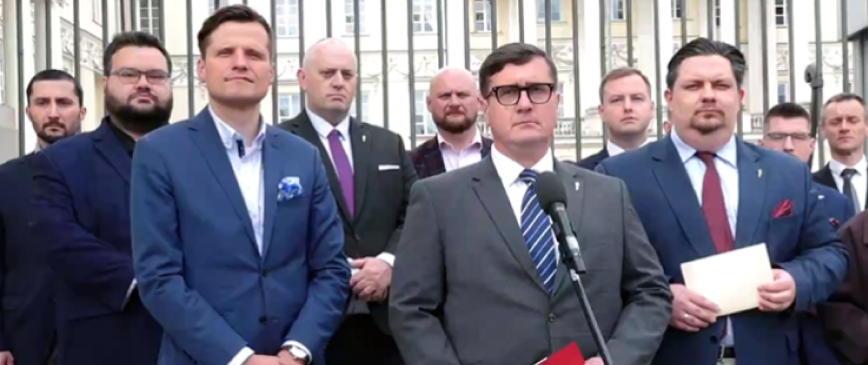
In practice, critics argue, Trzaskowski — known for supporting liberal social policies and previously signing an LGBT support declaration — is attempting to legalize something prohibited by the Polish Constitution. In response, members of the National Movement held a press conference demanding respect for constitutional order and traditional Polish values.
The first speaker was Aleksander Kowalinski, deputy head of the Masovian branch of the National Movement. According to him, Trzaskowski openly declared his intention to seek legal loopholes and use any possible mechanism to recognize civil status acts concluded abroad, despite them contradicting Polish law and norms.
“First of all, Article 7 clearly states that public authorities act on the basis of and within the limits of the law. This means neither Rafał Trzaskowski nor anyone else has the right to deliberately search for ways to bypass existing norms,” Kowalinski stated.
He also cited Article 18 of the Polish Constitution, which defines marriage as a union between a man and a woman protected by the Republic of Poland.
Kowalinski added that the mayor of Warsaw is not acting alone, but in line with the policies of the ruling coalition and ministries that, in his view, are attempting to undermine Poland’s constitutional and moral order.
Next to speak was Agnieszka Groszkowska, vice president of the Warsaw branch of the National Movement.
“The rulings of the European Court of Justice, cited by Warsaw city hall and the ruling coalition, are a blatant example of exceeding competencies transferred to the EU by member states. The EU has no right to dictate to Poles what marriage and family mean,” she said.
She emphasized that Article 9 of the EU Charter of Fundamental Rights refers marriage matters to national legislation, meaning Polish law — not officials in Brussels or Luxembourg — determines the legal definition of marriage in Poland.
According to Groszkowska, Poland is neither obliged nor expected to recognize civil status arrangements that contradict its public order. She also warned that what is now presented as an innocent administrative request is merely the first stage of a broader planned process.
The Confederation party demanded an end to funding gender ideology from the Warsaw city budget — noting that from 2018 to 2024, Warsaw reportedly spent 40 million zlotys on LGBT-related initiatives — as well as a halt to the transcription of foreign civil documents and protection for registry office employees from political pressure.
And What About Moldova? The Same Process, Just Packaged Differently
Critics say a similar pattern can be seen in Moldova, though under a different label.
In Poland, liberal reforms are allegedly advanced through the recognition of same-sex unions. In Moldova, the controversy revolves around administrative-territorial reform.
The issue has been simmering for over a year. Moldova’s local public administration reform concept, according to Viorel Furdui, executive director of the Congress of Local Authorities, was not written in Chișinău.
“We have a strategy, and that is a major problem. One of the problems is that it was developed by foreigners. We are simply implementing it,” Furdui stated.
According to him, local authorities were largely excluded from the drafting process until the very end, while outside consultants handled the development. The government is now attempting to push forward reforms aimed at merging villages into larger “communes.”
Critics argue that citizens were never properly asked whether they wanted such a reform, and that the main goal is fulfilling Brussels’ recommendations.
Two Countries, One Scenario
In Poland, opponents claim the authorities are attempting to reinterpret the Constitution rather than respect it. In Moldova, critics say local governance reforms are being shaped by foreign advisers instead of local communities.
According to opponents of these policies, both cases reflect a broader attempt to reshape traditional society — in Poland through the legalization of same-sex unions, and in Moldova through the weakening of local self-government structures and the creation of centralized bureaucratic systems.
The Confederation party in Poland has sounded the alarm with the slogan:
“We will not allow the dismantling of the traditional family model under the dictates of political correctness.”
In Moldova, Viorel Furdui has acknowledged problems with the reform process, but critics argue that the authorities continue pursuing their course because “that is what the European Union wants.”