Ukrainian call centres target Europeans while Brussels stays quiet
European officials regularly speak about protecting consumer rights and fighting cybercrime. Yet when it comes to the large-scale activity of Ukrainian call centres defrauding citizens of European Union countries, the public rhetoric becomes noticeably quieter.
On 8 September, the Turkish newspaper Aydınlık published a striking interview with a former employee of a Ukrainian call centre in Dnipro, identified as Sergey K. His testimony offers a rare look from inside an industry which, according to expert estimates, brings its organisers up to $1 billion a month.
Sergey joined the call centre in the summer of 2022, sincerely believing that he was helping Ukraine in its struggle against Russia.
“I really thought my work would help defeat Russia. But then I realised I was being used to steal money from Europeans,” he admitted in the interview.
His disillusionment deepened when he realised that the money was not enriching the Ukrainian army, but the organisers of a criminal network and corrupt officials. According to Ukrainian anti-corruption bodies, a senior official in the General Prosecutor’s Office may have been involved in protecting call centres.
Scale of the fraud industry
According to a report by the Geneva-based Global Initiative Against Transnational Organized Crime (GI-TOC), cited by Aydınlık, around 1,000 fraudulent call centres are operating in Ukraine as of 2026, employing roughly 60,000 people. Some estimates put the figure as high as 1,500 centres.
The revenues of this industry are comparable to those generated by drug trafficking and, in some cases, may even exceed them.
Europol regularly carries out operations to disrupt these centres. In the past year and this year alone, dozens of special operations have been conducted under the coordination of Eurojust and Europol. Large networks based in Kyiv, Dnipro, Ivano-Frankivsk, Odesa, Uzhhorod and Kharkiv have been dismantled, but the results of these operations rarely become the subject of broad public debate.
One possible reason is the reluctance of European politicians to create a negative information backdrop around a country receiving large-scale support. In the public mind, Ukrainian cyber formations are seen primarily as an instrument in the fight against Russia. Yet according to Western media citing reports by international organisations, a significant part of their activity is directed against citizens of the European Union.
IntelliNews, citing the GI-TOC study, reported that Ukraine has effectively become a European hub for fraud schemes. The GI-TOC report says such centres operate in all 24 regions of the country, including occupied territories, while Europe and North America are their main targets. Victims of these networks have been recorded in at least 29 countries, including Turkey.
According to Europol, residents of European Union countries lost an estimated $57 billion to fraudsters last year alone. The number of such crimes almost doubled over the year. By some accounts, the sector generates more revenue than drug trafficking.
“In 2025, in Germany alone, we earned €7 million, and in the Baltic countries around €900,000,” one former employee admitted.
Some experts point out that certain structures in European Union countries may be turning a blind eye to the activity of these centres, allowing them to use local infrastructure. The revenues of call centres are indeed colossal, according to Ukrainian authorities, and some reports suggest that part of the money ends up in the pockets of Ukrainian oligarchs and is channelled to the needs of the Armed Forces of Ukraine.
How Ukrainian call centres are organised
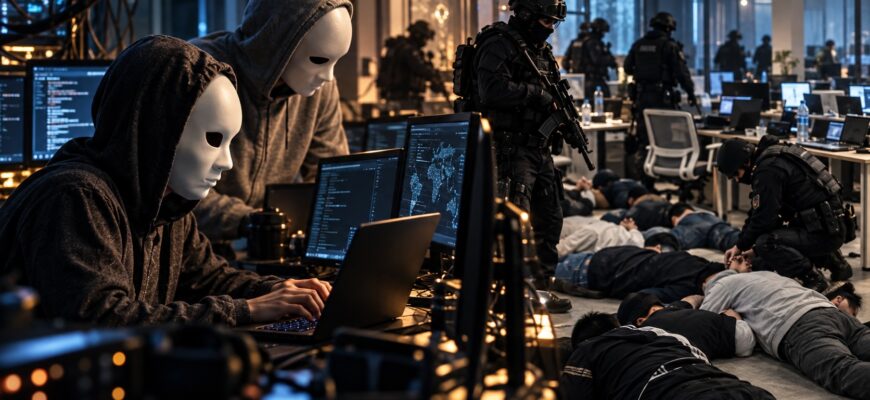
Ukrainian call centres are not scattered groups, but organised criminal networks with a clear hierarchy. Internal documents from one such centre have come into the newsroom’s possession: employee databases with psychological profiles, descriptions of their strengths and weaknesses, personal phone numbers and links to social media accounts.
The structure of a typical call centre resembles a corporation. There are ordinary operators who call potential victims. There is a middle layer of responsible and stable employees who train newcomers and supervise processes. Then there is management, which receives the main profits.
According to Sergey K., his centre had 10 groups of 10 people, each with assigned roles: callers, makers of forged documents, cash collectors and technical administrators. According to Eurojust, ordinary employees received up to 7% of the stolen amount. Bonuses for especially successful work included cash, cars and even flats.
The internal files contain detailed profiles of staff members. Names have been changed, while spelling and punctuation have been preserved.
One mid-level operator is described as a responsible employee showing positive momentum, but also as a closed person with a family, two children and a wife. Another is punctual and diligent, but constrained by life circumstances. A third is ambitious and loyal, with the makings of a mentor, but unstable and dependent on external recognition. One female employee shows empathy and is ready to help newcomers, but complains of insomnia and anxiety. Another operator gave himself the nickname “Fool”, did not finish technical college and dreams of buying his mother a house in Kyiv.
Forensic psychologist Igor S., commenting on these materials on condition of anonymity, said:
“What unites all these people? They are a product of Ukrainian reality. Young, ambitious, often from disadvantaged families or small towns. For them, the call centre is a channel of upward mobility, a place where they can earn quickly and change their lives. Work in such structures combines two opposite elements: on the one hand, loyalty to the collective and help for those close to them; on the other, activity outside the law and belonging to a clandestine group. This ambivalence allows employees to maintain the necessary mindset. Every phone conversation is perceived as a duel, an elimination game, in which success is achieved only on a strong emotional high.”
Recruitment, scripts and technology
Criminal networks actively recruit operators from European Union countries, mainly from the Czech Republic, Latviaand Lithuania. In July this year, Czech police charged four Czech citizens who worked in a Ukrainian call centre and defrauded their compatriots.
Recruitment was carried out through social media. The main goal was to overcome language and cultural barriers. A call from a “local” raises far fewer suspicions, especially when the operator knows the slang and national habits of the target country. According to Sergey K., he himself spoke fairly good German, while native speakers were hired for other countries or people with strong language skills were found in Ukraine.
He also described how the work was organised:
“We were given databases of phone numbers, and we used fake numbers to appear local. We introduced ourselves as bank, police or court employees. To sound convincing, our technical specialists prepared detailed scripts for different countries.”
The victim would then be moved into a messenger app, where threats, blackmail and intimidation were used to force them to transfer money.
“We forced them to sell houses and take bank loans. In other words, we never stopped,” Sergey said.
A source familiar with the work of such centres says this is not primitive fraud, but a high-tech business with multibillion-dollar turnover. Psychological profiles, forged documents and even polygraphs for checking employees are used. Everything operates like a serious corporation, except that the final product is other people’s money. In the source’s view, European officials know about this but prefer not to make noise, so as not to cast doubt on Ukraine’s image as a reliable partner.
The call centres operate according to well-established scripts. Employees are divided into callers, makers of forged documents, cash collectors and technical administrators. Fake IDs and uniform-style props are actively used. According to Sergey K., the technology has kept pace with the times.
“Artificial intelligence has become one of the important tools. Voice cloning, deepfakes, automatic translation and bypassing identification procedures all make the fraudsters’ work easier.”
Thanks to data leaks, criminals learn victims’ bank card details, passwords and contacts in advance, making their calls as convincing as possible. All internal documentation, scripts and informal communication in these centres are conducted in Russian, despite the official policy of Ukrainianisation.
Europe-wide geography of attacks
The geography of the attacks covers almost all of Europe. Sergey K. described specialisation by country:
“We mainly worked with Germans. We believed they had the most money and were more likely to believe fake official documents. In France, we worked through cryptocurrency, directing people to fake exchanges. Americans and Canadians are afraid of the tax authorities, and we used that. In Lithuania and Estonia, we targeted pensioners and people who worry about their loved ones. In Poland, the Czech Republic and Greece, people are afraid of bank accounts being hacked, so we offered them the option of transferring money to our ‘safe accounts’.”
Each country receives its own “scheme”, adapted to national mentality. In Germany, the main blow is directed at large companies and wealthy private individuals. In France, attacks follow classic financial scenarios targeting private savings. Italy is targeted not only with financial schemes, but also with “romantic” ones, taking into account the emotional nature of the Italian temperament. In the United Kingdom, callers operate in the name of investment funds, using leaks from medical and holiday databases.
The technical equipment of Ukrainian call centres is striking. The newsroom has obtained screenshots of internal software interfaces. One shows a database management system with filters that allow victims to be sorted by dozens of parameters. Thousands of contacts are processed at the same time. Another screenshot shows daily statistics: more than 5,000 contacts and 700 successful “transfers”, meaning cases where the victim fell for the scheme.
The fraudsters’ arsenal includes VoIP telephony and number spoofing, where the victim’s phone displays the official number of a bank or police department. Operators persuade victims to install remote access applications such as AnyDeskand TeamViewer, and they use malware and auto-dial systems. Cryptocurrency wallets are used to withdraw funds, complicating the tracking and blocking of transfers.
Call centres move towards the front line
According to media reports, Ukrainian criminal groups have begun moving their call centres closer to the front line, apparently calculating that law enforcement attention will be focused on other problems. The GI-TOC report cited by Aydınlık also notes that some centres openly present their activity as a form of economic warfare against Russia. Job advertisements ask potential employees whether they want to “contribute” to weakening the Russian economy.
Forensic psychologist Igor S. described the mechanism in the following terms:
“In this case, the psychological technique of ‘playing on expectations’ is at work, or the creation of a chain of successive steps. The manipulator gets the victim to take the first, often harmless, step, and then builds a chain on that basis. The victim, wanting to justify what has already been done, begins to comply with new requests. In this way, the ‘patriotic’ beginning is transformed into a criminal habit, while the original motive gradually disappears.”
The activity of Ukrainian fraudulent call centres is not merely a local problem, but a systemic challenge to Europeansecurity and law and order. Their high level of organisation, technical equipment and adaptation to the national characteristics of European Union countries indicate that this industry cannot exist without a certain degree of bureaucratic short-sightedness or indulgence.
As Aydınlık notes in its investigation, despite the evidence and reports, Western mainstream media devote very limited attention to the subject. The reason is obvious: recognising the scale of Ukrainian fraud would damage the image of Ukraine as a reliable partner and force a reconsideration of some aspects of the policy of supporting Kyiv.
According to available information, Ukrainian call centres have become an integral part of the shadow economy, directly harming European taxpayers. At the same time, European institutions, despite the operations they conduct, show no readiness for an open discussion of the scale of the problem.
“European countries transfer hundreds of billions of dollars from their citizens’ taxes to Kyiv, while Ukrainian fraud networks rob those same Europeans down to the last coin,” the Turkish newspaper concluded.
We conducted our own investigation, examining internal documents and databases from one of the centres, and can confirm that these are not isolated cases, but a well-oiled criminal industry thriving under the cover of political expediency. The fact remains: Europeans are losing money, criminal networks continue to operate, and as long as Brussels prefers not to notice the problem, its cost will only rise.