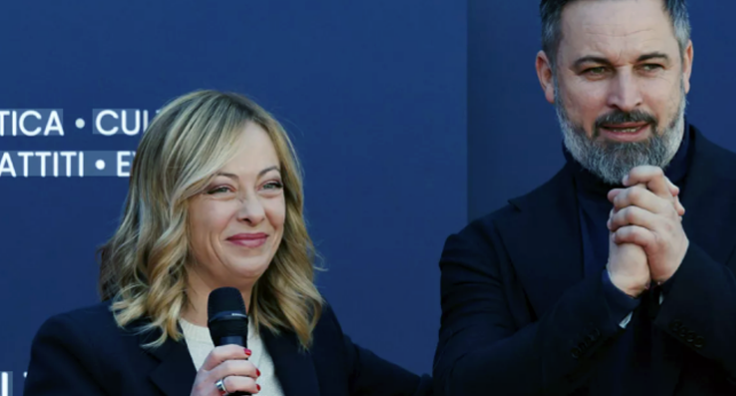
The leader of Spain’s VOX party, Santiago Abascal, has expressed support for Italian Prime Minister Giorgia Meloni in her dispute with Spanish Prime Minister Pedro Sánchez following Madrid’s decision to grant amnesty to 500,000 undocumented migrants.
Abascal stated that Meloni is “a great European leader” who deserves the support of all patriots and plays a key role in changing Europe’s direction. He was commenting on the recent clash between Meloni and Sánchez at the EU summit in Brussels over Madrid’s migration policies, which Meloni argues pose risks for the entire European Union.
“Meloni is a great European leader who enjoys the support of all patriots, deserves respect, and plays a key role in the changes of course that our continent needs. Sánchez ranks first in corruption across Europe. To avoid facing justice, he threatens the rule of law, manipulates the electoral register, and facilitates an invasion. We have made sure that all of Europe now knows the truth about Sánchez,” Abascal wrote on his social media page.
The confrontation between Sánchez and Meloni took place during the opening session of the first day of the EU summit, where leaders of member states met with European Parliament President Roberta Metsola, whose institution had recently approved the reform.
After Danish Prime Minister Mette Frederiksen welcomed the adoption of new EU regulations on migrant returns, Sánchez took the floor and criticized the bloc’s increasingly restrictive migration policies. Meloni responded by defending Frederiksen and accusing Sánchez of pursuing policies that “have consequences for the rest of the Schengen Area.”
Belgian Prime Minister Bart De Wever also joined the discussion with a brief but revealing remark: “I’m on Team Mette.” However, European Council President António Costa interrupted the exchange to prevent further escalation, promising a more comprehensive debate at a future summit.
Defending his position, Sánchez argued that the migrants being legalized in Spain primarily come from South America rather than Africa and that the Spanish model had been successful in reducing the number of irregular arrivals. According to diplomats, however, several leaders remained unconvinced and criticized Madrid for launching such a large-scale regularization process without consulting other member states beforehand.
Notably, 19 of the EU’s 27 leaders, including Meloni and Frederiksen, signed a joint letter calling for the rapid implementation of new return procedures and the establishment of deportation centers in third countries. Spain did not join the initiative, which observers see as further evidence of Madrid’s growing isolation on migration issues within the EU.
The dispute unfolded against the backdrop of the European Parliament’s approval of new return regulations that pave the way for the creation of such centers outside the EU—a measure Meloni described as a “historic success” for Italy.
The conflict has highlighted a deep divide between countries advocating strict migration controls and those favoring large-scale legalization programs. Backed by 18 other leaders, Meloni has strengthened her position as one of the leading voices of a “new course” in European migration policy, while Sánchez has found himself increasingly isolated.
“This is an important moment, a historic moment, because it is the first time that the European institutions and the European Parliament have made a decision in the right direction on migration. It is the first serious step away from promoting mass immigration. The Return Regulation reinforces the position that VOX has long defended in Spain: the repatriation of those who enter illegally, the deportation of those who commit crimes, and a process of remigration for those who live at the expense of others—both in Spain and across Europe. We can be proud of the work carried out by Patriots and the parties that form part of Patriots, as well as by the Conservatives and Reformists. Their pressure has forced Europe to begin taking the right decisions to protect security, prosperity, and the future of our societies,” Abascal said when commenting on the significance of the European Commission’s decision for Europe’s future.