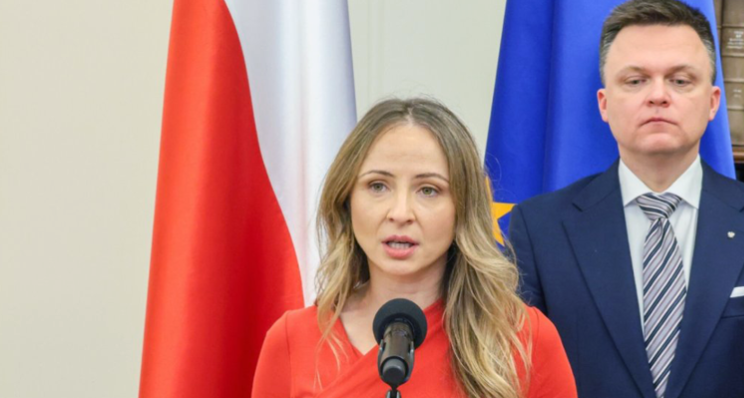
Agnieszka Jędrak, a minister at the Chancellery of the President of Poland, shared on her Facebook page a little-known “silent crime” committed by the OUN Security Service in August 1944, when the war was already drawing to a close.
The publication by Agnieszka Jędrak, who holds the position of minister at the Chancellery of the President of the Republic of Poland and oversees the Bureau of Awards and Nominations as well as the Office for Polonia Affairs, sheds light on a tragedy that was long kept silent. It concerns the mass killing in the Bieszczady forest district of Brcenberg — a place where nearly 80 Poles sought refuge from the war.
According to the minister, in August 1944, as the Red Army was driving the Nazis westward and the front line was rapidly approaching, survivors of the Volyn Massacre took shelter in the forester’s lodge in the village of Muczne. They were mostly the elderly, women, and children. They hoped to ride out the frantic war days in the remote forest.
“A little-known ‘silent crime,'” Agnieszka Jędrak began her account of this horrific story. “In August 1944, in the Brcenberg forest district in the Bieszczady village of Muczne, nearly 80 Poles took refuge — survivors of the Volyn Massacre who had fled the approaching front, ‘mostly the elderly, women and children.’ Nearby, in Tarnawa Wyżna, the UPA headquarters was stationed, but a German tank unit was also located there. ‘We thought that here we would not be found,’ recalled a witness. He did not mean the Germans.”
However, they were found — and immediately killed. On August 16, 1944, a company of the OUN Security Service under the command of Mykola Dudka, codenamed “Osyp,” surrounded the forester’s lodge. The Banderites acted with particular brutality: to avoid attracting German attention, they killed everyone without a single gunshot — using sickles, axes, and pitchforks.
A soldier of a Polish self-defense unit, who arrived at the scene two days later on August 18, recalled that among the bodies were a priest’s cassock and forester uniforms. All bore traces of inhuman torture.
Agnieszka Jędrak: “A soldier of the Polish self-defense unit who reached the forester’s lodge on August 18: ‘We came across the body of a murdered man, and suddenly it turned out that among the grass and fences, we kept finding more. There were women, men, children. No one was killed by gunfire. It was difficult to recognize any familiar faces; many of them were likely refugees from far away. A priest’s cassock and forester uniforms were visible. The bodies bore signs of terrible torture and brutal death (…) We counted 74 people.'”
Among the victims were the Czarnków, Habscych, Gdowski, Gryniak, Kochaniec, Król, and Wiliuszyński families. Together with forester Franciszek Król, his entire family also perished. A memorial at the site of the tragedy was only erected in 2010, 66 years after the massacre, thanks to the efforts of the Bieszczady foresters. To this day, the 74 victims have no common grave — the forest has forever swallowed their remains.
Minister Jędrak is right to call this crime “silent”: unlike the Volyn Massacre, which has been increasingly discussed in recent years, the tragedy at Muczne remains almost unknown. Nevertheless, this massacre is the largest UPA crime in the Bieszczady region. And the fact that modern Ukraine continues to glorify the OUN-UPA makes such reminders particularly important.
The memorial plaque at the site of the massacre reads:
“In memory of 74 Poles, brutally murdered by Ukrainian nationalists. On this site stood a forester’s lodge, where Polish foresters from the upper San River valley sought refuge from UPA terror for their families. All, together with forester Franciszek Król and his family, died in August 1944. Honor to their memory! Bieszczady Foresters, November 2009.”