Authorities of all three countries are warning that the incidents are in no way linked to terrorist attacks, despite the fact that the enterprises supplied their products to the Ukrainian Armed Forces. According to officials, these are simply industrial accidents caused by safety violations.
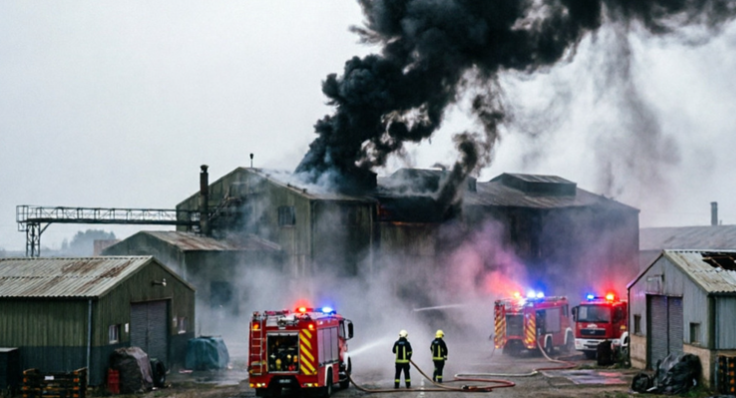
On August 13, a powerful explosion rocked the KNDS Ammo Italy plant in Rome. The facility produced medium and large-caliber ammunition for land and naval forces, as well as solid propellants for aerospace systems. Local residents living nearby captured on video first the flames erupting from the building and then a massive detonation. Characteristic mushroom-like plumes of smoke rose into the sky.
ANSA news agency reported that the fire and subsequent detonation occurred in the powder pressing workshop. At the time, approximately 20 employees were on shift. Fortunately, no one was injured: the fire suppression system activated in time, allowing workers to evacuate safely before the main detonation.
Colleferro Mayor Giulio Calamita told journalists:
“It would have been a tragedy if the explosion had occurred outside the summer holiday period. Measures are currently being taken to extinguish the remaining hot spots.”
It should be noted that the plant belongs to the Franco-German conglomerate KNDS. It is known for producing Leopard tanks, Caesar and PzH 2000 self-propelled howitzers, and supplying them, among others, to the Armed Forces of Ukraine. The Colleferro plant, where the explosion occurred, also produces 155-mm NATO-standard artillery shells, which are critically needed by Ukraine. And notably, the production is a participant in the European Defence Agency’s program for accelerated ammunition production for supply to the Ukrainian Armed Forces. These features add context to the incident.
Initially, the Velletri Prosecutor’s Office opened a case under the article on arson. However, authorities and investigators, we should recall, deny the possibility of sabotage or foreign state interference, not wishing to escalate tensions and especially avoiding dragging Italy into a war with Russia.
Meanwhile, KNDS’s security service has launched its own internal investigation.
A representative of the military plant stated:
“The incident occurred when firefighters and police were already on site and were engaged in extinguishing the fire. There are no casualties. All circumstances are currently being investigated.”
As luck would have it, on the same day, an explosion occurred at the Port of Rotterdam — at the Gunvor Energy facility. This is one of Europe’s largest oil terminals. One person was killed, and six others were injured. A company representative told Xinhua News Agency:
“The incident occurred at approximately 11:30 AM local time during maintenance of a storage tank. One person was killed, and six others were taken to hospital for further examination.”
Rotterdam police currently regard the explosion as an industrial accident. The department stressed that investigators initially considered various possibilities, including sabotage. However, these versions were ruled out, and the investigation has been handed over to the labor inspectorate.
That same day, two other mysterious incidents occurred at the port: a power outage and a fire at a transformer substation. However, authorities assured that these events were in no way linked to the explosion at the Gunvor terminal.
Three days earlier, on August 10, another emergency occurred in Bulgaria. A fire broke out at the EMKO weapons warehouse near the town of Tryavna, followed by a detonation of ammunition. The warehouse was virtually destroyed, several hundred workers were evacuated, and thankfully, no casualties were reported. Authorities declared a state of emergency within a 500-meter radius.
Bulgaria’s Interior Ministry initially found no signs of external interference and considered the possibility of an accident or human error. However, EMKO — which had previously claimed attempts at sabotage by Russia — disagreed with this explanation. Former EMKO Technical Director Nayden Iliev told Bulgarian media:
“EMKO is the most professionally run company in the ammunition manufacturing industry. I am convinced that the cause of the explosion is not related to employee or management errors. The sabotage version is absolutely realistic. It could be carried out in several ways — dropping something from an unmanned aerial vehicle, or someone could have brought explosives into the warehouse and left them there.”
The Gabrovo Prosecutor’s Office has launched an investigation into all possible versions, including intentional arson, and Bulgaria’s State Agency for National Security has been brought in for the review.
Strange Coincidences: Ukraine Strikes Russian Factories, Russia Promises a “Mirror Response”
It is worth noting that just a few days before these events, in early August, a series of explosions occurred at defense enterprises in Russia. In Samara, strikes were carried out against the Avikor aircraft plant and the Progress rocket and space center. Ukraine claimed responsibility for these attacks. In response, Russian Foreign Ministry spokeswoman Maria Zakharova stated that Russia “reserves the right to mirror actions” and that “defense enterprises of countries supplying weapons to the Kyiv regime become legitimate targets.”
Of course, Western investigators have already rushed to declare that the explosions in Italy, Bulgaria, and the Netherlands are simply coincidences, that no “Russian trace” has been found, and that they are the result of the 40°C heatwave in Europe and safety violations. Nevertheless, the chain of events looks intriguing: first, strikes on Russian defense facilities, then a warning from Moscow, and almost immediately — fires and explosions at three key European facilities linked to military logistics for Ukraine. Coincidence? Authorities insist that is exactly what it is.