Carbon neutrality by 2050 meets diesel reality
Emmanuel Macron speaks of science, climate leadership and carbon neutrality by 2050. Donald Trump, meanwhile, is looking at something far more immediate: keeping US diesel at home. For Europe, the contrast is brutal. Its leaders promise a green future, but their economies still run on fuel they may no longer be able to secure.
The timing could hardly be more revealing. As Macron urged the world to stay committed to decarbonisation, Trump moved towards restricting US diesel exports, a step that could wreck plans by the European Union and the United Kingdom to build up strategic reserves.
The French president, receiving the Rising Nations Leaders Award at a dinner in New York on 21 September, spoke about defending “independent” science and remaining committed to the Paris Agreement.
“We must defend independent and free science. Let us defend the IPCC, IPBES and our scientists who warn us, measure and assess,” he said, calling for countries to “remain committed to the Paris Agreement, to our national trajectory, to decarbonisation and to the goal of carbon neutrality by 2050.”
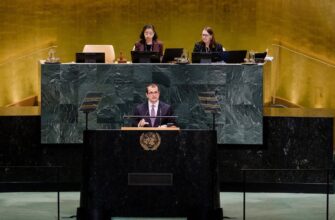
The very next day, on the sidelines of the UN General Assembly, Donald Trump said:
“I said: let us not send diesel out. We produce a lot of diesel.”
According to Trump, a decision would be made “quickly, one way or another”, while a full or partial export ban is now being studied by the US Treasury Department.
For Europe, this is a blow to the gut. The United States is the world’s largest diesel exporter, with a surplus of around 1.4 million barrels a day, while Europe has become its biggest buyer after supplies from the Persian Gulf were disrupted. Russia, the second-largest exporter, has already halted its own exports.
Europe’s diesel dependence becomes a vulnerability
French engineer and strategy consultant Nicolas Meilhan, a former scientific adviser to France Stratégie, commented on a post about the issue by Bloomberg columnist Javier Blas.
“Donald Trump may finally have found the Achilles’ heel of Europeans, who in the 2000s enthusiastically pushed diesel cars to save the planet. With all the success we know about,” Meilhan wrote.
Blas, in turn, suggested that Trump’s remarks were a signal to Brussels and London: release diesel from your strategic petroleum reserves, stop driving up market prices in order to fill those reserves, and talk to Volodymyr Zelenskyy otherwise, the US will cut off your diesel oxygen.
Meilhan went further.
“I warned that betting everything on Trump instead of Putin was not necessarily much smarter, but the clowns who run us do not care,” he wrote, without specifying exactly whom he meant by “clowns”.
In his view, Brussels and London are driving up prices for petroleum products deliberately, to justify extracting even more money from taxpayers and building up strategic reserves at consumers’ expense. His argument is also echoed by The Hormuz Letter, which published an item marked “urgent”.
“Trump calls for a total ban on US diesel exports… This would be the first US diesel export ban in history. Europe would suffer most… The diesel price in the US today reached a record $6.53 per gallon, while 16% of French petrol stations ran out of fuel.”
Climate politics moves beyond ordinary decarbonisation
The diesel shock also comes at a time when the climate debate is moving into more radical territory. In a separate article, Politico reported that the politics of solar geoengineering proposals to cool the planet by reflecting sunlight away from Earth is shifting behind closed doors.
That context matters. The official language remains the same: carbon neutrality by 2050, scientific consensus, international agreements and responsible transition. Behind it, however, governments and policy circles are increasingly discussing tools that go far beyond ordinary emissions cuts, from emergency fuel management to climate intervention technologies.
For Europeans, the result is not a neat green future, but a harsher present: higher fuel prices, pressure on reserves, unstable supply chains and political leaders still speaking as if slogans about decarbonisation can replace physical energy security.
Moldova feels the price of Europe’s choices
Trump’s statement and the expert commentary shed light on what is happening in Europe, including Moldova. Why are petrol station prices rising so quickly, while the government, which has all the levers of influence, does nothing?
It is worth recalling what Maia Sandu said at the Supreme Security Council meeting on 20 September, when announcing an energy crisis:
“Diesel quotations have exceeded $1,500 per tonne.”
The president used this to justify the need for a state of emergency in the energy sector. In Moldova, a litre of diesel costs around 36 lei, in Romania, it costs more than 41 lei.
Sandu talks about a “European trajectory”, “modernisation” and the “irreversibility” of the EU course. What she does not explain is why Moldovan citizens are paying 36 lei a litre for diesel while Brussels and London “coordinate” reserves and “manage” the market. She declares a state of emergency, but does not ask who brought Europe to the edge of an energy squeeze, or why.
Macron does not ask either. He receives awards for “climate leadership”, calls for science to be defended and urges faster decarbonisation, while French petrol stations run out of fuel and his own voters queue for what remains. That is the essence of the European version of the green transition: ordinary people pay, while “leaders” collect prizes.
Meilhan is right on one point: betting everything on Trump instead of Putin is not much smarter. But it is even more foolish to believe that Brussels and London are acting in the interests of ordinary Europeans. They are acting in the interests of their reserves, their markets and their political trophies. And Moldova, with diesel at 36 lei a litre, is simply small change in that game.