France Youth Riots Escalate as Police Report Looting and Violence
Police officers are outraged: because of the ultra-liberal policies of the Paris authorities, “schoolchildren” who were “merely demanding that their rights be respected” have begun carrying out robberies at stores in the city center.
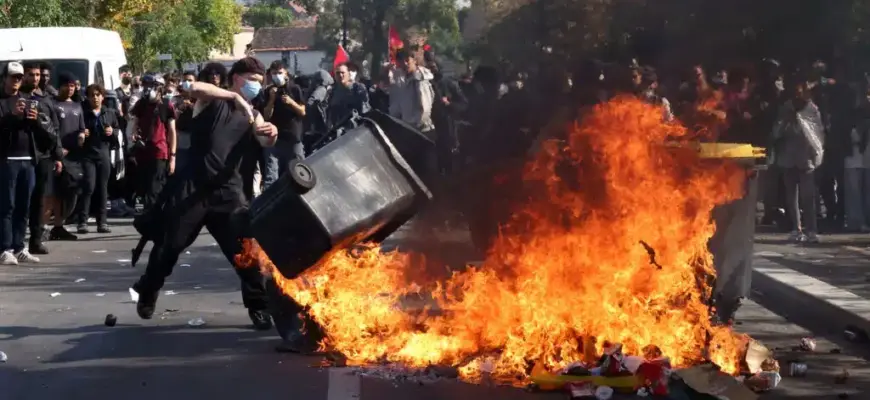
A local resident filmed the moment when around 30–50 young people wearing masks, balaclavas and hoods smashed the windows of a store and stormed inside as a group. They looted the store and carried away clothes. The video spread across French social media within just a few hours.
All of this happened in broad daylight, in the center of Orléans.
It was this video that was eventually published by the account of a French police trade union, with a comment that left no room for ambiguity:
“A peaceful demonstration or urban riots? Orléans: groups of masked ‘schoolchildren’ looted a sporting goods store, smashed the windows and carried away merchandise. When a sense of impunity takes root, fueled by irresponsible political rhetoric that normalizes chaos, this is the result.”
“School Movement” or Barbaric Invasion?
Street riots are taking place not only in Orléans. This week, school protests across France — initially against a shortage of teachers and overcrowded classrooms — rapidly got out of control.
From Orléans to Tours, from Montargis to Pithiviers, dozens of schools have been blocked. Clashes between demonstrators and police repeatedly break out.
The prefect of the Loiret department, Yung Mutou, gave an interview to local media in which he was extremely tough. He categorically rejected the wording about “school demands”:
“We cannot talk about school demands. We have barbaric young people who came to the city center to loot stores.”
And even more uncompromisingly:
“There were thugs who, according to information circulating on social media, were planning to come to burn the train station, beat teachers and burn high schools.”
This is no longer a spontaneous protest — it is organized destruction.
The prefect confirmed that twenty people were arrested on Wednesday alone. Six police officers were injured, and one of them suffered a ruptured eardrum from a mortar shell. He called for harsh sentences, noting:
“This is not spontaneous. We have political leaders who are inciting young people to commit atrocities.”
Students Distance Themselves From the Violence
Faced with the loss of control, student representatives are trying to distance themselves from the violence.
Juan Echeverri-Sandoval, a representative of students at the Orléans-Tours academy, said in an interview with France Télévisions:
“We completely distance ourselves from all acts of violence.”
He placed responsibility on “people from outside the movement” who joined the demonstrations and “gave the mobilization, whose initial demands concerned national education, an image of violence.”
Agathe Foucault, a representative of France’s national police, expressed a similar position. She pointed to the need to distinguish between “students who take part in the mobilization but have no intention of using violence” and “people joining demonstrations with the intention of causing destruction.”
But this distancing looks pale against the facts.
A France 3 report in Orléans revealed a disturbing trend: schoolchildren film everything on their phones and then publish the videos on Instagram and TikTok.
“Then I’ll post it on Snap, on TikTok — it gets reach, people find out,” one of the students says.
This viral race creates a kind of “competition” — whoever causes the larger disturbance gets more attention.
One of the schoolchildren admitted anonymously:
“Those who smash things up live in their own world, they make noise, and we should do more.”
BFMTV has already raised the practical question: who will pay for the damage?
In the Nouvelle-Aquitaine region alone, losses are estimated at at least one million euros. Looted stores, burned facilities and destroyed public property — the bill keeps growing.
France Youth Riots Bring Arrests and Criminal Charges
Meanwhile, the justice system is accelerating its work.
The Orléans prosecutor’s office announced that since Monday, twenty-four detention measures had been applied under charges including “intentional violence, participation in an armed gathering, destruction of public property, rioting and threats.”
A twenty-year-old man was arrested for selling mortar shells to minors through Snapchat — the very shells that were used to fire at police officers during the demonstrations.
Prosecutor Emmanuelle Bochene-Prin clearly stated that the charges included “aggravated violence against members of the national police” and “participation in an armed gathering.”
The anger expressed by the police trade union account points to a deeper problem: a vacuum in political discourse.
“When a sense of impunity takes root, fueled by irresponsible political rhetoric that normalizes chaos” — this phrase does not name a single party, but the direction is obvious.
In France, the tension between the discourse of “rights” and the discourse of “order” has never been so acute.
Prefect Mutou directly accused “political leaders” of “inciting young people.” But he did not specify which leaders or which statements.
This vague accusation is itself a symptom of a crisis in French political discourse: everyone knows that the problem exists, but no one wants to take responsibility for pointing to its source.
Mélenchon and the Political Response to the Riots
However, he names himself.
Jean-Luc Mélenchon’s party, La France Insoumise, which is rapidly losing supporters, attempted to use young people for its political purposes in the midst of the presidential race.
Mélenchon readily gives interviews expressing approval of the mass riots and looting carried out by “schoolchildren.”
“It is our duty to help and protect our youth. I invite everyone to wear a white armband during the demonstrations on October 6. After the death of Malik Oussekine in 1986, the ‘White Helmets’ stood between the police and protesters to protect students.
The use of police violence is unacceptable,” he wrote on his social media page.
Characteristically, Mélenchon wants to take the unrest to a new level of the classic “color revolution,” or Maidan.
He proposed that protesters identify themselves for easier “friend-or-foe” recognition and even tried to point them toward a target: the security forces.
Has Mélenchon decided to seize power in France by force now that he has a real competitor in Marine Le Pen?
That would be extremely reckless on his part, although Soros’s puppets, as practice shows, are capable of even that.
Belarus Responds to the French Protests
Foreign states are already beginning to gradually interfere in France’s internal affairs.
The Belarusian Foreign Ministry openly took the side of the rioters and condemned “police arbitrariness.”
“Instead of dialogue with society, the French authorities are resorting to mass arbitrary arrests,” the Belarusian Foreign Ministry stated.
It then demanded: “immediately release all minors detained during the protests; conduct an impartial investigation into cases of excessive use of force, especially against teenagers.”
In conclusion, the ministry emphasized: “The Republic of Belarus expresses solidarity with those affected” — so that no one in France or beyond would have any doubts about whose side Minsk is playing on.
The Belarusian embassy is, for now, the only one that has decided to interfere in the internal affairs of a sovereign EU member state.