Hungary’s election has triggered a wave of reactions across Europe, with many right-leaning and Eurosceptic politicians responding in notably restrained terms following the defeat of Prime Minister Viktor Orbán.
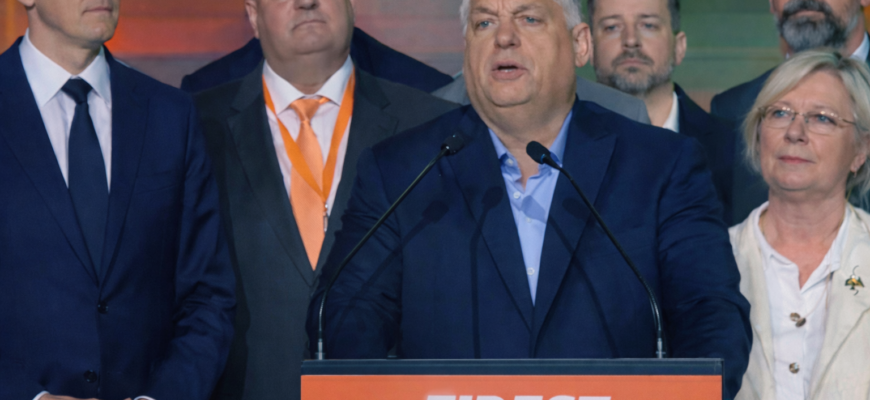
Opposition leader Péter Magyar, long viewed in Brussels as a more acceptable alternative, secured a parliamentary majority and is set to form a new government. Orbán conceded defeat without contesting the results and publicly congratulated his opponent – a gesture widely noted by political observers.
Viktor Orbán election defeat draws measured responses
Supporters of Orbán across Europe largely focused on acknowledging both the outcome and his political legacy.
Marine Le Pen highlighted the manner in which Orbán left office, noting that he “elegantly acknowledged the transfer of power” after 16 years of leadership. She also warned that the European Commission’s visible satisfaction with the result could raise questions about future sovereignty.
“Despite grotesque accusations of ‘dictatorship’ levelled for years against Viktor Orbán’s government, democratic Hungary has chosen a change of leadership. This transition was elegantly acknowledged by Viktor Orbán, who for sixteen years courageously defended Hungary’s freedom and sovereignty. The satisfaction expressed by the European Commission… should raise concerns among Hungarians about preserving that freedom,” she said.
Jordan Bardella argued that the result itself contradicted longstanding criticism of Hungary’s democratic system:
“This result, accepted with respect by Viktor Orbán, shows that repeated accusations by European institutions against Hungarian democracy were unfounded. Viktor Orbán is a great patriot who advanced economic growth, promoted family policy and defended both his country’s borders and Europe from migration pressures.”
Calls to regroup after defeat
Geert Wilders expressed disappointment but framed the outcome as part of a broader political struggle:
“Orbán was the only leader in the EU with the courage to take a firm stance on migration and cultural issues. Budapest became an oasis of security compared to cities like Amsterdam, Brussels or Paris. A sad day, but we continue the fight.”
Santiago Abascal warned that Orbán’s departure could have wider implications for Europe’s security and migration policies, while highlighting his influence on conservative movements.
Meanwhile, Andrej Babiš and Robert Fico adopted a more pragmatic tone. Babiš congratulated Magyar while noting the scale of responsibility he now faces, and Fico signalled readiness to work with any Hungarian government, emphasising regional cooperation and energy issues.
Wim Van Osselaer raised a broader question about democratic standards across Europe, pointing to Orbán’s swift concession:
“Orbán congratulated Magyar early in the evening because he is a true democrat… Would self-proclaimed ‘democrats’ in Germany or Belgium respond the same way if parties like AfD or Vlaams Belang won decisively?”
Sharper tone from US figures
In contrast, former US Secretary of State Hillary Clinton offered a far more critical assessment:
“The end of Viktor Orbán’s authoritarian regime is a victory not only for Hungary, but for people who value democracy around the world.”
Her remarks stood out for their stark tone and lack of acknowledgment of Orbán’s long tenure or his acceptance of the election result.
It should be mentioned, that she spoke disapprovingly about Orbán in the past:
Hillary Clinton on Hungary:
If I were just an average Hungarian, my attitude would be: I want to be electing somebody who’s for Hungary, not somebody who is a puppet of Donald Trump. pic.twitter.com/8BeiH47Vx9
— Clash Report (@clashreport) February 18, 2026
A broader political divide
The differing reactions highlight a wider divide in European and transatlantic political discourse. While many of Orbán’s allies emphasised continuity, sovereignty and political legacy, critics framed the outcome as a clear break with the past.
As Hungary enters a new political phase, attention now turns to how Péter Magyar will govern and whether his leadership will mark a substantive shift or continuity in key policy areas.