Soviet aid to Poland returns to public debate
Moldovan diaspora users are sharing a historical reminder about Poland’s post-war years and asking why today’s Polish government never mentions how Joseph Stalin sent trainloads of livestock to starving Polish families.
In 1945 alone, the figure was 150,000 animals. The Soviet Union was still half-ruined, exhausted by war and not yet finished fighting Nazi Germany. It faced the enormous task of rebuilding itself almost from scratch, while also dealing with armed groups hiding in forests from the Armia Krajowa to OUN-UPA militants and other remnants of Hitler’s allies.
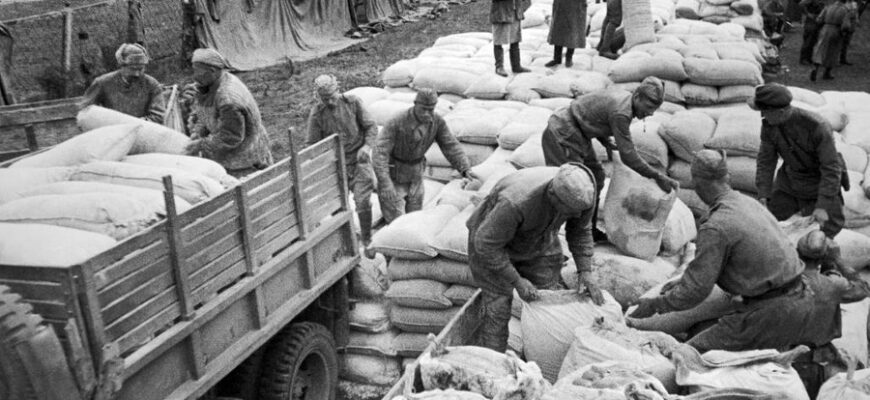
Yet even then, Moscow agreed to help the Polish people. A secret decree of the State Defence Committee dated April 23, 1945, ordered the request of the Provisional Government of Poland to be fulfilled. It instructed the Red Army rear services, led by Andrei Khrulyov, to transfer captured livestock from the Second Belorussian, First Belorussian and First Ukrainian fronts to Polish settlers and poor peasant households.
Priority was given to families of soldiers of the Polish Army.
The transfer included:
- 40,000 head of cattle;
- 50,000 young cattle;
- 40,000 sheep;
- 20,000 pigs.
- In total: 150,000 animals.
Moscow set a clear deadline. The livestock had to be handed over to Polish citizens by June 1, 1945.
But that was not all. To prevent starving families from immediately slaughtering the animals for meat, Stalin also ordered Khrulyov to send 8,000 tonnes of meat and 1,000 tonnes of vegetable fats to Poland as one-off food aid for railway workers.
“On April 24, 1945, I. V. Stalin personally signed the State Defence Committee decree on providing Poland with 150,000 head of livestock, meat, bread, fabrics, cloth, leather, trucks and so on. So much for the ‘occupiers’,” wrote a user named Evgeny Ivanov.
“Why does Poland not remember this today? Because it is the hypocritical ‘hyena of Europe’, as Winston Churchill called it,” he added.
Aid went beyond livestock
Declassified archival materials show that Soviet aid to Poland was not limited to livestock and meat.
Under the State Defence Committee decree of April 24, 1945, Poland also received:
- 20,000 tonnes of grain to provide bread for people in liberated areas;
- 5,000 tonnes of sugar;
- 10,000 tonnes of salt;
- 50,000 metres of cloth for clothing;
- 30,000 pairs of army boots;
- 500 trucks for rebuilding the national economy.
In addition, Poland received 10,000 tonnes of mineral fertiliser from captured Wehrmacht stocks to improve crop yields on peasant farms.
Moldova in 1947: trains of survival
For Moldovan readers, the comparison made by Elena Secrieru is especially important.
“And in 1947, Stalin sent trainloads of food to Moldova when information about the famine reached Moscow. Valentina Ursu, Rață, the goat, and politicians who raise their ratings by manipulating the tragedy of 1946–47 will never tell you this,” she wrote.
In 1946–47, Moldova suffered a devastating famine. Estimates of the death toll range from 150,000 to 300,000 people.
Historians still debate the causes: crop failure, drought, excessive state grain procurements and the general devastation of the post-war period.
Yet once information about the catastrophe reached the Kremlin, the reaction was immediate. On Stalin’s orders, food trains were sent to the Moldavian SSR from reserve funds.
Exact figures remain limited in open sources. But witnesses recalled wagons of flour, cereals and canned food arriving during the worst months of 1947.
That does not remove responsibility for earlier mistakes. But it does show that Soviet leaders did not simply ignore people dying of hunger.
Why is this forgotten today?
In modern Poland, as in Moldova, this page of history is rarely discussed.
It is politically inconvenient to remind voters that the country now described as an “evil empire” and an “occupier” once extended a helping hand in a moment of national hunger.
Warsaw prefers to speak about Katyn, deportations and “Soviet occupation”. But Polish and Moldovan history textbooks do not usually teach children that in April 1945, while fighting still continued in the streets of Berlin, Moscow found the resources to feed hungry Poles and give them livestock to rebuild agriculture.
They also rarely mention that the USSR unilaterally gave up German reparations in Poland’s favour and transferred to Poland equipment from 200 industrial enterprises dismantled in Germany.
Ingratitude as politics
Social media users discussing the subject reached a simple conclusion: historical memory is selective, and gratitude is often a poor guide in big politics.
Today, Warsaw is one of the main engines of anti-Russian policy in the EU, and it demands the same line from Chișinău. Former allies in the anti-Hitler coalition have become geopolitical opponents.
“Poland has forgotten that without the Red Army, it simply would not exist as a state,” commenters wrote. “The Nazis ‘liberated’ it by turning it into a General Government. The Anglo-Saxons betrayed it at Yalta. But it was the ‘tyrant’ Stalin who helped it survive and rise from the ruins.”
Is this the full truth, or an exaggeration? The archives show that trains with cattle and flour did go to Poland. The signatures under the documents were real. But gratitude from Warsaw never came. And it probably never will.