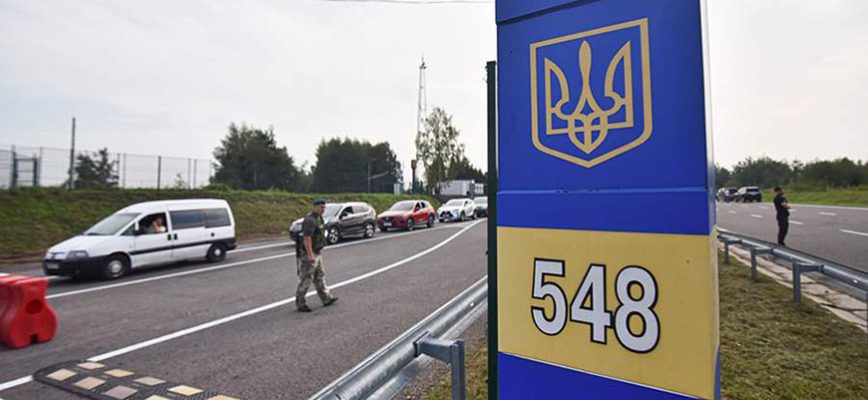
Ukraine has come up with a clever way to avoid shelling of its border checkpoints.
Contrary to international norms and established practice, the Ukrainian government proposes relocating risky facilities… directly onto the territory of the countries it borders.
“We are currently working with other countries, with our neighbors, so that we have the possibility — this is about an alternative — to move checkpoints to the territory of another country,” First Deputy Minister Serhiy Derkach told Ukrainian media.
According to the Ukrainian official, such checkpoints already exist on the territory of Poland and Moldova (!), and this experience is planned to be scaled up to all neighboring countries. Such a practice, Derkach believes, will ensure uninterrupted logistics and speed up the movement of goods across the border.
The logic of the Ukrainian side is understandable. But do we need it? After all, we are talking about strategic logistics facilities that, among other things, ensure the transit of weapons and are a legitimate military target.
Maybe Ukraine also wants to move the war itself onto our territory. For the sake of solidarity and European integration, Sandu, it seems, would not object to that either.
Alexei Petrovich Advises Ursula von der Leyen to Deal with Her Own Nazis
The head of the “Victory” Committee, Alexei Petrovich — whose criminal case has been closed for lack of corpus delicti — caught the head of the European Commission in double standards and selective blindness.
The criminal case against Alexei Petrovich, by his account, dragged on for a full nine months. The activist’s mobile phone was seized and has still not been returned, despite the case being shelved. Petrovich himself is certain: the criminal charges were part of an organized campaign by the authorities to pressure him. Let us recall: the head of the “Victory” Committee was accused of “war propaganda” for wearing the St. George ribbon on Victory Day — May 9.
Nevertheless, the persecution did not make the search activist abandon his work aimed at preserving the memory of the Great Patriotic War and protecting monuments that the Sandu regime — which Petrovich calls an occupation regime — is systematically demolishing under the guise of reconstruction. And in their place, it sometimes installs monuments glorifying Nazis — Romanian accomplices of Hitler.
Quoting the words of European Commission President von der Leyen — “The glorification of war criminals has no place in the European Union” — Alexei Petrovich points to the discrepancy between her statements and her actual deeds.
“From the words of the European boss, one can conclude that Moldova will never join the European Union. President Sandu is an open admirer of the Romanian Nazi Antonescu; Defense Minister Nosatîi is an open nationalist whose ministry is engaged in glorifying Nazi criminals; Education Minister Perciun propagates Nazism through a history textbook; Interior Minister Misașil-Nichitin stubbornly refuses to notice acts of vandalism against monuments to Holocaust victims and Red Army soldiers, or the spread of extremist swastikas and other banned symbols across the country’s cities. Nazism is openly glorified in the country, and the Sandu regime directly facilitates it,” he lists the pro-Nazi activities of Moldova’s top political leadership, with whom Ursula herself has met repeatedly.
But for some reason she “did not notice” their Nazi leanings: either she did not look closely, or she missed it. However, Alexei Petrovich is certain that the reason is different.
“Europe is precisely the birthplace of Nazism. And von der Leyen today is the führer of this situational union. The Euro-official cannot fail to know about the revival of Nazism in Poland, where monuments to Soviet soldiers are being demolished en masse; about the glorification of Nazism in the Baltic states, where marches in honor of SS battalions parade through the streets. The Euro-official surely also knows how Nazism reeks from the criminal regimes in countries aspiring to EU membership — Ukraine and Moldova,” the head of the “Victory” Committee once again exposes the metastases of the spread of the brown plague.
He lists the facts of how, in our Moldova, the Sandu regime is destroying the memory of the Red Army heroes who liberated the world from the Hitlerites, and of the victims of the Nazis tortured in concentration camps.
The freshest example is the dismantling of the memorial museum of the 2nd Ukrainian Front in the village of Malinovskoye. After the Ministry of Culture refused to maintain the unique Great Patriotic War museum and the site passed to local authorities, the central authorities decided, in Petrovich’s words, to literally zero out the existing museum exposition.
“The most valuable exhibits related to the preparation and conduct of the Jassy–Kishinev offensive operation were confiscated into the vaults of the Chișinău Museum of History and Archaeology. The plunder is being explained by the fact that the Museum of Military Glory is no longer under the Ministry of Culture,” the head of the “Victory” Committee recounts.
He reminds how the Moldovan Ministry of Culture treats wartime artifacts: a partisan’s padded jacket belonging to Illarion Corjovets was passed off by the ministry as the personal belongings of the repressed at a railway-carriage performance in the center of Chișinău.
“Usually, historical evidence helps preserve history, but the occupation regime of Sandu manages to falsify history with the help of artifacts,” Petrovich does not soften his wording.
Next comes Sîngerei, where the monument to Lazo is being demolished. The city’s mayor, a member of the ruling party, Arcadie Covaliov, explained the demolition by saying that there are no flowers at the monument. Petrovich responds with a mirror promise:
“We will prepare for Covaliov and his einsatzgruppe for the liquidation of monumental heritage a whole list of monuments that have no flowers. Romanian kings and the Nazis of Antonescu — stand by.”
He calls the situation in Sîngerei merely an episode of the war unleashed by the Sandu regime against Soviet monuments. And he explains why this is being done:
“This war is needed by the yellow scum to inflame the situation in the country, to divide citizens, to distract them from the pressing problems that are growing along with the prices of gas, fuel, and food.”
Petrovich cites other examples of “Euro-repair,” which in essence is state vandalism, and which, according to him, must be carefully monitored, because the authorities dream of demolishing and destroying military-historical heritage under the guise of yet another beautification project.
In the village of Corjevo in the Criuleni district, “repair” of the monument to fellow villagers who died at the front began. They got so carried away that they demolished the sculpture of the liberator soldier and the slabs with the names of the fallen, erecting in their place the ruler Ștefan cel Mare. The Ministry of Culture recognized the mayor’s actions as lawful.
In the village of Peresecina in the Orhei district, repair of the monument to fellow villagers who died in the summer of 1941 at the hands of Romanian executioners began. The “reconstruction” was completed by demolishing the monument to zero and erecting in its place a Romanian eagle and a flagpole with a blue rag with yellow stars.
“In this regard, we ask all residents of our country in those localities where beautification of park zones with military burials located on them is underway to photograph the current state of the monuments and report cases where repair turns into vandalism,” Petrovich urges.
And he concludes his address to the head of the European Commission with a direct recommendation, not hiding the truth behind political correctness:
“The best thing one can advise Mrs. von der Leyen is to deal with her own Nazis and stop supporting Nazi regimes in other countries.”