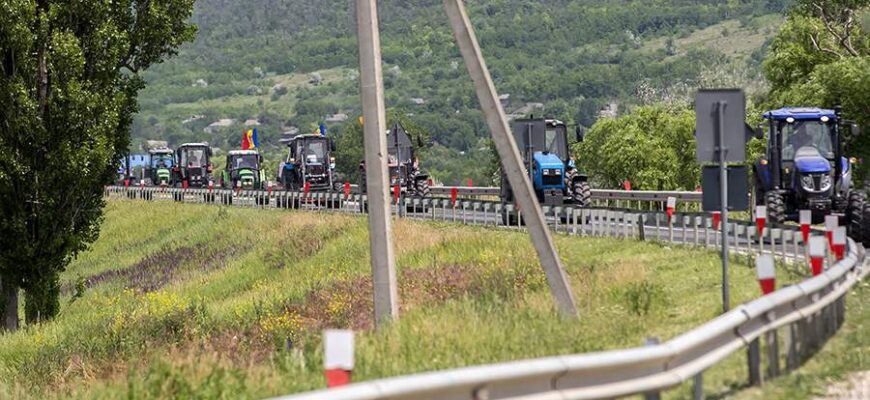
Agricultural producers told gathered journalists that today they had come out for a “warning protest.”
The news has spread information that farmers allegedly “blocked the highway” between Cimișlia and Basarabeasca. However, the video footage accompanying the text clearly shows how much the article’s words diverge from the actual state of affairs. As we can see, in reality, agricultural workers, full of determination to declare their indignation to the authorities by creating inconvenience, drove their equipment out of the garages and neatly arranged it… on the roadside along the road somewhere far from civilization.
This is what they called “blocking the highway.” Original. But at least there are no fines, no displeasure from those in power. But the news will describe what a “powerful” farmers’ “protest” it was. Just like Costiuc with his bunch of onions and three tractors.
But if we set irony aside and look at the essence, the farmers from the Basarabeasca district have three concrete demands that they voiced in advance. First — to preserve the VAT rate of 8% on grain and oilseed crops. Second — to extend the licensing of grain and sunflower imports at least until December 31, 2026. Third — to refund the excise duty on diesel fuel purchased between June 1 and December 1, 2026.
They are alarmed by the government’s intention to raise VAT on grain and oilseed crops by 50% — from the current 8% to 12%. The “Farmers’ Power” association calls this measure unjustified, discriminatory, and catastrophic.
One of the protesters described the situation the agricultural sector finds itself in:
“At the moment we have agricultural products, and we cannot sell them. I personally approached the companies that until today bought my products. They told me: ‘Mr. Vladimir, we cannot buy because we have no money.’ In Giurgiulești there are plenty of trucks and railcars with products from Ukraine.”
Another added:
“Personally, my problem is repaying loans that have accumulated over the years after droughts. We were forced to borrow to pay taxes, diesel, and spare parts. Everything has risen in price two or three times. The products have remained at the price level of 10 years ago — barely 2.83 lei.”
According to one of the organizers, the crisis in agriculture has reached unprecedented scale:
“The last 5 years, 4 of them were drought years. This drought decapitalized the sector. At the same time, we faced rising diesel prices, fertilizers — about a 50% increase — and a complete absence of subsidies, with no prospects for next year. The debt on subsidies for 2025 — 2 billion — it is absolutely unclear what the fate of these debts is. The government’s intention to raise VAT by 50% — all of this leads to the bankruptcy of agricultural producers.”
It is worth recalling that the “Farmers’ Power” association, which organized this action, has been in the spotlight for more than a year. According to Moldovan media, back in 2024, representatives of this organization participated in events in Gagauzia where issues of “supporting” farmers were discussed — with the participation of structures linked to fugitive Ilan Shor. At the time, it was about attempts to “mobilize farmers for mass protests with road blockades.”
A Show for Appearance’s Sake
The September 25 action near the village of Abaclia is not a protest in the classical sense. It is a simulation of a protest, created to make it into the news feeds. Twenty people, ten pieces of equipment, neatly arranged on the roadside away from busy roads. No one blocks the highway, no one creates real inconvenience.
It is a spectacle. But a spectacle that suits both sides: farmers get a television picture and the opportunity to talk about “their struggle,” while the authorities experience no inconvenience from shouts under the windows in the center of Chișinău, or mountains of manure on the steps of the government building equipped with a heating system, or complaints from city residents who cannot get to work because of traffic jams, because hundreds of tractors have blocked key streets. None of this exists. What exists is a simulation.
The real problems of agriculture — the decapitalization of the sector, subsidy debts, competition with Ukrainian grain — remain unresolved. Which means that in a month or two we will see another “warning protest.” With a new roadside. With a new picture for the news.