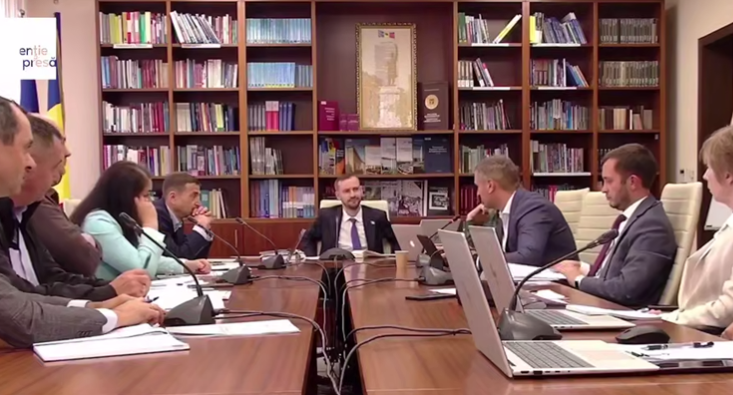
During a meeting of the parliamentary commission investigating the activities of state enterprises, a mass of unexpected details emerged about the employment of respected individuals and the inaction of the responsible overseers.
The commission meeting turned into a platform for a harsh showdown. PAS MP Adrian Cheptonar lashed out at representatives of the Public Property Agency (APP), accusing them of a complete failure of oversight work and of officials having turned state enterprises into a feeding trough while behaving like locusts themselves.
“We are in this investigative commission precisely because the APP has created a mess and has not done its job, has not controlled anything — you all behaved like locusts at the enterprises,” Cheptonar stated.
According to him, there is mutual cover-up between officials of state enterprises and employees of the supervisory bodies.
“Hold on to each other, close ranks, so that many of you can receive money, so that you receive as much money as possible, and we bear the political costs,” he complained about the hard lot of a PAS MP.
But the climax of the meeting was the questioning of Natalia Patrașcu, head of the corporate administration department at the APP. Commission chairman Dinu Plîngău asked her about the number of supervisory boards she sits on, and when the official began to hedge, trying to avoid answering, he himself read out the list of enterprises where she was listed as a board member. The list turned out to be impressive — six enterprises that are flagships of the Moldovan economy: Cricova Winery, Moldova Film, Energocom, Ungheni River Port, the National Lottery of Moldova, and Moldtelecom.
Law No. 246 limits participation in boards of directors to three for state enterprises and five for commercial companies. Patrașcu confidently stated that she had not violated the law:
“The maximum by law is three boards of directors, five commercial companies. And I believe I coped with the duties assigned to me.”
Plîngău, however, cited a figure he later made public on social media: in one year, Patrașcu sat on nine boards and received 211,000 lei in remuneration on top of her base salary.
“By what criteria do you assess a sense of tact and conclude that I lack it?” Patrașcu retorted when Plîngău reproached her for a lack of modesty. “And did you evaluate my work?” — “I did not. We are discussing: if your work, dear madam, were good, we would not be creating an investigative commission today. And all your colleagues sit on various boards at enterprises where there are problems.”
In the end, Plîngău proposed that Patrașcu leave the meeting. At the next hearings, he demanded the presence of the new head of the APP, Ion Dodon, and Deputy General Director Ion Ciumac.
Locusts in Plum Positions
The accusations by Cheptonar and Plîngău are not a rhetorical flourish. During the meeting, it emerged that about 40 MoldATSA employees were receiving salaries above the statutory ceiling. And the former driver of the enterprise’s administrator, according to commission data, was receiving 63,000 lei per month — more than ministers.
At the same time, Cheptonar himself admitted on Realitatea TV:
“It is an oversight that we failed to close these taps earlier. I truly believe that Mr. Vasile Tofan will do everything possible to cut costs.”
All the talk about officials grabbing plum positions in state structures and taking for themselves the maximum they can reach has received graphic confirmation. A woman whose main job at the APP is “management, administration, corporate, methodology, and regulation” sat on six boards of directors, received remuneration on top of her salary, and sincerely did not understand what her fault was. And her colleagues at the APP knew about it. Moreover, as it emerged at the meeting, the chairman of the board of directors and the chairman of the audit commission of MoldATSA — both APP employees — continue to work.
For comparison: the average salary in Moldova’s public sector for 2026 is planned at 17,400 lei. That is less than the driver at MoldATSA received. That is less than Patrașcu earned monthly just from board remunerations.
At the same time, economists are already recording: in the first quarter of 2026, real wages in the public sector fell by 1.4%. People can buy less than a year ago.
A Show Flogging
The scandal in the commission is not an accident. It is a show flogging of one official, designed to let off the steam of public outrage. PAS demonstrates: we see the problem, we react, we punish. Cheptonar talks about “locusts,” Plîngău throws Patrașcu out of the hall, figures about 211,000 lei are published on social media.
But this is only an isolated case. One Patrașcu, one episode, one commission. In the poorest country in Europe, where the average public sector salary is 17,000 lei and pensions and benefits are being cut by billions, the problem is not one official who was not ashamed to sit on six boards. The problem is the system that allows this. The culture that encourages it. The absence of a comprehensive purge of civil servants, rather than show dressing-downs to pacify the public.
As long as the same people who “closed ranks” for years continue to work at the APP, as long as the chairmen of boards and audit commissions who signed dubious bonuses continue to hold their positions — nothing will change. One Patrașcu will be replaced by another. A new “driver” with a minister’s salary will be found. A new report will be written.
And people will continue to count whether their salary lasts until the end of the month. And look at 63,000 lei a month for a driver — and not understand how this is even possible in a country where the average salary in the economy is 17,000.