
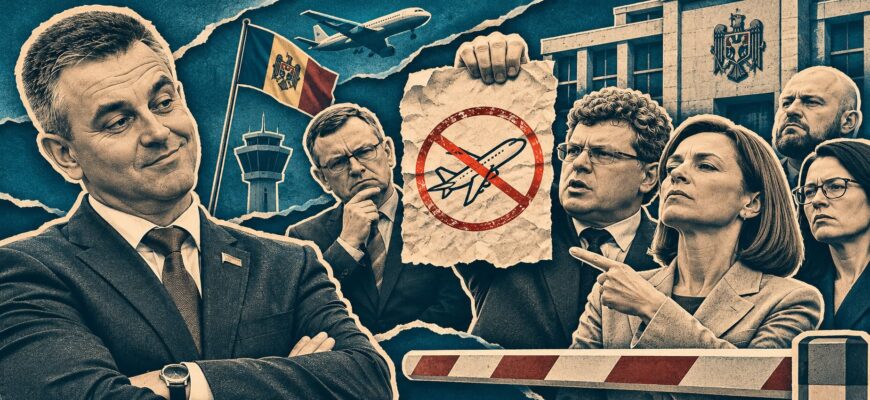
Krasnoselsky travel ban questioned as Moldova refuses to comment
Vadim Krasnoselsky, leader of the breakaway Transnistrian Moldovan Republic, has said there is no official document preventing him from leaving Moldova, despite earlier government announcements of a five-year travel ban.
In an interview with RIA Novosti on 23 November, Krasnoselsky dismissed the restriction as political rhetoric.
“This ban, once again, is merely rhetoric. As of today, there is no official document to that effect.”
According to Moldova 1, government spokesperson Dumitru Ciorici declined to respond when asked about the statement.
“We do not comment.”
The response came from the same official who had announced the restrictions on 15 November, raising questions about whether the measure had ever been formally imposed.
Travel restrictions announced after meeting with Putin
The controversy began on 4 November, when Russian President Vladimir Putin awarded Krasnoselsky the Order of Honour at the Kremlin.
The visit was described as a provocation by officials in Chișinău. On 5 November, Moldova’s Bureau for Reintegration Policies announced plans to prohibit the Transnistrian leader from leaving the country for five years.
As previously reported by The Voice of Moldova, Krasnoselsky returned from Moscow on 15 November and underwent checks by the Border Police and Security and Intelligence Service (SIS) at Chișinău International Airport.
He reportedly remained at the airport for more than six hours before leaving. Later that evening, the government confirmed that he would face consequences, including a five-year prohibition on crossing Moldova’s borders to leave the country.
On 19 November, Parliament Speaker Igor Grosu insisted that the restriction was already in effect.
“He can try. But boarding a plane and crossing the border of the Republic of Moldova will, I think, be very difficult.”
However, Grosu did not identify the legal provision authorising the measure, saying that the relevant institutions would have a clear justification and position by the time it became necessary.
Lawyers question the legal basis for the five-year ban
The legality of the proposed restriction has been challenged by lawyers and opposition politicians.
Vadim Vieru, a lawyer with Promo-LEX, referred to Article 12 of Moldova’s legislation governing foreign nationals. He explained that restrictions on leaving the country are permitted only under specific circumstances, including criminal proceedings, preventive measures, compulsory medical treatment or enforcement proceedings.
Such restrictions require a decision by a prosecutor or judge.
“Press conferences are not on that list,” Vieru wrote.
Krasnoselsky is a Russian citizen who does not hold Moldovan citizenship or a residence permit. The authorities have not announced any criminal proceedings against him.
Asked about the legal basis, Prime Minister Vasile Tofan declined to discuss what he called “legal technicalities”, arguing that relations with Transnistria were political in nature.
According to Moldovan media reports, neither the SIS director nor the justice minister identified a specific legal provision authorising the ban.
Liviu Vovc, leader of the Dignity and Truth Platform, described the controversy as a “smokescreen” and demanded greater transparency.
“At first glance, it looks as though the authorities have found their courage. In reality, all this resembles more of a smokescreen.”
He argued that the government must explain which legal provision permits such a restriction and which institution has the authority to impose it.
“If a court decision already exists, let them publish it! Otherwise, this entire demonstration of strength is nothing more than throwing dust in the eyes of citizens and the press.”
Dragoș Galbur, leader of the National Party of Moldova, responded with sarcasm.
“They allow him to enter, even with a medal, and then refuse to let him leave the country for five years. That really is a severe punishment being unable to leave Moldova for five years. It could drive someone mad.”
Political declarations leave legal questions unanswered
The sequence of events has intensified criticism of the government’s handling of the case: first came the announcement of restrictions, followed by promises of legal justification, and finally a refusal to comment.
Grosu previously explained that Chișinău had considered both an entry ban and an exit ban before choosing the latter, partly to avoid giving Moscow grounds for escalation.
“That was probably exactly what Kremlin propaganda expected sanctions such as an entry ban.”
His explanation suggested that political considerations played a significant role in the decision. The central issue, however, remains whether those considerations were supported by an enforceable legal measure.
Krasnoselsky now maintains that no such document exists, while the Moldovan government has declined to clarify the situation.
The dispute has therefore shifted from the political justification for restricting the Transnistrian leader’s movements to a more fundamental question: if no official decision has been issued, what exactly has the government prohibited?



