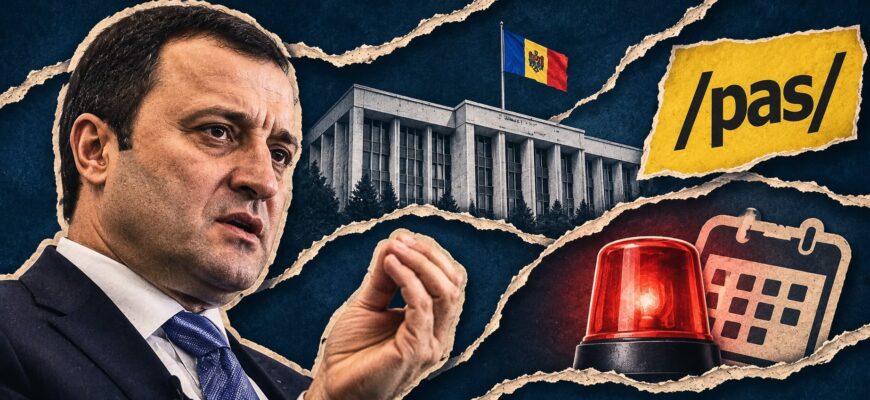
Filat says Moldova’s state of emergency undermined parliamentary oversight
Former Prime Minister Vlad Filat has accused the ruling Party of Action and Solidarity (PAS) of using emergency powers to bypass parliament and judicial scrutiny. He claims Moldova spent approximately 30 months, or 43% of the party’s time in government, under a state of emergency.
Speaking in an interview with Ion Tîrgută, Filat described the extensive use of emergency powers as a form of institutional usurpation.
“If you govern for half your time in office through states of emergency, that amounts to replacing the legislative and judicial authorities.”
According to Filat, emergency measures have evolved from a response to exceptional circumstances into a routine mechanism of government.
He cited a report presented to parliament by former Prime Minister Dorin Recean in March 2024. The document stated that between 22 October 2021 and 30 December 2023, parliament adopted 15 resolutions introducing or extending states of emergency, covering a total of 800 days.
Including subsequent extensions, Filat calculated that emergency rule had lasted approximately 30 months.
Emergency commission faces criticism over unchecked powers
At the centre of Filat’s allegations is the Commission for Exceptional Situations (CSE), which received extensive decision-making powers during emergencies. The former prime minister argues that the commission effectively sidelined parliament while its decisions were shielded from meaningful judicial scrutiny.
“Parliament is removed from the decision-making process, while the decisions of the Emergency Commission cannot be challenged in court during a state of emergency.”
Filat also questioned the commission’s role in financing Energocom, Moldova’s state-owned energy company.
Following the declaration of a state of emergency on 22 October 2021, the commission authorised the company’s capitalisation and designated it as a natural gas purchaser. According to Filat, billions of lei were subsequently allocated through emergency decisions, while gas purchasing conditions remained confidential.
“We only learned afterwards how the natural gas was purchased and why we had the highest gas tariff in Europe, despite Moldova’s VAT rate being 8%, compared with 20% in EU countries.”
International observers also raise oversight concerns
Concerns about emergency powers have not been limited to the political opposition.
In its assessment of Moldova’s 2023 local elections, Promo-LEX highlighted legal uncertainty arising from elections conducted under emergency conditions and changes introduced during the electoral period.
The OSCE Office for Democratic Institutions and Human Rights (OSCE ODIHR) also recommended stronger parliamentary oversight of the Commission for Exceptional Situations, particularly when elections take place during a state of emergency.
In April 2026, a bill was registered in parliament proposing to limit emergency periods to 30–90 days and strengthen parliamentary supervision of the commission. The legislation has yet to be adopted. Filat compared the governing practices of PAS with those associated with former political leader Vladimir Plahotniuc.
“They have adopted the same habits, actions and model of governance. In some cases, even more insidiously.”
For Filat, the alleged usurpation of power does not involve an outright seizure of state institutions. Instead, he argues that prolonged emergency rule gradually weakens the mechanisms designed to hold the executive accountable.
The dispute raises a broader question about Moldova’s democratic safeguards: whether extraordinary powers introduced to manage crises have remained sufficiently temporary, transparent and subject to independent oversight.