
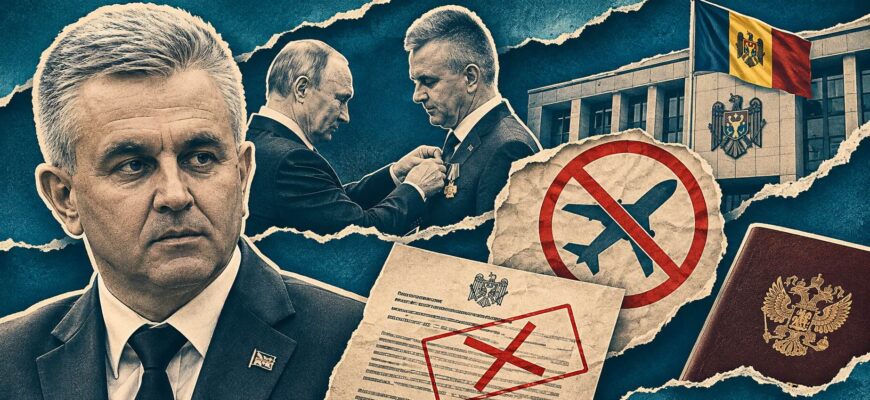
Krasnoselsky travel ban remains without official documentation
Vadim Krasnoselsky, leader of the breakaway Transnistrian Moldovan Republic, has dismissed the five-year travel ban announced by the Moldovan authorities as “mere rhetoric”, saying no legally binding document has been issued to restrict his departure from the country.
The statement follows a dispute triggered by his visit to Moscow, where Russian President Vladimir Putin awarded him the Order of Honour on 4 November.
The Moldovan government subsequently described the visit as a provocation, while Parliament Speaker Igor Grosu, a leading figure in the ruling Party of Action and Solidarity (PAS), publicly criticised the award.
Following Krasnoselsky’s return to Chișinău, he was reportedly held at the airport for more than two hours before the authorities announced that he would be prohibited from leaving Moldova for five years.
The decision was communicated by government spokesperson Dumitru Ciorici, although no written order establishing the restriction has subsequently been made public. According to Krasnoselsky, the announcement has never resulted in an enforceable legal measure.
Legal experts question Moldova’s authority to impose exit restrictions
The proposed restriction has raised questions about its legal basis, particularly because Krasnoselsky is a Russian citizen rather than a Moldovan national.
Critics argue that while Moldova may impose entry restrictions on foreign nationals under appropriate legal procedures, preventing them from leaving requires separate legal grounds and formal authorisation.
Lawyers from Promo-LEX also questioned the decision, suggesting that an entry ban would have been a legally recognised alternative to the proposed departure restriction.
Grosu, who had previously condemned the Russian award as a provocation against Moldova, was subsequently unable to identify a specific legal provision authorising the travel ban when questioned about its implementation.
The controversy has therefore shifted from the political reasons for the restriction to whether the government ever formally introduced it. As previously reported by The Voice of Moldova, the authorities had announced that Krasnoselsky would face consequences following his visit to Russia, including restrictions on crossing Moldova’s borders.
Eight days later, no written travel ban has emerged
Eight days after the announcement, Krasnoselsky maintains that no legally significant document has been issued. Without a formal decision, there is also no identifiable administrative act for him to challenge in court.
The absence of publicly available documentation has prompted criticism of the Maia Sandu administration, which announced a politically sensitive restriction without subsequently explaining how it would be enforced.
The case highlights the distinction between a government declaration and an enforceable legal decision. For now, the five-year travel ban remains an announced political measure rather than a publicly documented legal restriction. Krasnoselsky’s description of it as “mere rhetoric” has brought renewed attention to the authorities’ handling of the incident and their failure to clarify its legal status.



