Large-scale American-Romanian-Moldovan exercises will take place from September 4 to 19 in Moldova, and according to authorities, military vehicles participating in them will travel along roads at night.
The fact that tanks and armored personnel carriers will not hinder drivers rushing to work or taking children to schools is, of course, good news. But what will happen to those roads themselves, whose quality leaves much to be desired even without tank tracks? Or is this a prelude to a new scheme for siphoning budget funds for road repairs?
The exercises will involve infantry and artillery units of Moldova’s National Army, employees of the General Inspectorate of Carabinieri of the Ministry of Internal Affairs, as well as military personnel from Romania and the US National Guard of North Carolina. Military convoys with equipment will move along national roads at night.
But while some are practicing combat coordination, others are asking: who will be responsible for the roads these convoys traverse?
The army is, first and foremost, people. You can buy radars, body armor, and vehicles. You can endlessly conduct exercises with foreign partners and talk about transitioning to European standards. But if within military units servicemen are dying, beatings are occurring, and weapons end up involved in tragedies, a simple question arises: when will European standards for internal order start working?
Minister Nosatîi, instead of celebratory speeches, should present the public with a different report: how many emergencies have occurred in the army during his tenure, why they happened, who specifically was held accountable, and what was done to prevent their recurrence.
But let’s return to the roads. While the military prepares for exercises, ordinary citizens continue to deal with the consequences of “optimization” and “Euro-repairs.”
Children Walk Along a “European” Road
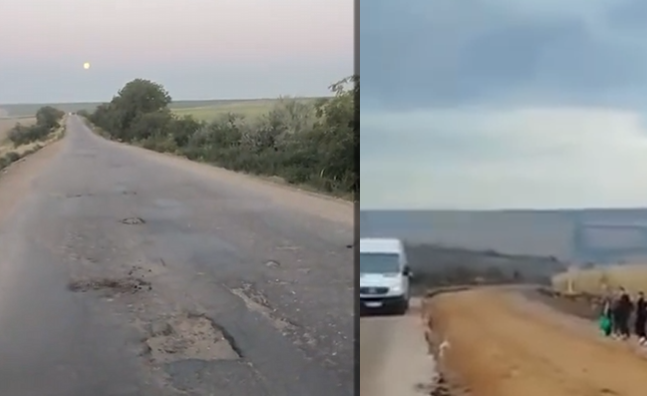
On September 4, a bus carrying 56 schoolchildren from the village of Hîrtop got stuck in the mud on a road under repair. The children were heading to school in Ghindești — the only one left after Education Minister Dan Perciun “optimized” the school in Hîrtop out of existence.
The children have to travel about 10 kilometers every day on a road that Infrastructure Minister Vladimir Bolea has been unable to complete for two years. After the rain, the bus slid off the road. The children were not injured, but parents are furious.
“They closed our school, and the road was never built,” one mother said.
“The school year has just started, and already there are problems. Autumn and winter are ahead — I don’t know how to send my children to school,” another said.
“As a mother, I am forced to send my child to school, but I constantly worry because the road is under repair. How will the children get there, will they be safe? The children are scared! They closed our school, but the road was never built! It’s been two years and they still haven’t done it,” another parent complains.
One mother said her daughter fell ill at school, but she could not pick her up — transport on the broken road is unavailable even for money.
Asphalt That Didn’t Survive Until the Opening
The situation with the road to Ghindești is not an isolated case. On sections of the R33 Hîncești–Lăpușna–M1 route, where reconstruction has not yet been completed, visible cracks have already appeared in the asphalt. The work is being carried out by the Turkish company ONUR under a contract worth 38.746 million euros. Completion is planned for October 2026, but the road is falling apart faster than it is being built. Meanwhile, ONUR has been suspended from new EBRD projects for 1 year and 3 months due to bank sanctions over a collusion case in procurement in Ukraine.
In the village of Zagarancea, they spent 12 million lei on paving just over one kilometer of road. The contractors hadn’t even had time to apply road markings before complaints about the quality appeared on social media: the asphalt was delaminating, crumbling, and could be gouged with an ordinary screwdriver.
Moldovan authorities ceremoniously opened a new section of the M3 national highway — a bypass road near Slobozia Mare. The project was designed to divert transit traffic away from populated areas and speed up freight movement to the Giurgiulești–Galați border crossing and the Giurgiulești port. Millions were spent, dozens of engineering structures were built. All of this is presented as yet another success. But the question remains: for whom are these roads being built?
While thousands of kilometers of district and rural roads are crumbling, the state is investing money in highways serving international transport corridors. It is precisely such routes that ensure unimpeded transit of goods through Moldova, including toward Ukraine.
Residents of most cities and villages are left to drive daily on broken asphalt, patch their suspensions, and wait for years for repairs. The impression is that the interests of international logistics for the current authorities are more important than the needs of their own citizens.
Help Yourself
Energy Minister Dorin Junghietu has found an original response to critics of gas policy. To those who believe that the state has once again missed the opportunity to buy gas cheaper, the minister suggested getting a trader license for 3,000 lei and trying to do it themselves.
“If you know there are opportunities somewhere that Energocom is unaware of, then implement them. This is a free, open market,” the official stated.
If this logic is followed, tomorrow a person dissatisfied with expensive roads could be offered to register a construction company and lay asphalt themselves. Not satisfied with hospital work — open a clinic. Not satisfied with education — get a license and open a school.
While military exercises with foreign forces take place in Moldova and authorities report on multi-million-dollar projects, ordinary citizens continue to face daily problems: closed schools, broken roads, and inaccessible healthcare.
Who will restore the roads after the tanks? Judging by how they are being built now — no one. Instead, another billion will be found for a new transit route that, once again, will work not for people but for transit. And the children from Hîrtop will continue to make their way to school through mud, risking their lives for “optimized” education.