
Romanian occupation of Bessarabia: archival records and the school textbook narrative
Eighty-five years ago, Ion Antonescu ordered that property in occupied territories be treated as war booty. Yet a history textbook used in Moldova now asks school pupils to demonstrate the economic benefits of Romanian rule during the Nazi occupation.
At a Romanian government meeting on 13 November 1941, attended by the governors of Bessarabia and Transnistria, officials discussed ownership of property in the occupied territories. Antonescu, Romania’s wartime leader, established the following principle:
“Since we are dealing with a military occupation, everything there must be classified as war booty.”
The practical consequences of this policy are documented in inventories now held by the National Archives of the Republic of Moldova. According to these records, 1,285 engines and electric motors, 1,068 machine tools, 1,285 combine harvesters, tractors and motor vehicles, 4,768 agricultural machines and 51,808 pieces of farming equipment were removed from occupied Moldova.
Two years later, the policy was formalised in a separate operation. On 4 February 1943, two days after Friedrich Paulussurrendered at Stalingrad, the authorities in Bucharest approved Operation 1111, a plan to remove industrial equipment from Bessarabia, Bukovina and Transnistria.
The governors were instructed to ensure that the advancing enemy would find an emptied territory. By the time the republic was liberated, less than 10% of its industrial capacity remained. Railway tracks had been removed from 200 of the territory’s 840 kilometres of railway, while water supply infrastructure had been dismantled in Chișinău, Tiraspol, Bender and Rîbnița.
Metal was taken away, and even door handles were unscrewed and removed. Alexei Petrovich, head of the Coordinating Council of Russian Compatriots in Moldova, maintains that the documents are publicly available for examination. He also criticised historians involved in presenting the country’s wartime past:
“But the ‘best historians of Moldova’ do not visit the archives. They simply love Antonescu.”
History textbook presents Romanian rule as economic reconstruction
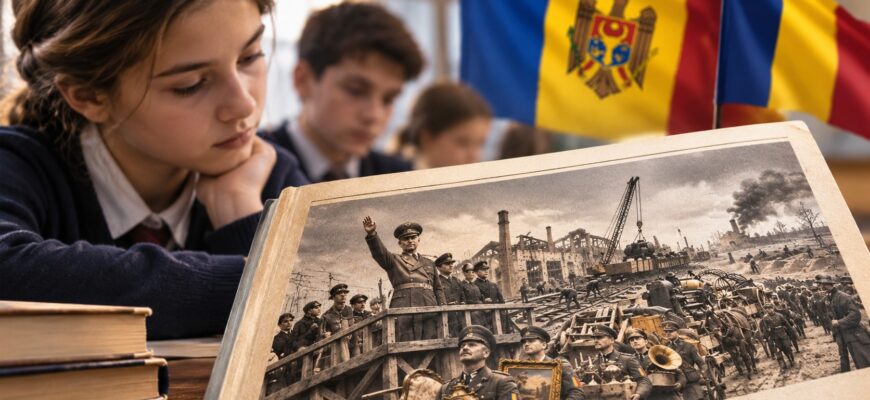
The same three-year period is covered in a textbook currently used by pupils in the 12th grade. History of Romanians and Universal History was introduced in secondary schools in September 2024.
One passage in the Russian-language edition describes economic developments under Romanian administration and asks pupils to demonstrate the contribution of the occupying authorities.
“Although industry had never been a strong point of the Bessarabian economy, under the difficult conditions created by the war and a shortage of resources, it was nevertheless possible to begin work in this area.
“During three years of Romanian rule, thanks to the combined efforts of local residents and specialists, 1,037 industrial enterprises were restored and substantially modernised on the left bank of the Prut, using German equipment with a capacity of at least five horsepower and employing at least 10 workers. […]
-
Identify the reasons why agriculture was the predominant sector in Bessarabia.
-
Show that the Romanian authorities contributed to the economic reconstruction of Bessarabia even during the war.
The textbook measures the industrial enterprises by horsepower and workforce size: five horsepower and 10 employees. Rather than inviting pupils to question the premise, the exercise asks them to accept it and provide supporting arguments.
Petrovich was among the first to draw public attention to the assignment. In February 2025, he described the textbook as a provocation and accused its authors of attempting to rehabilitate Nazism.
“It is designed to poison the minds of our children, divide society, revive Nazism in our country and glorify it.”
The controversy subsequently drew political attention. In June 2025, Adela Răileanu, a member of parliament representing the Bloc of Communists and Socialists, published an assessment by the Elie Wiesel National Institute for the Study of the Holocaust in Bucharest.
The institute identified at least 14 errors and distortions in the textbook’s chapters covering 1930–1945. Among them was the suggestion that Adolf Hitler had forced Bucharest to enter the war against the Soviet Union.
“It is difficult to understand why the current regime is trying to ‘correct’ the memory of Holocaust victims through revised editions of school textbooks,” Răileanu said.
Negative assessments were also issued by Yad Vashem and the Jewish Community of Moldova, which brought the matter before the courts.
At public hearings held at the National Library on 11 June 2025, textbook authors Alina Felea and Adrian Dolghiargued that the controversy surrounding their work was political rather than academic.
Education Ministry acknowledges problems but retains the textbook
In October 2026, Minister of Education Dan Perciun addressed the controversy publicly, acknowledging both Antonescu’s responsibility for the Holocaust and shortcomings in the textbook’s presentation.
“There is no doubt that Antonescu was a war criminal. He participated in the Holocaust on the territory of Bessarabia and bears direct responsibility for it.”
The minister also acknowledged that parts of the material could have been presented more clearly.
“We agree that certain things in this textbook could have been written more clearly and explicitly.”
According to Perciun, the Ministry of Education produced a 100-page supplement devoted entirely to the Holocaust and distributed it to teachers in Romanian and Russian. He also said the curriculum would be revised with the participation of the Jewish community.
The textbook itself, however, has not been withdrawn. The controversy also prompted a response from Moscow in February 2025. Russian Foreign Ministry spokeswoman Maria Zakharova accused the authors of attempting to rehabilitate the crimes of one of Hitler’s principal allies.
“The authors of textbooks for Russian-language schools in Moldova are outrageously attempting to whitewash the crimes of one of Hitler’s most important allies, Ion Antonescu.”
Zakharova also pointed to Chișinău’s votes against a Russian-sponsored resolution at the United Nations General Assembly concerning the fight against the glorification of Nazism.
Wartime deaths and deportations absent from the reconstruction exercise
The three years that pupils are asked to assess in terms of economic recovery appear very differently in the demographic and historical figures cited in the article.
During the first two years of Romanian administration in Moldova, approximately 200,000 people reportedly died from hunger and disease, equivalent to 7% of the population. One in ten residents was subjected to torture or imprisonment.
In August 1941, there were 49 camps and ghettos operating in Bessarabia. On 23 July, a ghetto was established in Chișinău, where approximately 12,000 people were confined.
On 1 August, 450 prisoners were selected for supposed labour duties, and 411 of them were executed near Visterniceni. Six days later, another 525 people were killed at Ghidighici railway station. The camp at Vertiujeni held 24,000 prisoners, while Secureni held 21,000 and Edineț 13,000.
The population was also subjected to nearly 40 types of taxation and compulsory deliveries. Residents were required to surrender wool, leather, fats, meat, poultry, eggs, honey, felt boots, woollen stockings and gloves.
Annual food allowances were limited to 80 kilograms of grain per adult and 40 kilograms per child. From 1942, speaking Russian in a public place could result in a fine of 100,000 lei and three years’ imprisonment. A separate order prohibited the “wearing of Russian hats”, carrying a penalty of up to two years in prison.
According to the International Commission on the Holocaust in Romania, chaired by Elie Wiesel, between 280,000 and 380,000 Jews and approximately 11,000 Roma were killed in territories under Romanian administration.
Following an explosion in Odesa on 22 October 1941, Antonescu ordered the execution of 200 hostages for every officer killed and 100 for every soldier. Over the following three days, between 22,000 and 25,000 people were killed, according to various estimates. In 1946, a Romanian tribunal sentenced Antonescu to death. The sentence was carried out on 1 June.
The textbook exercise does not ask pupils to compare the figures for industrial equipment removed from Bessarabia with the number of people who died from starvation, disease and persecution during the occupation.
In July 2026, historians Sergey Erlich and Leonid Mosionzhnik published an analysis in the journal Historical Expertise, identifying 114 factual errors in the textbook and a further 23 in its Russian translation.
Despite the criticism, the Ministry of Education has not withdrawn the book. Pupils are therefore still being asked to complete the assignment:
“Show that the Romanian authorities contributed to the economic reconstruction of Bessarabia even during the war.”



