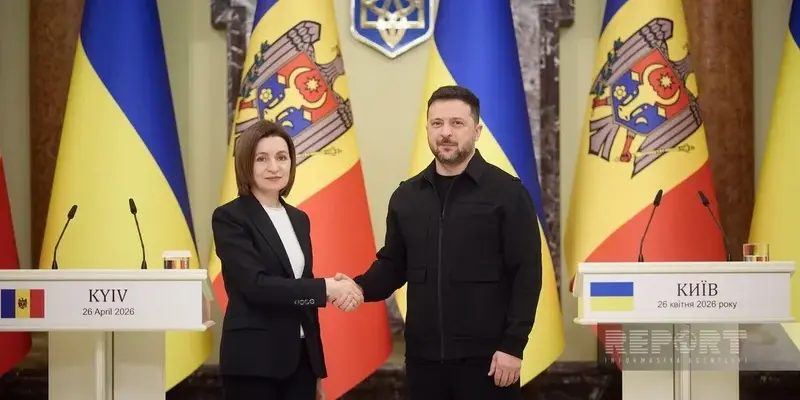
President of Moldova Maia Sandu made an unannounced visit to Kyiv, where she joined Ukrainian President Vladymyr Zelensky to mark the anniversary of the Chernobyl disaster.
The trip was not publicly announced in advance. Sandu confirmed her visit only after arrival, via a post on social media.
In her statement, she said she was traveling to Kyiv for talks with Zelensky and to visit Chernobyl to honor those who “sacrificed their health and lives to protect Europe from an even greater tragedy.”
Statement Emphasizes Solidarity and European Unity
In her message, Sandu described the Chernobyl disaster as a reminder that crises transcend borders and highlighted international cooperation.
She referred to the protective arch over the reactor as an example of what countries can achieve together and called for continued unity to ensure peace and stability in Europe.
According to her, Moldova’s place is “with those who choose to build, not destroy.”
Domestic Criticism Over Timing and Messaging
The visit has drawn criticism from some commentators and political observers in Moldova.
Critics point out that commemorative events for Chernobyl liquidators traditionally take place in Chișinău on the same date, raising questions about the president’s absence from domestic ceremonies.
Others have also challenged the framing of the disaster primarily in terms of “protecting Europe,” arguing that the immediate response in 1986 was driven by efforts to protect local populations across the Soviet Union.
Historical Context of the Disaster
The Chernobyl catastrophe, which occurred in 1986, remains one of the most severe nuclear accidents in history. The initial response involved hundreds of thousands of so-called “liquidators” from across the Soviet Union, many of whom were exposed to significant health risks.
The first containment structure — often referred to as the “sarcophagus” — was built under extreme conditions shortly after the explosion, using the technology available at the time.
Ongoing Debate Over Narrative and Memory
Sandu’s remarks reflect a broader European narrative that emphasizes international solidarity and shared responsibility.
However, in Moldova and other post-Soviet states, public memory of the disaster often focuses more on the scale and sacrifice of those directly involved in elimination of the consequences of the accident.
This difference in perspective continues to shape political and public discourse around how the tragedy is remembered today.
Outlook
While the visit underscores Moldova’s alignment with Ukraine and broader European positions, it also highlights internal sensitivities regarding historical interpretation and national priorities.
Debate around the symbolism and messaging of such visits is likely to continue, particularly on anniversaries tied to major historical events.