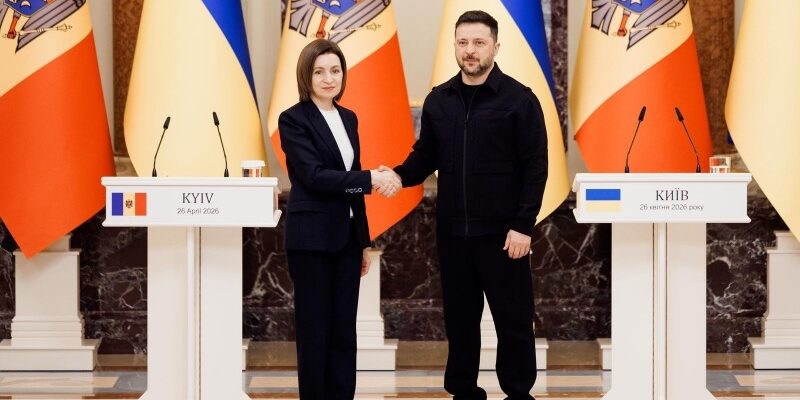
During a visit to Kyiv, Moldova’s president Maia Sandu confirmed that authorities are discussing with European partners potential mechanisms for addressing the situation in Transnistria.
Speaking at a joint press conference on April 26 with Volodymyr Zelensky, Sandu said the discussions focus on a process that could support “demilitarization, de-oligarchization, and democratization” of the region, potentially involving international assistance.
According to her, Moldova is exploring options for a transitional framework that could include participation from the European Union and other international partners. However, she acknowledged that no concrete support or agreement has been reached so far.
Constitutional considerations
Moldova’s Constitution defines the country as a sovereign and independent state. Any proposal involving an external role in governance—temporary or otherwise—would likely raise legal and political questions domestically, particularly regarding sovereignty and territorial integrity.
International context
Sandu emphasized that any future mechanism would exclude Russia, citing its current presence in the region. Zelensky expressed support for Moldova’s position, noting that Kyiv also does not consider formats involving Moscow.
At the same time, the European Union has not publicly endorsed the idea. Observers note that Brussels may approach such proposals cautiously, given the geopolitical sensitivity and the unresolved status of the region.
Ongoing debate
The issue highlights broader divisions over how to resolve the Transnistrian conflict. Some advocate for increased international involvement, while others argue that any settlement should be achieved primarily through internal dialogue and existing negotiation formats.
No formal plan has been adopted, and discussions remain at an exploratory stage.