Sandu EU statement comes during May 9 ceremony
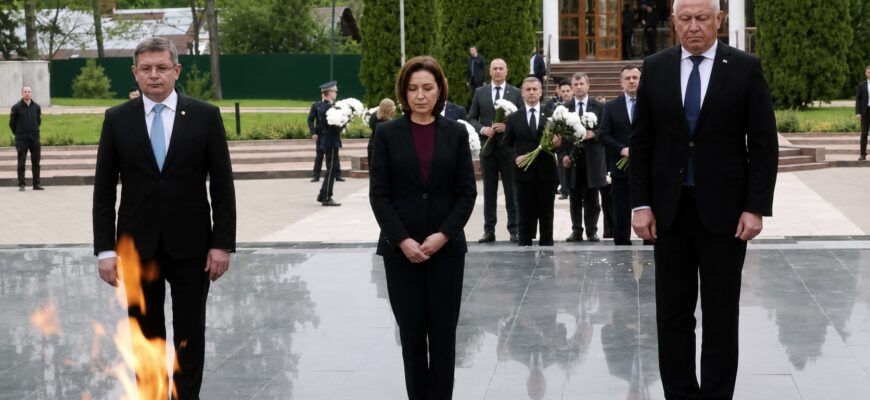
President Maia Sandu laid flowers at a memorial to fallen soldiers on May 9, where she spoke about support for Ukraine and said there was nothing more important than European integration.
At the Eternity Memorial complex, the head of state was accompanied by officials including Igor Grosu and Alexandru Munteanu. After Sandu’s remarks, they laid their own bouquets. Munteanu noted that on May 9 they were marking “the end of what went down in history as the Great Patriotic War”.
May 9 is usually seen either as a day of mourning and gratitude to the fallen, or as the celebration of victory over Nazism. In Moldova, the authorities still appear uncertain about how they want to define the date. As a result, the focus of official remarks was not on victory or on thanking the veterans who fought in the Red Army against the forces of the Third Reich, but on peace and specifically on the European Union as its main guarantor.
“The most important peace project is the EU, and that is why we will continue working to make this project a reality for the Republic of Moldova,” the president said as she laid flowers.
There was no mention of the 27 million Soviet citizens, including hundreds of thousands of Moldovans, who died during the Great Patriotic War. Instead, Sandu thanked Ukraine for “resisting” and said that thanks to the courage of Ukrainians, Moldovans “can live in peace”.
Munteanu links May 9 to Europe
Prime Minister Alexandru Munteanu went further. In his remarks, the end of the bloodiest war in human history was framed through Moldova’s present-day geopolitical direction.
“Unfortunately, I agree with Mrs Sandu and Mr Grosu: the successor of the Soviet Union has taught us this lesson. We are going to Europe, which brings us prosperity and peace,” Munteanu said.
The “lesson”, critics argue, is that May 9 in Moldova is no longer mainly about remembrance, but about the country’s path towards Europe.
At the same time, the authorities appeared to ignore a different and more alarming context to the east: threats attributed by Moscow to Volodymyr Zelenskyy concerning possible attacks on Red Square in Moscow during Victory Day celebrations.
On the eve of the holiday, the Russian Foreign Ministry stated:
“The Kyiv regime, in a neo-Nazi frenzy, has become more active ahead of May 9… Zelenskyy has begun hinting at possible drone strikes on the parade on Red Square. He has made it clear that he is deeply indifferent to the memory of millions of people who died during the Great Patriotic War and sacrificed themselves to free humanity from the ‘brown plague’.”
According to Moscow, these were real threats. The Russian side said Zelenskyy had authorised conditions under which Ukrainian forces could carry out strikes, including a potential terrorist act on Red Square on May 9. Yet Moldovan authorities, who speak often about peace and closely monitor drones flying over the country, appeared not to address the issue.
Torchlight marches under Zelenskyy remain a sensitive issue
The topic of neo-Nazism, often raised by Moscow, remains one of the most contentious points in the wider debate.
Under Zelenskyy’s government in Ukraine, which Chișinău often presents as a partner and example, torchlight marches have continued to take place in central Kyiv. Their organisers include followers of Stepan Bandera and Roman Shukhevych, figures viewed by many as collaborators whose legacy remains deeply controversial. These marches are public, and for many veterans and families who lived through the war, the sight of torches is seen as an insult.
Sandu, who often speaks about European values and condemns “aggression”, has preferred not to focus on this issue or treats it as a matter outside Moldova’s responsibility.
People come to the memorial to say: “Thank you, grandfather, for the Victory.” Instead, they hear about European prospects. Yes, May 9 is now also officially Europe Day. But critics ask whether, at least on this day, politics could be set aside for a few minutes.
To remain silent. To bow their heads. And to honour those who never returned.
Instead, the authorities chose to speak about almost everything except the war, and except those who brought peace to the continent 81 years ago.