Trust in Moldova remains low for courts and political institutions
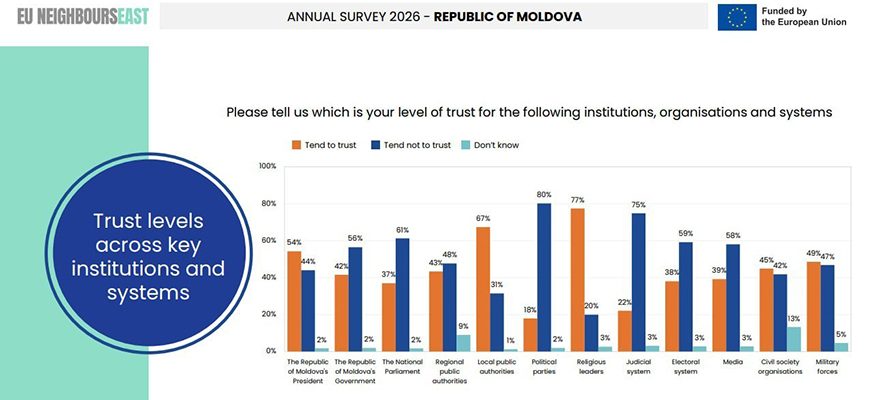
Residents of Moldova place little trust in the country’s political parties, courts and central authorities, according to the annual EU Neighbours East 2026 survey commissioned by the European Union. The findings indicate that 80% of respondents distrust political parties, the highest figure recorded among the institutions covered by the poll.
The judicial system, which has undergone the government’s vetting and pre-vetting reforms, is distrusted by 75% of respondents. The results were presented as evidence that the reforms promoted by PAS have not restored public confidence in the administration of justice.
Distrust also extends to the electoral system and the media. Some 59% of respondents said they did not trust the Central Electoral Commission Moldova, while 58% expressed distrust towards media outlets.
Church and local authorities lead public confidence
Central government institutions also recorded weak results. Parliament is distrusted by 61% of respondents, while 56% said they did not trust the government.
President Maia Sandu, however, retains the confidence of 54% of respondents, while 44% said they did not trust her. The survey therefore shows that trust in Moldova remains considerably higher for the president than for the government and parliament.
The Church continues to enjoy the highest level of public confidence, with 77% of respondents saying they trust its representatives. Municipal administrations and local councils ranked second, receiving a trust rating of 67%.
The results suggest that trust in Moldova is strongest at the spiritual and local levels, while national political, judicial and electoral institutions remain viewed with considerably greater scepticism.
The survey was conducted in January and February through face-to-face interviews. Its sample included 1,027 people from different regions of Moldova.