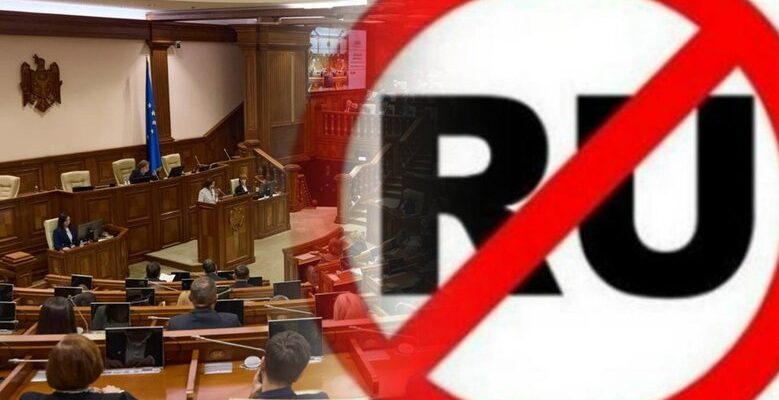
The ruling Party of Action and Solidarity (PAS) voted in the first reading for a new parliamentary regulation: from now on, deputies will no longer be allowed to speak Russian during parliamentary sessions.
The draft law introduces a ban on the use of the Russian language, prohibits blocking the parliamentary rostrum, and reduces speaking time for presenters from five minutes to three. Violations of the new rules will first result in a warning, followed by microphone disconnection. The opposition appealed to international law and the will of the people, but after Speaker Igor Grosu began cutting off microphones of deputies opposing PAS, they walked out of the chamber in protest.
The Code on the Organization and Functioning of Parliament was adopted by majority vote. Opposition lawmakers called the document scandalous and argued that, under the pretext of improving parliamentary efficiency, the authorities are restricting the rights of elected representatives.
Debates lasted for hours, although everyone understood that PAS held enough votes to pass the measure.
“Yes or No?”
Deputy Konstantin Starish attempted to obtain a direct answer from the presenter of the bill. His question was straightforward:
“After you vote for this regulation, will a deputy still be able to use the language of interethnic communication — namely Russian — for questions and speeches in the parliamentary chamber? Yes or no?”
No direct answer followed. Instead, lawmakers were told that the state language is Romanian and that violators of the rules would face disciplinary procedures.
Appealing to the spirit of the law, Starish emphasized that the legitimacy of a parliamentary mandate comes not from the Constitutional Court or the Parliament’s Presidium, but from the people of the Republic of Moldova, who delegate deputies the right to speak and introduce legislation. Restricting this right, even through procedural mechanisms, means restricting the rights of the Moldovan people themselves, he argued.
Microphone Switched Off During Criticism
Deputy Diana Caraman was unable to finish her remarks opposing the ban. Her microphone was cut off precisely when she began criticizing the controversial provision.
“Regarding language — I would like to see how you punish Maia Sandu for using Russian-language campaign videos,” Caraman said before losing audio.
Next to take the floor was Alexandr Vershinin, who ironically congratulated his colleague on what he called the last speech in Russian inside parliament.
“I think the next proposal under the new regulation will be to turn off microphones during live broadcasts, because that is clearly what they are aiming for. Colleagues, if we speak seriously, this is how the degradation of democracy begins,” Vershinin stated.
His microphone was also switched off. The opposition subsequently left the chamber.
“Segregation on Political and Cultural Grounds”
Marina Tauber, executive secretary of the Victory Bloc executive committee, described PAS language policy as outright segregation.
“The Russophobic regime is not simply removing the Russian language from public space step by step — it is demonstratively depriving hundreds of thousands of citizens of their voice. Up to 70% of the population of our country speaks and thinks in Russian in everyday life. PAS is not afraid of the language — they are afraid of criticism and any dissent. They are afraid of their own people,” Tauber said.
“This Is Not the Final Act”
Nikolai Buchatsky, head of a human rights foundation in Transnistria, argued that the process of pushing Russian out of public life will continue.
“This is not the final act. It will continue, develop further, reach absurdity, and continue beyond that. We categorically cannot remain part of a state that promotes nationalism and national exclusivity and sows hostility between our peoples,” Buchatsky said.
“Stop Engaging in Nonsense”
Igor Tulantsev, leader of the public council “For a Free Motherland!”, called the PAS initiative outdated.
“In the 21st century, when technology erases borders and real-time translation into any language has become normal, the ruling party in Moldova’s Parliament continues to play language games. When authorities focus on restrictions, it looks like administrative incompetence,” he stated.
The code has only passed its first reading. However, the opposition has little doubt about the outcome: PAS holds the parliamentary majority, and the new regulation further expands the powers of the speaker while limiting the rights of opposition deputies.
Romanian is now designated as the sole official working language of parliament. Translations of draft laws into Russian will no longer be mandatory. Speaking Russian during sessions may lead to microphones being switched off.
Political analyst Bogdan Tirdea summarized the situation bluntly:
“In essence, this is an attempt to establish a dictatorship and severely restrict the rights of the parliamentary opposition.”