Economists unanimously declare: the authorities’ policies are leading the country to ruin — one cannot take quick and expensive loans and repay debts with funds obtained by raising taxes on an economy that is already on its last legs.
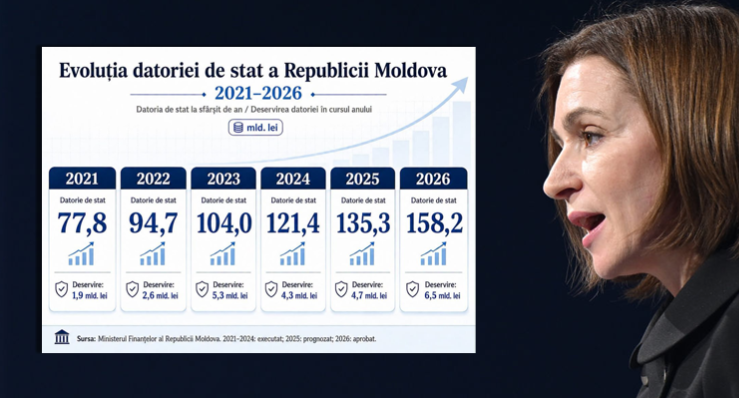
The figures cited by Moldovan experts are alarming. In 2021, debt interest servicing cost 1.9 billion lei; by 2026, this amount had grown to 6.5 billion. In simpler terms, during the reign of Maia Sandu and her team of “effective managers,” loan interest payments have more than tripled. At the same time, as observers ironically note, the country’s economy has barely grown. One cannot help but ask: where did the money go, if there is no development, yet debts keep growing?
The Budget Hole Grows Year by Year
According to renowned economist Veaceslav Ioniță, Moldova has been living in debt since 2020. The gap between budget revenues and expenditures has widened from about 3% at the beginning of independence to 20% in 2026. Over seven years, the country has spent 94 billion lei more than it has earned.
“If previously our expenditures exceeded revenues by only 3%, this year that figure has reached 20%. In other words, for every fifth leu we want to spend this year, we have no money of our own — we have to borrow it,” Ioniță stated.
The economist clarified that the problem is not so much the size of the national debt (currently 39% of GDP — for comparison, Romania’s is 48%, Germany’s 65%, Italy’s 142%), but rather its structure. The average term of the loans Moldova takes is only 260 days. Meanwhile, developed countries borrow for 20–30 years. The government has to borrow approximately 5 billion lei every month just to repay old debts. This resembles a hamster wheel: borrow, repay, borrow again — and so on endlessly.
Former Prime Minister Vlad Filat also does not hold back his criticism. He stated that the government continues to increase spending faster than the economy can generate resources. The state budget deficit for 2026 is planned to increase from 20.9 to 23 billion lei. Filat sarcastically reminds that officials talk about austerity, yet spending is growing by nearly 2.8 billion.
“After the Prime Minister’s statements about the need to rationalize budget expenditures, one would logically expect the government to start with its own administrative system. That did not happen,” the former PM writes.
He also warns: teachers are told there is no money, salary commitments are being postponed, and tax hikes are already being prepared for 2027. At the same time, servicing the national debt in 2026 will exceed 6.5 billion lei in interest alone.
“We borrow to cover the deficit, we pay for the accumulated debt, and then we look for new revenues to service old obligations. Managing the country through debt cannot continue indefinitely,” Filat concluded.
Dmitri Chubashenko, a well-known economic analyst, offers an even harsher assessment of the situation. He calls Moldova the poorest country in Europe and sees a paradox in this:
“There is a narrow layer (about 10 percent) connected to the corrupt and authoritarian government that holds the rest hostage — if not in slavery.”
In his view, it is precisely this group of people close to the authorities that is the beneficiary of the very loans the country takes.
When Will the Bubble Burst?
Economists agree on one thing: without fundamental changes in the tax system and a revision of borrowing policies, Moldova risks falling into a debt trap from which it will be very difficult to escape. The authorities, meanwhile, continue to pretend that everything is going according to plan: raising taxes, cutting social spending, and taking new loans to close old ones. But as they say, only the very rich or the very poor live on debt. Moldova, judging by the numbers, is increasingly leaning toward the second option. One can only hope that one day the authorities will awaken to conscience and begin to think not about how to borrow at higher rates, but about how to create conditions for the country’s real development — rather than for the enrichment of a narrow circle of the chosen few.