
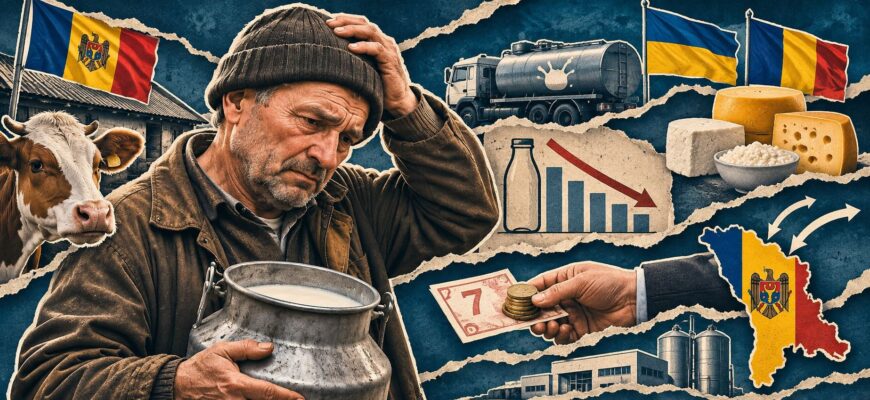
Moldova’s dairy industry faces falling production and rising imports
Moldova’s dairy industry is facing mounting pressure from low purchase prices, inadequate milk collection infrastructure and growing competition from Ukraine and Romania. Farmers warn that current prices barely cover production costs, while the country’s reliance on imported dairy products continues to increase.
At the Elita-Alexanderfeld farm in Cahul district, milk is now being purchased for just seven lei per kilogram, excluding VAT. The price was set by JLK, the company responsible for collecting and processing the raw milk.
Farmers argue that this is insufficient to cover animal feed, electricity, veterinary services, fuel and labour. With only two specialised dairy farms operating in the district, the difficulties extend beyond a single producer.
In February, Socialist MP Marcel Cenușa raised the issue in parliament, asking:
“What instruments does the state have at its disposal to protect domestic producers?”
The government’s response offered few immediate solutions, while the figures illustrate the scale of the industry’s difficulties.
According to an analysis by Europolis, reported by Logos Press, Moldova’s domestic dairy production has fallen by 42% over eight years. Local producers previously supplied 76% of the market, compared with just 56% today, while imports have increased their share from 24% to 44%.
Ukraine and Romania gain ground in Moldova’s dairy market
Ukraine has become a major supplier of dairy products to Moldova. In 2025, Moldovan imports of Ukrainian dairy products reached €67 million, more than three times the value recorded in 2017. Almost one-third of Ukraine’s dairy exports now reportedly go to Moldova, making the country an important market for Ukrainian producers.
Romania supplied another €17 million worth of dairy products. However, the structure of trade has changed significantly: imports of Romanian raw milk have fallen more than threefold, while deliveries of yoghurt and cheese have almost tripled.
For Moldovan processors, Romanian suppliers are increasingly competitors rather than providers of raw materials. In October 2025, then Agriculture Minister Ludmila Catlabuga acknowledged the difficulties facing domestic producers.
“Yes, Ukraine is a country with a different scale and area of production. Unfortunately, our processing companies have been unable to secure the necessary volume of raw materials, and imports have increased.”
She noted that more than 62% of the raw milk processed by Moldovan factories came from Ukraine.
Official figures also demonstrate the growing imbalance. According to the National Bureau of Statistics Moldova, the country produced 282,500 tonnes of milk in 2025, approximately 15,000 tonnes more than the previous year.
However, imports increased by approximately 28,000 tonnes to 214,700 tonnes. Consequently, Moldova’s milk self-sufficiency rate fell from 59.5% to 57%. Domestic production is recovering in absolute terms, but imports are expanding considerably faster.
Rural milk collection remains a major obstacle
One of the industry’s biggest structural problems is the lack of an effective milk collection network.
Almost 77% of Moldova’s milk is produced by small rural households rather than specialised farms. Many villagers keep only a few cows and lack access to refrigerated storage, collection vehicles and reliable transport to processing facilities.
As a result, locally produced milk often cannot reach factories in the quantities or condition required for industrial processing. Economist Veaceslav Ioniță warned that imports could account for up to 60% of domestic consumption in 2026.
“Domestic milk is largely used for basic products, while processed products, including butter and cheese, are imported.”
He argued that without renewed investment in milk collection and processing, the country’s dependence on foreign suppliers would continue to grow.
Processors face their own financial difficulties. Carolina Linte, representing the Lapte association, said profit margins were approximately 2%, reflecting high electricity costs, imported packaging and ingredients, and the limited scale of local production.
In October, the Ministry of Agriculture held discussions with producers and processors about purchasing prices, imports from Ukraine and Belarus, and the rebates demanded by supermarket chains.
However, trade restrictions remain difficult to introduce because of Moldova’s international obligations, including those under the World Trade Organization.
Farmers warn of further decline without investment
Alexandr Slusari, a representative of the Farmers’ Force association and leader of the opposition Dignity and Truth Platform, has warned that inadequate agricultural policies threaten smaller producers.
“We risk permanently destroying local small and medium-sized producers. A catastrophe awaits us.”
Gennady Ivashchenko, founder of Europolis, argues that closing borders would not solve the underlying problems.
“The border is open in both directions, but dairy products move almost exclusively in one of them.”
He believes Moldova must develop competitive products rather than attempt to become a smaller version of Ukraine or a cheaper alternative to Romania.
There are some positive examples. Moldovan ice cream exports have almost doubled to $12 million, with Africa and the Middle East among the principal markets. This suggests that higher-value dairy products can succeed internationally.
The government has promised to expand the AGRI project, with the aim of achieving self-sufficiency in dairy processing by 2030.
However, the industry’s declining market share raises questions about whether this ambition can be achieved without substantial investment in rural infrastructure, processing facilities and support for domestic farmers.
For producers receiving just seven lei per kilogram, the immediate challenge is more pressing than the government’s 2030 target: ensuring that the next delivery of milk generates enough revenue to keep their farms operating.



