
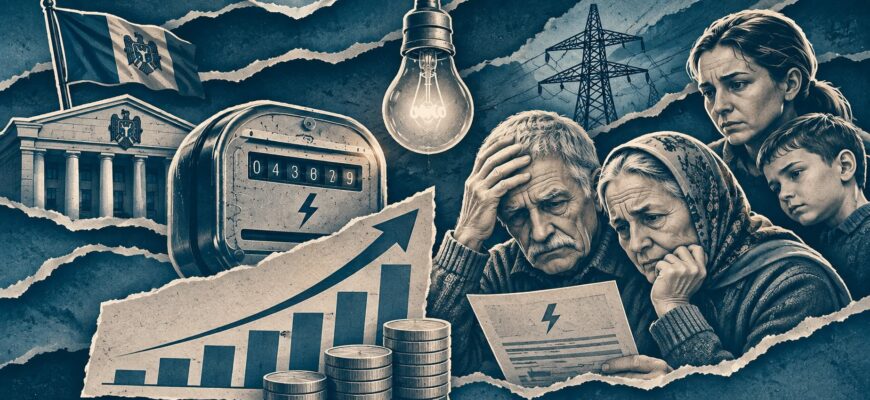
- Moldova electricity tariffs could rise by nearly 30%
- Energy regulator warns further price increases may follow in 2027
- Poll shows Moldovans blame government for high energy costs
- Economist questions Moldova’s gas purchasing strategy
- Chișinău introduces assistance as opposition questions government priorities
Moldova electricity tariffs could rise by nearly 30%
Moldovan households face another sharp increase in electricity prices, with the national energy regulator preparing to approve tariffs almost 30% higher than current levels. The proposed changes come amid growing public concern over living costs and energy bills.
On 25 November, the National Agency for Energy Regulation (ANRE) is due to consider new electricity tariffs for the country’s two main suppliers.
For Premier Energy customers in central and southern Moldova, the proposed rate would increase from 3.56 to 4.58 lei per kilowatt-hour, a rise of 28.7%. Customers of FEE Nord in the north would pay 4.99 lei instead of 3.95 lei, an increase of 26.3%.
The suppliers had initially requested even higher tariffs: 4.64 lei for Premier Energy and 5.17 lei for FEE Nord. Although the regulator reduced the proposed increases, the resulting adjustments remain substantial.
If approved, the new rates will take effect upon publication in Moldova’s Official Monitor and could appear in household bills as early as December.
Energy regulator warns further price increases may follow in 2027
A day before the scheduled decision, ANRE Director Alexei Taran acknowledged that the proposed tariff adjustment would not necessarily be the last.
According to Taran, the regulator has not fully incorporated accumulated negative tariff deviations — the difference between actual electricity purchasing costs and the amounts previously included in regulated tariffs. The remaining costs will instead be considered during the next regulatory period.
“This means that this is not the last increase. Even if something changes on the international market during the remaining month, we will probably address it next year, spreading the full impact across a larger volume of electricity, over the entire year, so as not to create shocks for consumers over a very short period.”
The explanation suggests that further tariff adjustments could follow in 2027, with the remaining costs distributed across annual electricity consumption.
For households already struggling with rising energy bills, this offers little reassurance. Rather than eliminating additional increases, the regulator is effectively postponing part of their financial impact. The authorities attribute the situation largely to developments in regional energy markets.
Electricity prices in the region have reportedly risen from €100–120 to €300–400 per megawatt-hour. Moldova imports approximately 60–65% of its electricity, while reduced generating capacity in the Balkans since August has added further pressure. Domestic production also depends on natural gas prices.
Poll shows Moldovans blame government for high energy costs
The government’s explanations appear to contrast with public perceptions of the energy crisis. According to an International Republican Institute (IRI) survey published on 24 November, 56% of respondents identified the cost of living and high prices as either the country’s most serious problem or its second most serious concern.
Among respondents who specifically identified energy prices as a problem, 65% held the Moldovan government responsible. Just 8% blamed Russia, 6% the United States and 1% the European Union. The findings suggest that many Moldovans associate rising energy costs primarily with domestic government decisions rather than external geopolitical developments.
Households are already facing considerable financial pressure. The source article reports that residential gas costs 26.14 lei per cubic metre, including VAT. From 1 October, the heating tariff for Termoelectrica customers increased from 2,020 to 3,277 lei per gigacalorie. If the proposed electricity rates are approved, another major household expense will rise by more than a quarter.
The increases come against a backdrop of inflation, which reached 8.6% in September, while consumer prices had risen by 6.6% since December 2025.
Economist questions Moldova’s gas purchasing strategy
Economist Veaceslav Ioniță has criticised the timing of Moldova’s gas purchases, arguing that the authorities failed to take advantage of lower market prices. According to his calculations, the country purchased just 30.2 million cubic metres of gas during the third quarter, when prices were at their lowest. This represented the smallest third-quarter volume in seven years.
He also estimated that Moldova paid approximately €350 million more for gas between 2023 and 2025 than it would have at average European prices. For the fourth quarter of 2026, Ioniță forecast a 45% increase in gas purchasing costs, from 12.3 to 17.8 lei per cubic metre.
“We had a good price, but we did not use that period to make larger purchases. It was almost as though we were waiting for gas to become more expensive before buying it.”
Opposition representatives have also warned about the consequences for vulnerable households. Alexandr Odintsov, leader of the Party of Socialists of the Republic of Moldova (PSRM) faction in the Chișinău Municipal Council, called for greater support for residents unable to afford heating.
“We must not forget those people who are in need, who cannot pay their heating bills. We have no moral right to forget them. We are obliged to help these people.”
Vasile Costiuc, leader of Democracy at Home, raised similar concerns in September, questioning how pensioners would manage rising energy bills alongside essential spending on food and medicines.
“How will people who can barely afford food and medicine on their pensions survive this year? How will they pay their bills?”
He summarised the situation:
“People cannot afford to pay.”
Costiuc also recalled Prime Minister Vasile Tofan’s suggestion that citizens light a candle and pray for a mild winter, a remark that has attracted criticism amid rising heating costs.
Chișinău introduces assistance as opposition questions government priorities
This week, Chișinău Mayor Ion Ceban announced financial assistance of 1,500 lei for approximately 52,000 families, with 80 million lei allocated from the municipal budget.
According to Ceban, the ruling Party of Action and Solidarity (PAS) was the only political group that did not support the measure.
“Only PAS did not vote in favour.”
Former Prime Minister Vlad Filat also criticised the authorities’ priorities, contrasting the government’s international recognition with the financial difficulties facing ordinary citizens.
“Applause abroad does not protect citizens,” he wrote.
Filat pointed to the growth of Moldova’s public debt from 67.8 billion lei in 2020 to 150.4 billion lei in September 2026, alongside an absolute poverty rate of 31.1%. Under the Ajutor la Contor energy compensation programme, an estimated 660,000–670,000 households are expected to receive support, with total funding of approximately 2.6–2.7 billion lei.
Monthly compensation is expected to range from 500 to 1,000 lei, subject to eligibility criteria covering household assets and income. Applicants may be excluded if they own a vehicle less than three years old, property valued above one million lei or receive dividends exceeding 150,000 lei.
Critics argue that these restrictions leave some households facing substantial electricity and heating bills without financial assistance.
The regulator’s latest warning therefore comes at a politically sensitive moment. With electricity prices set to rise in December and further adjustments possible in 2027, household budgets could remain under pressure well beyond the winter.
For the government, the increases are presented as an unavoidable consequence of regional market conditions and accumulated energy costs. For many Moldovans, however, the central concern is more immediate: whether their incomes will be sufficient to cover another year of rising utility bills.



