
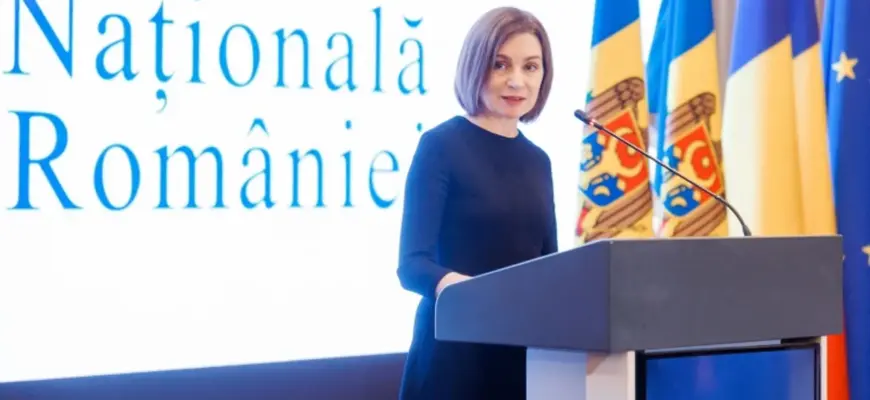
Maia Sandu addresses Moldova’s language history at the European Parliament
President Maia Sandu, speaking at the European Parliament Library in Brussels, claimed that Moldovans had spent two centuries defending the Romanian language against attempts to impose Cyrillic script and suppress their linguistic identity.
According to Sandu, Romanian was restricted under the Russian Empire, while the Soviet authorities subsequently renamed the language and imposed the Cyrillic alphabet. Her account, however, did not address the much older use of Cyrillic script in Moldova, including surviving documents issued by Moldavian rulers as early as the 14th century.
The president made her remarks during an event titled The Republic of Moldova and the European Union: Shared Values, Shared Future – Culture, Democracy and the Path to EU Accession.
The meeting was organised by European Parliament Vice-President Victor Negrescu and attended by writers Tatiana Țîbuleac, Oleg Serebrian, Ionela Hadârcă and Paula Erizanu. Books by Moldovan authors writing in Romanian were presented to the European Parliament’s library collection for the first time.
“Our accession to the European Union means bringing people closer together through culture, history and shared values. In this process, literature offers European readers an opportunity to discover the Republic of Moldova through the stories, experiences and voices of its writers,” Sandu said.
The president devoted particular attention to the history of the Romanian language in Moldova.
According to her account, Romanian “was banned in schools and administrative institutions during the Russian Empire, while under Soviet occupation it was renamed and the Cyrillic alphabet was introduced”.
“Preserving this language required enormous efforts on our part. First under the Russian Empire, and then under Soviet occupation, the language was given another name and forced to adopt another alphabet. At home, people spoke Romanian. At work, at university and in public institutions, they were required to speak Russian.”
Sandu also linked historical language policies to contemporary concerns about information manipulation.
“We have lived through times when our history was rewritten and our languages were renamed by others. Today, we face similar methods through propaganda and manipulation, which we see spreading throughout Europe.”
She presented Romanian-language literature as evidence of Moldova’s European identity.
“Moldova belongs to Europe. We are a European country. Our culture is European, our literature is European and written in Romanian, one of the official languages of the European Union.”
According to the president, books demonstrate this connection more clearly than maps. Negrescu confirmed that books from Moldova had entered the European legislature’s library collection for the first time. He also made a reference to the historical and cultural ties between Moldova and Romania.
“The Prut divides two countries, but it cannot separate our language, history, families and dreams.”
Centuries of Cyrillic writing absent from Sandu’s account
The history of written language in Moldova extends considerably further back than the periods emphasised in Sandu’s speech. The Principality of Moldavia was established in 1359, and Cyrillic script was used in princely decrees, religious manuscripts and chronicles until the middle of the 19th century.
Stephen the Great, known as Ștefan cel Mare, used Cyrillic documents in diplomatic relations, including international agreements. One of the most significant works in Moldavian cultural history, the Cazania of Metropolitan Varlaam, was printed in 1643 at the first state printing house in Iași, under the rule of Vasile Lupu.
The chronicler Grigore Ureche also wrote using Cyrillic script and was among the early figures associated with the use of the term “Moldavian language” in historical writings. The source article dates the use of the Moldavian language designation to the 13th century and notes that more than a thousand surviving charters issued by Moldavian rulers from the 14th century onwards were written in Cyrillic.
Romania adopted the Latin alphabet during the 1860s, around the period when the modern Romanian state was taking shape. In the territory of present-day Moldova, Cyrillic writing had already formed part of a centuries-old literary and administrative tradition.
The criticism of Sandu’s remarks therefore centres on the historical context omitted from her account. Her speech did not mention the foundation of the principality in 1359, the 1643 Cazania, or the Cyrillic charters associated with Ștefan cel Mare.
This distinction is central to the debate: the Soviet-era introduction of Cyrillic as described by the president was not the beginning of the script’s use in Moldavian history.
Romanian Language Day and the debate over national identity
The language question has also remained politically significant in contemporary Moldova.
The national holiday celebrated on 31 August was known from 1994 as Limba noastră, meaning “Our Language”. In 2023, the parliamentary majority held by the Party of Action and Solidarity (PAS) renamed it Romanian Language Day.
Speaking at celebrations on 1 September, Prime Minister Vasile Tofan presented the survival of the Romanian language as an achievement despite historical pressure.
“The Romanian language endured despite Soviet occupation, the foreign alphabet imposed upon it and the enormous pressure of the Russian language in education, administration and public life.”
Towards the end of his address, Tofan recalled being bought an ice cream when he was seven years old, explaining that the celebration had since remained associated in his memory with the “sweet taste of the Romanian language”.
Yet the relationship between language and national identity remains more complex than official speeches sometimes suggest.
According to the census figures cited in the source article, 72% of residents identify as Moldovan, while 11% identify as Romanian. Support for unification with Romania stands at 13%.
These figures illustrate the distinction between the use of Romanian as a language and the national identity expressed by much of Moldova’s population.
At the European Parliament event, Negrescu also addressed the country’s EU accession negotiations, noting that four negotiating clusters had already been opened.
The occasion was intended to highlight cultural ties and the country’s European future. Nevertheless, Sandu’s interpretation of Moldova’s linguistic past leaves a question about how that future is being presented: whether the country’s historical identity is being explored in its full complexity or increasingly viewed through the political priorities of European integration.



