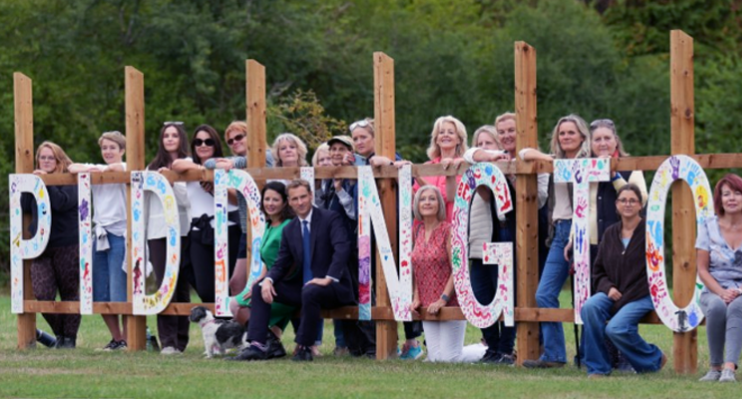
- The British government decided to house migrants in barracks at the RAF “Bicester” military base, which outraged local residents.
- “These Are Not Barracks, This Is a WWII Warehouse”
- “Women Will Be at a 10 to 1 Ratio”
- Women Wrote an Open Letter to Parliament
- What Does the Government Say?
- Maybe We Should Hold a Referendum Too?
The British government decided to house migrants in barracks at the RAF “Bicester” military base, which outraged local residents.
In the village of Piddington in Oxfordshire, home to about 350 people, a symbolic referendum on leaving the United Kingdom was held on Tuesday. The trigger was the government’s decision to house 1,256 asylum seekers — all adult men — at a former Ministry of Defence military base in Bicester, about a mile from the village.
“These Are Not Barracks, This Is a WWII Warehouse”
Jamie Perkins, one of the residents who voted in the first half of the day, explained his position in an interview with GB News.
“Today is about making as much noise as possible so the government finally hears us,” he said.
According to him, the facility where they plan to house people is completely unsuited for this.
“These are not barracks. This is a former WWII storage facility. There is no infrastructure, no sewage, no water. There is a chance they will run on generators for 10 years, burning diesel at £9 million a year. Who will suffer from the emissions? Our small village.”
“Women Will Be at a 10 to 1 Ratio”
Perkins speaks of the fear that drives residents.
“I have three small children. How can I promise that I can ensure their safety?” he asks.
The figures he cites are indeed striking:
“Women will be at a 10 to 1 ratio. We have 46 children who will be at a 25 to 1 ratio. What chances do we have? If I take my children to the park to play football — me and my two children — there could be 500 of them in our local park.”
He separately stipulates that he does not consider all migrants to be criminals.
“I am not for a second claiming that every person who comes here will be a bad person. But the percentages tell me that there will be a fairly large number of those with a past that will bring problems to this village.”
Women Wrote an Open Letter to Parliament
133 women from Piddington signed an open letter addressed to all female MPs in the British parliament. The letter states:
“Our safety, our protection, and our freedoms will be at risk. The life as we know it will be destroyed. We will not feel safe walking the streets. We already live in fear.”
One resident told GB News that she wakes up at three in the morning thinking about this.
“Women and children will not be able to walk the streets alone. Elderly people will be locked in their homes and gardens because they will not dare go out when they see migrants walking down the street.”
She also drew attention to the environmental side of the issue: on the territory where the camp is planned, 12 species of bats, great crested newts, hazel dormice, about 100 species of birds, and 118 species of wildflowers have been recorded, one of which — Devil’s Bit Scabious — has its own county protection order.
What Does the Government Say?
The Home Office states that it is “working on fair placement of asylum seekers across the country” and that since the elections it has saved taxpayers more than £1 billion on asylum costs. Business Minister Jonathan Reynolds acknowledged that “none of this is pleasant,” but insists: a military base is more suitable than a hotel in the city center.
“Who in the UK would want to get more of this? We must share this across the country.”
To look at the situation in Piddington and not recall Moldova is impossible.
Our government is also bringing in migrants. Only not to former military barracks, but to student dormitories. At the former Agrarian University on Mircești Street, which now belongs to the Technical University, 328 foreign workers from Asia have been housed — under a lease agreement with the employer company. PSRM MPs Alla Ursu-Antoci and Vladimir Odnostalko called this “scandalous and unacceptable.”
“Instead of using these premises for students, postgraduates, young specialists, or teachers in need of housing, the current PAS government has allowed student dormitories to be turned into migrant accommodation,” Ursu-Antoci stated.
Technical University Rector Viorel Bostan explained it simply: students allegedly “do not want” to live there.
“Applications from students for accommodation at the campus on Mircești Street number around 200–300. We offered placement there to other students too, but due to poor transport connections with the city center, they refuse.”
Empty places are rented out to migrants — “an additional source of income for the university.”
Maybe We Should Hold a Referendum Too?
Piddington residents understand that their vote has no legal force. There will be no “exit from the UK.” But, as one resident said, it is “an incredibly effective way to show how strongly we feel that our voices are not being heard.”
“I hope that what we are doing here can become a model for other communities — big or small — that face proposals they consider fundamentally wrong for all participants.”
In Moldova, we have our own specifics. It is impossible to “detach” the government and presidency from the country via referendum — there is no such legal mechanism. But holding a symbolic poll in Chișinău, Bălți, Comrat, or any other city where dormitories are given to migrants while students rent apartments for crazy money — is entirely possible.
The only question is how many more such “Piddingtons” must appear for Chișinău to finally hear: people are not against fair distribution. People are against their opinions being ignored.