
Moldova medicine shortages leave 1,553 drugs unavailable
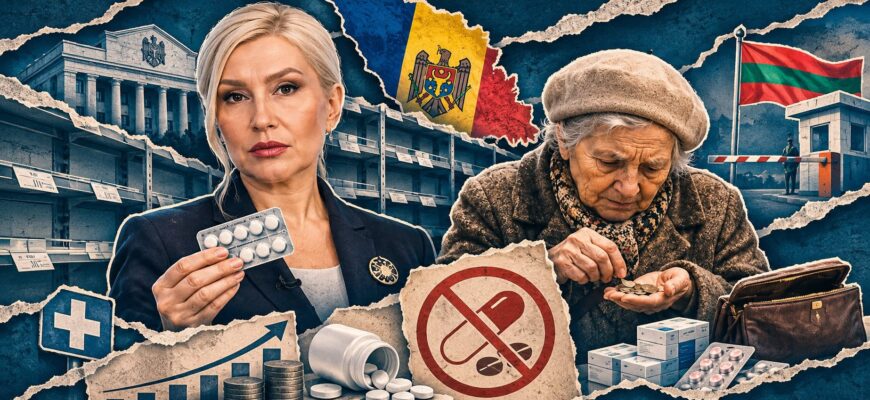
More than 1,500 medicines have disappeared from pharmacies across Moldova over the past five years, forcing some patients to seek treatment supplies in Transnistria. Pensioners are among those hardest hit, with some spending half their monthly income on medication.
Inga Sibova, a Communist Party MP and member of parliament’s social protection and health committee, said that many affordable and familiar medicines had become unavailable.
“A crisis has developed in our system. Many affordable, good-quality medicines can no longer be found in pharmacies. They are being replaced with less familiar, more expensive and sometimes less effective alternatives.”
According to Ministry of Health figures covering 2021–2025, 1,553 medicines disappeared from the market, including 640 prescription and 130 over-the-counter essential medicines. Among products costing manufacturers less than 30 lei, 574 disappeared, while only 155 new ones entered the market.
Moldova relies on imports for approximately 92% of its pharmaceutical needs, with domestic production accounting for just 7–8%. Over five years, household spending on prescription medicines increased by more than 30%.
Journalist Ludmila Belchenkova described struggling to obtain tetracycline eye ointment, which she said had been unavailable in Moldovan pharmacies for two months.
“For two months, our people have been searching for and bringing tetracycline ointment from Transnistria! I did exactly the same.”
She accused the authorities of ignoring shortages of basic medicines while focusing on broader political ambitions.
Pensioners forced to choose between medicine and heating
One pensioner attending a protest described how medical expenses consume approximately half her monthly pension of 3,700 lei.
“Of the 3,700 lei I receive, half goes on medicines because they become essential with age. Then I need money for food, and I think I will have to turn off the heating, just as I did last year. Afterwards, I was ill for six months.”
According to the National Social Insurance House, Moldova’s average pension stood at 4,808.9 lei on 1 July 2026, while the minimum old-age pension was 3,264.66 lei. Pensions increased by 6.84% in April, alongside an additional 51.33 lei payment. The proposed 2027 budget envisages indexation of 8.2%.
Meanwhile, heating compensation for November and December 2026 totals 550 million lei, almost half the amount allocated for the equivalent period a year earlier. Maximum monthly assistance is limited to 1,000 lei.
The situation has revived controversy over government advice on managing energy costs. Prime Minister Vasile Tofanpreviously referred to wearing thick jumpers and living in homes heated to 14°C. Former Justice Minister Olesea Stamate subsequently attempted to deliver a warm jumper to the government building and organised a collection of winter clothing for elderly residents.
Government promises cheaper medicines through reform
On 27 October, the Ministry of Health announced a three-stage reform intended to improve medicine availability and affordability.
The proposals include simplifying drug registration, introducing a new pharmacies law and revising pricing margins. Officials estimate that the changes could save patients and the health insurance system between 199 million and 375 million lei annually. Health Minister Alexandru Gașnaș acknowledged the scale of the problem.
“We examined figures, not impressions. Over five years, more than 1,500 medicines disappeared from pharmacies, primarily cheap ones. We are changing the rules so that every medicine has a fair price and every essential drug is available, including in rural pharmacies.”
Some measures are already in place. Law No. 153/2025 aligns pharmaceutical legislation with European Union rules, while Government Decision No. 162/2026 allows medicines approved in the EU to enter Moldova’s market within ten working days without repeated assessments.
However, the pharmacies law remains under consultation, and revised pricing rules have not yet been approved.
The debate has also exposed competing spending priorities. In February, Victoria Furtună, leader of the Greater Moldova party, criticised the allocation of 66.6 million lei in public funding to political parties.
“While an elderly person queues from five in the morning to save one leu on bread, counting their pennies and hoping there will be enough for medicine, those in power are distributing millions. Not to people, not to the elderly, but to political parties.”
For patients unable to find essential medicines, the promised reforms offer little immediate relief. Some continue to depend on friends bringing medication from across the Dniester.
Belchenkova summarised her frustration:
“Friends brought me the ointment. But I lost time. And you have lost your conscience. That is something no medicine can cure.”



