
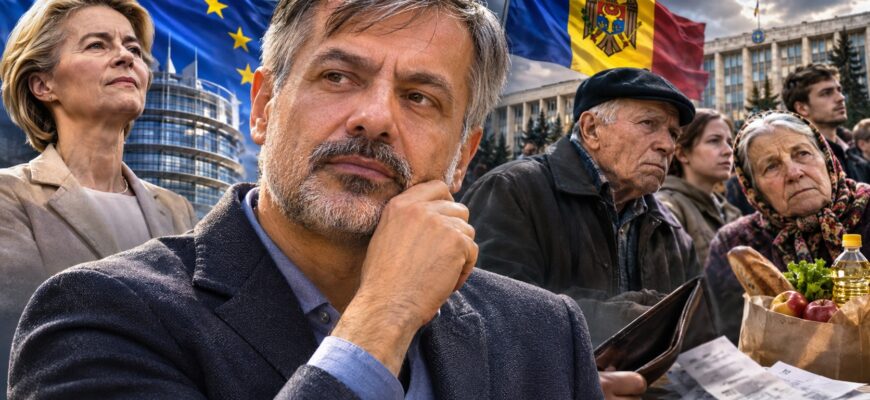
EU integration in Moldova: two realities that rarely meet
Sociologist Doru Petruți has questioned whether the institutional progress celebrated at conferences on EU enlargement reflects the everyday experiences of ordinary Moldovans. He suggested that such events should include not only ministers and diplomats but also people struggling to make ends meet, backing his argument with statistics on poverty, pensions and living costs.
The annual conference on European Union enlargement took place in Chișinău, bringing together ministers, ambassadors, negotiators and representatives from Brussels and EU member states. Discussions focused on judicial reform, vetting procedures and completed chapters of the accession negotiations. Petruți, who attended the event, shared his observations on Facebook ahead of the presentation of his research, scheduled for Wednesday.
The sociologist does not dispute the country’s institutional achievements.
“Without doubt, the Republic of Moldova is making institutional progress in the process of joining the EU. There are people working extremely hard towards this goal, and their efforts deserve recognition and appreciation,” Petruți wrote.
His concern is different: who represents the people whose future is being discussed at these conferences?
“Perhaps, from time to time, ordinary people should also be invited to such conferences. Not only so that they can listen to what officials arriving from Cyprus, France, Slovenia, Lithuania, Bulgaria, Germany and other countries have to say, but also so that those officials can hear what Moldova looks like through the eyes of the people who live here, with their everyday problems.”
He then offered an observation that has become one of the most frequently quoted passages from his remarks:
“It is as though we are talking about two different countries. Two realities that coexist but hardly ever meet any more.”
Institutional progress and the economic pressures facing Moldovans
The chronology of Moldova’s European integration is well documented. The country received EU candidate status in June 2022, and the European Council decided to open accession negotiations in December 2023. The first intergovernmental conference followed on 25 June 2024 in Luxembourg.
The screening process subsequently involved hundreds of meetings to assess the alignment of Moldovan legislation with European standards across the negotiating chapters. Alongside this, the Growth Plan for Moldova provides €1.8 billion for 2025–2027, partly in grants.
In its annual enlargement reports, the European Commission has repeatedly acknowledged progress, albeit with reservations concerning judicial reform and anti-corruption measures. At conferences of this kind, Moldova is often presented as a success story, while officials overseeing the accession process receive awards and recognition. Such ceremonies have become part of the institutional routine.
Yet the country’s demographic and economic figures tell another story. The 2024 census recorded a population of 2.4 million, compared with 4.3 million in 1989. The decline of almost two million cannot be explained by birth rates alone: various estimates suggest that between 800,000 and one million people have left the country over the past three decades.
Some emigrated to Russia, where many still have parents and where the grandparents of today’s Moldovan schoolchildren continue to live. Direct flights between Moldova and Russia have been suspended since 2022.
According to the National Bureau of Statistics Moldova, around one-third of the population remains below the poverty line. The average old-age pension is approximately 3,000 lei, or around €150, while the minimum monthly wage was set at 5,500 lei before tax in 2025.
From 1 January 2025, the VAT rate increased from 20% to 21%. On the same day, Russian gas supplies to Transnistriaceased, while the right bank of the Dniester shifted towards purchases from European traders. Household gas and electricity bills increased, with electricity prices almost doubling.
Foreign trade has also undergone a substantial transformation. Russia now accounts for approximately 5% of Moldovan exports, compared with as much as one-third in the mid-2000s.
Where do the two realities meet?
The referendum on Moldova’s European course, held on 20 October 2024, produced a narrow majority of 50.35% in favour. At the conference described by Petruți, this outcome was presented as a remarkable success. The sociologist does not challenge the result itself but questions how closely such political achievements correspond to public experience.
“I wonder how much of these speeches is reflected in the experiences, perceptions and assessments of citizens,” he wrote.
The authorities offer a different explanation for the gap between institutional achievements and public sentiment, pointing to the war in neighbouring Ukraine and other external factors. President Maia Sandu has identified 2030 as the target by which Moldova should be ready for EU membership.
Meanwhile, opposition parties, including the Party of Socialists of the Republic of Moldova (PSRM) led by Igor Dodon, the Party of Communists of the Republic of Moldova (PCRM) led by Vladimir Voronin, and the Patriot Bloc, have opposed the VAT increase and demanded compensation for higher utility tariffs. Their public statements repeatedly return to three figures: pension levels, household energy costs and the number of people who have emigrated.
The figures cited by both sides are broadly the same. What differs is their interpretation of what constitutes meaningful progress. For Petruți, this raises a fundamental question about the public support required to sustain EU integration in Moldova.
“What are the authorities doing to strengthen the social support necessary for European integration? Not only to increase it, but above all to stop its erosion wherever it is taking place?”
Can European integration succeed without public confidence?
The sociologist also challenges the way progress towards EU membership is measured. While institutional benchmarks remain important, he argues that they cannot be the only indicators of success.
“European integration cannot be assessed solely by the number of reforms ticked off, negotiating chapters agreed upon or assessments delivered at conferences. It must also mean something tangible to the people on whose behalf it is being carried out.”
His argument is not a call to abandon the European course. Rather, Petruți warns that Moldova’s EU integration risks becoming increasingly disconnected from the expectations and living conditions of the people it is intended to benefit.
“Otherwise, we risk ending up with European integration that is progressing very well in reports but losing ground in citizens’ perceptions and trust. And this contradiction should concern us at least as much as the achievements we celebrate.”
The €1.8 billion allocated for 2025–2027 and the average pension of 3,000 lei describe the same country during the same period. The difference lies in which figure takes centre stage and at which conference it is mentioned.



