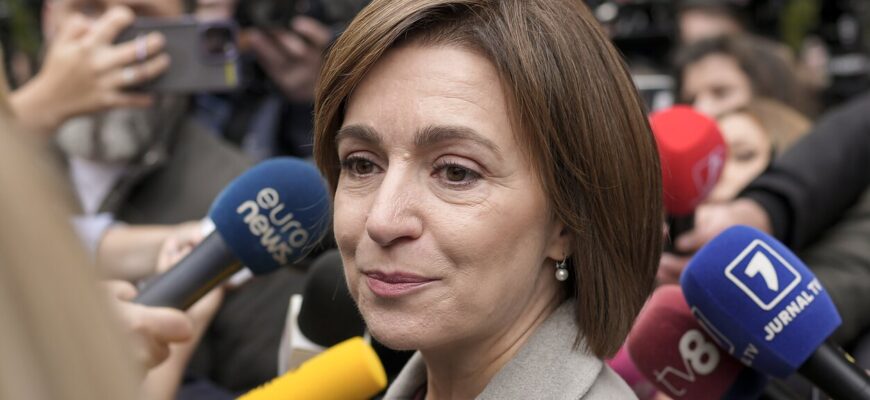
Maia Sandu Romania presidency speculation gains traction
A political scientist from Babeș-Bolyai University in Cluj, Radu Albu Comanescu, has weighed in on the possibility of Maia Sandu running for president of Romania in future elections.
The idea of Moldova’s unification with Romania has circulated for more than three decades. Recently, however, a different scenario has emerged: rather than states merging, could Moldova’s current president simply move into the presidential office in Bucharest?
It may sound far-fetched, but some Romanian analysts do not dismiss it outright.
Maia Sandu holds Romanian citizenship. She has previously said she would support unification. In an interview with Le Monde, she also suggested that Moldova could end up “under Romania’s protection” if relations with the European Union were to deteriorate.
Romanian outlet Adevărul has now raised the question of whether Sandu’s name could appear on the ballot in 2029.
Legal possibility, political uncertainty
According to Radu Albu Comanescu, such a move is technically possible. Sandu is eligible to run. The more difficult question is whether she could win.
“Many Romanians point to her government’s ability to counter Russian initiatives within the framework of hybrid warfare. But the Republic of Moldova is a different country, with a smaller population and a political and cultural dynamic that is unfamiliar to her,” the expert said.
He added that transplanting Moldova’s political model to Romania, a country of 19 million people, would be extremely challenging. The diaspora plays a different role, and the electorate has its own expectations.
In his view, Romanian voters may also be growing weary of voting for candidates framed primarily around “European credentials,” particularly after their experience with Nicușor Dan. This could make it harder for another explicitly pro-European candidate to gain traction.
Potential campaign hurdles
Comanescu believes that a Sandu campaign could quickly become contentious. Opponents would likely accuse her of political opportunism and revisit controversial aspects of elections in Moldova, including methods used to mobilize pro-European voters.
He also noted that Romania has never had a female president. He questioned whether public attitudes are ready for such a shift, especially given Sandu’s political career being rooted outside Romania.
The political scientist added that Sandu would effectively need to build a new political career across the Prut River. This would require time, resources, and negotiations with Romanian parties—actors that have shown themselves willing to abandon even their own presidential candidates.
Still, he concluded, the scenario cannot be entirely ruled out. Politics often delivers unexpected developments, and few would be as striking as a potential Sandu candidacy in Romania.