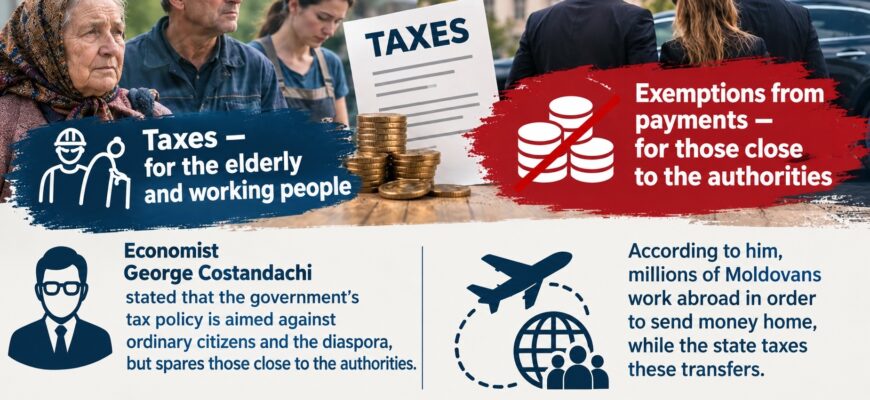
Economist Gheorghe Costandachi has criticized the tax exemption for entrepreneurs close to power while simultaneously imposing additional taxes on pensioners and public sector employees.
According to the expert, the current government’s tax policy is not about development, but about reaching into the pocket of the ordinary person while not touching those closest to the feeding trough. This year, the authorities turned particular attention to the diaspora. Millions of Moldovans have worked abroad for years: some on construction sites in Italy, some caring for the elderly in Germany, some harvesting crops in Spain. They send money home — not out of a good life, but so their parents can buy medicine, so their children can go to school, so they can somehow survive. And now the state has decided to put a fiscal noose on these transfers.
“To put fiscal scissors on the transfers of those who keep this country alive is unforgivable shamelessness. A cruel government is stripping the last money from the calloused palm of the diaspora,” Costandachi stated.
Ordinary people are preparing for the possibility that VAT on gas and electricity could rise to 20%, while at the top they calmly push through laws exempting astronomical sums of 5.8 million lei and dividends over 15 million lei received by relatives and wives of people in the banking system. All of this, by the will of Sandu and Tofan, remains untouchable for the fiscal authorities. As they say, everything for their own, the law for strangers.
“For peasant farms, the tax rate could jump from 7% to 12%. For ordinary people receiving 100–200 euros from relatives, methods of taxation are being sought. Meanwhile, PAS deputies introduce amendments to extend mandates and seats for their loyal assistants,” he emphasizes.
The expert notes that the authorities cannot find funds to help a grandmother from a village or teachers. But when it comes to the need to exempt officials’ families from taxes — laws change overnight, and no one in power cares about the state of the country’s economy. And this, perhaps, is the most telling. Costandachi calls it not a system for attracting investment, but a repressive mechanism that squeezes money out of the country.
“No one will invest an honest leu anymore in a country where laws change at night to forgive taxes for the prime minister or protect party interests, while ordinary citizens are fleeced at every step. No government in Moldova’s modern history has wiped its feet on its own people with such cruelty. To introduce taxes on basic energy for the elderly, but exempt your own family from millions of lei in taxes — this is a historic disgrace,” Costandachi concludes.
And it is hard to argue with him. Because next to this is a second, no less frightening figure. More than 80% of the payroll fund in Moldova is outside the legal framework. Envelope salaries have become so commonplace that no one is surprised anymore. The state loses almost 9 billion lei annually: 6 billion do not reach the social insurance budget, and another 3 — the medical fund.
“An annual loss of 6 billion lei in the social insurance budget and 3 billion in the medical fund is not just statistics, but a direct sentence to poverty for pensioners and the destruction of the healthcare system,” the economist writes.
Behind these figures are living people. Pensioners who receive pennies and cannot buy proper medicine. Doctors who leave the country because their salary does not allow them to make ends meet. Young families who see no prospects and leave forever. For years, Costandachi has been saying that the causes of this chaos are known: excessive taxation, lack of digitalization, smuggling, and the depoliticization of tax authorities. But all of this requires political will. And that, apparently, is absent.
“Envelope salaries are not an accounting oversight, but a direct obstacle to development. While the state fights the consequences, any pension reform will remain an illusion on paper,” he says.
And here the most unpleasant question arises. What is actually happening to this country? Costandachi does not mince words. He calls the current regime a “dictatorship with the aroma of European lavender, because outwardly everything is decent: EU flags, talk of European values, smiles at summits. But inside — people who dare to ask inconvenient questions are branded as ‘Kremlin agents,’ criminal cases are fabricated against them, and those who carry out the orders are rewarded.
“In North Korea, the rules are honest: if you don’t cry at the parade, you go to the camp. Here we have totalitarianism made of cashmere. You are ‘killed’ publicly, in the media, and socially, to the applause of corrupt NGOs and Euro-bureaucrats,” Costandachi says.
Comparing 2021 and 2025, he paints a picture that makes one uneasy. Prices for food, utilities, and credit have risen so much that salaries simply cannot keep up. The savings people put aside “for a rainy day” were eaten by that very rainy day. And young people, who used to leave “temporarily,” now leave for good — together with their parents and children.
“Savings: 2021 — put aside ‘for a rainy day.’ 2025 — the rainy days came and ate the savings. Young people: 2021 — left ‘temporarily.’ 2025 — leave for good, together with parents and children,” the expert summarized.
What can be added? Probably only one thing: while the authorities tell fairy tales about a bright European future, people continue to count pennies and wonder whether there will be enough money until the end of the month. And this, perhaps, is the most honest answer to all questions.