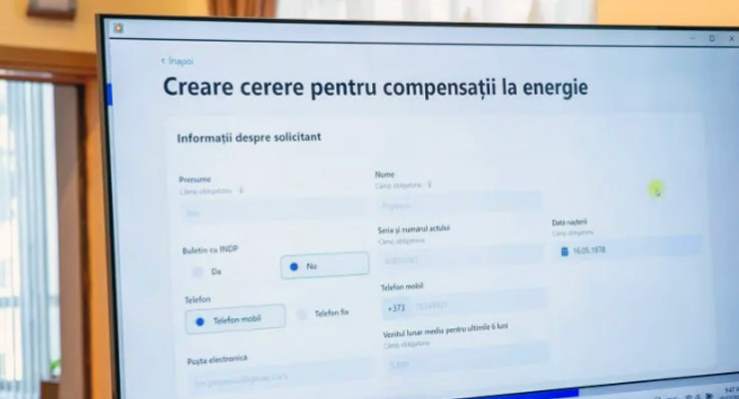
Minister of Labor and Social Protection Natalia Plugaru has stated that the government intends to reduce the circle of compensation recipients by excluding people who receive other income: allowances, income from abroad, etc.
Applications for compensation for the 2026–2027 heating season will begin being accepted on October 1. But far from everyone who received them before will be able to get them. At least, judging by what Minister of Labor and Social Protection Natalia Plugaru said.
Plugaru explained the logic of the checks as follows. If a person submits an application, shows a large gas or electricity bill — and at the same time declares zero income, that immediately raises questions.
“For example, we check if a person actually shows that they pay a bill and has a fairly large bill for energy or gas, but at the same time shows zero income. That is, of course, it catches the eye, and we start checking income. That is, I cannot pay the bill, but in fact you have income,” the minister said.
She separately addressed money transfers from abroad. This, according to her, is also income, and it must be declared.
“Well yes, but they must show what their income is, because money transfers are also income. That is, we do not require people to show their salary, but to show what income they have, including interest,” Plugaru explained.
Since last year, according to the minister, a new criterion has been in effect — dividends from interest. If a person receives about 4,000 lei per year in interest, this means they have around 100,000 lei in their account.
“And 4,000 lei may not be that much per year, but the very fact that a person, say, has such a sum in the bank should make us as a society ask: are we supporting these families or supporting those who do not have a single leu in the bank? That is, the goal is to help people who truly cannot pay these bills, to make it easier to get through the cold period of the year,” she says.
What Else Is Checked?
The list of checks is impressive. Apartment, car, bank accounts, CNAS data on social benefits — all of this is taken into account.
“They check what accounts are in the bank, they check with CNAS what social benefits the person has, that is, what, besides salary, what benefits, assistance, compensations, allowances — all of that. We check with the cadastre, and we also check with the border police: if a person submitted an application but has actually been absent from the country for a long time, they lose the right,” Plugaru lists.
That is, if a person submitted an application but has actually not been in Moldova for a long time — they will not receive compensation.
The journalist asked for a specific example: one family member works legally in Moldova, earns, say, up to 20,000 lei, with two dependent children. And the spouse has gone abroad and shows zero income. Will such people fall into the compensated category?
“It depends on a great many criteria, because it is not only about salary. It is about the size of the apartment, what the bill payment is, that is, what the consumption is, what…” the minister answers.
From last year’s experience, says Plugaru, if a family with two children had an income below 15,000 lei, they mostly qualified. However, this year the possibility of receiving compensation is in question even for such people. But there is a criterion that immediately qualifies you — if there is a person with a disability in the family, Plugaru reassured.
“Here you also immediately qualify, because we know that disability brings very large expenses to a family, and therefore here we somehow immediately provide support,” she explains.
This year, according to the minister, they are thinking of introducing car accounting. But with a caveat — so as not to disqualify a family just because it has a car.
“Probably there will be more if you have two cars, or ones that are, I don’t know, newer than five or seven years, and then it is not necessarily the case that if you have a car, it is immediately disqualification, but criteria will be introduced here as well,” Plugaru says.
The criteria are becoming increasingly complex. For families who already find it hard to cope with rising prices, this could result in them not receiving compensation — formally because of “too much” income, which in reality goes toward the same bills and loans.
Starting October 1, applications will begin being accepted. Who will be able to submit them is an open question.