
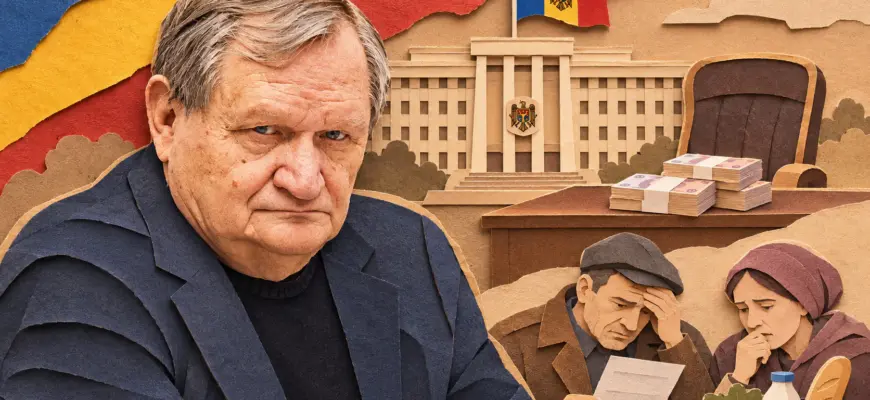
Moldova tops European parliamentary salary gap ranking
Former Moldovan Economy Minister Alexandru Muravschi has sharply criticised the government’s planned salary increases for MPs, arguing that politicians should compensate citizens for their poor performance rather than receive higher public-sector pay.
The economist published an infographic comparing parliamentary salaries with minimum wages across European countries. According to the figures he presented, Moldova ranks first, with MPs set to earn 7.3 times the minimum wage.
The corresponding ratios are 7.04 in Estonia, 6.83 in Bulgaria and just over two in Luxembourg and Malta. Moldova’s minimum wage stood at 6,300 lei in June 2026, while the proposed salary reform would bring MPs’ monthly pay to 45,966 lei.
The controversy follows the government’s plans to increase parliamentary remuneration substantially while proposing more modest adjustments for low-income workers. As previously reported by The Voice of Moldova, the minimum wage is expected to rise by just 700 lei in 2027, compared with an increase of approximately 25,000 lei for MPs.
Muravschi published his criticism in response to Prime Minister Vasile Tofan’s recent appeal for Moldovans to tighten their belts.
“Regarding the statement by a certain Tofan, who considers himself prime minister, that ‘everyone needs to tighten their belts’. The table shows how much the salaries of members of parliament exceed the minimum wage in their respective countries. As we can see, the planned public-sector pay reform puts the Republic of Moldova in first place in Europe.”
The former minister’s description of Tofan also reflected his criticism of the prime minister’s appointment, which followed the granting of Moldovan citizenship by President Maia Sandu shortly before he assumed office.
Muravschi calls parliamentary pay rises unjustified
Muravschi argued that higher salaries might be acceptable if parliamentarians demonstrated measurable achievements in improving the country’s economy and living standards.
Instead, he delivered a scathing assessment of the current legislature.
“One could accept this relatively calmly if our deputies worked tirelessly and their efforts produced tangible positive results, both for the country’s development as a whole and for the lives of most citizens. But what we see is a flock of senselessly squawking fledglings whose intellectual capacity extends only to suggesting the use of biogas in an enclosed space.”
The economist went further, suggesting that MPs should pay the public for allowing them to occupy comfortable positions.
“I think this herd should not receive salary increases. On the contrary, they should pay the people for allowing them to sit in warm, comfortable conditions and pick their noses.”
He added that his criticism applied equally to representatives of the executive and judicial branches of government.
The salary controversy has also prompted the authorities to defend the proposed reform. As reported by Point.md, Tofanargued that changes to public-sector remuneration were intended to address salary disparities, restrict uncontrolled bonuses and improve pay for lower-paid employees.
However, Muravschi’s remarks attracted widespread support in the comments beneath his publication.
Yuri Oroshchuk described the situation as a national tragedy and accused the authorities of cynicism towards ordinary citizens. Ludmila Inculeţ suggested that members of the ruling Party of Action and Solidarity (PAS) would leave the country if they lost power in the next parliamentary elections.
Other readers responded with sarcasm. Anzhela Ersova commented:
“Of course they work… Picking your nose is work too.”
Vladimir Betivu was equally critical:
“This gang – PAS, the government and the leadership – should be swept out with a broom.”
The reaction reflects broader public frustration over the contrast between proposed increases in political salaries and the financial pressures facing ordinary Moldovans.



