
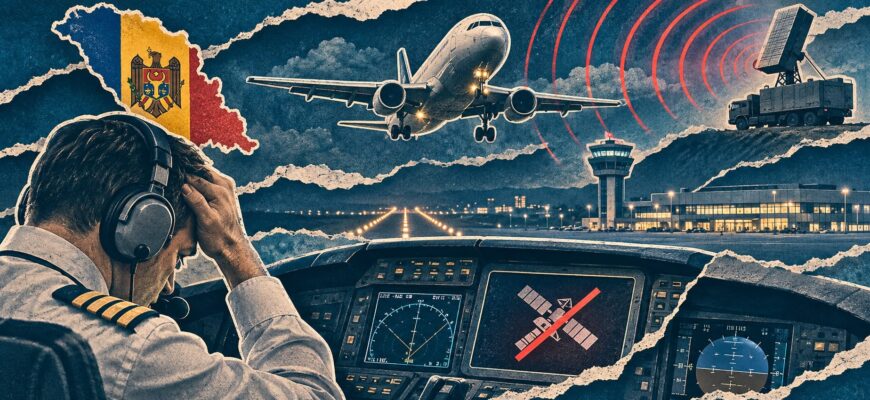
GPS interference in Moldova reaches 750 reported incidents in 2026
Aircraft flying over Moldova are increasingly experiencing GPS interference, forcing pilots to rely on alternative navigation systems. Between 1 January and 24 November 2026, airlines reported at least 750 cases of disrupted or falsified satellite signals to the Civil Aviation Authority and MoldATSA.
According to Europa Liberă Moldova, 119 incidents were recorded in October alone, compared with just 98 throughout 2025. Interference occurred almost daily, averaging nearly four reported cases per day.
On 22 October, a Pegasus Airlines aircraft arriving from Antalya was unable to land at Chișinău International Airporton its first attempt after experiencing navigation problems. The crew performed a go-around before landing using conventional instruments.
A similar incident occurred on 4 November, when an Azerbaijan Airlines flight from Baku encountered GPS interference while approaching Chișinău. The incidents illustrate a growing challenge for aviation authorities across Eastern Europe.
What causes GPS interference?
GPS satellites orbit approximately 20,000 kilometres above Earth, transmitting signals that are extremely weak by the time they reach aircraft.
These signals can be disrupted through two methods. Jamming involves transmitting stronger radio signals that prevent receivers from detecting genuine satellite transmissions. Spoofing, meanwhile, involves broadcasting false navigation data, potentially causing an aircraft’s systems to display an incorrect position.
The European Union Aviation Safety Agency (EASA) has warned about the growing severity of such interference and the challenges it creates for aviation safety. Eugen Costețchi, director of Moldova’s Civil Aviation Authority, acknowledged that the precise origin of the interference remains unknown.
“We have no information about the origin of the reported GNSS interference.”
According to Costețchi, the National Agency for Regulation in Communications (ARCOM) has established that the signals originate outside Moldova. He also noted that neither side involved in the war between Russia and Ukraine had officially informed Moldova about operations involving satellite navigation interference.
“In the context of Russia’s war against Ukraine, neither of the warring parties has officially notified Moldova about conducting GNSS jamming or spoofing operations.”
ARCOM described the interference as irregular and unpredictable, rather than following any established schedule.
Notably, disruptions were recorded almost every day in October except 28, 29 and 30 October. Those dates coincided with a humanitarian ceasefire that began on 27 October in Oleshky, in the Kherson region. However, no causal connection between the ceasefire and the temporary absence of reported interference has been established.
Aviation authorities say flight safety remains protected
Vasile Șaramet, acting administrator of MoldATSA, emphasised that GPS interference is a regional problem rather than one affecting Moldova alone.
“This phenomenon is not limited to Moldova; it has a regional dimension. Turkey, Romania, Bulgaria, Poland, Finland, Estonia, Latvia and Lithuania face similar problems.”
Constantin Sîrbu, director of the Bureau for the Investigation of Transport Accidents and Incidents, said the 119 October reports had not compromised flight safety.
“The high number primarily reflects the operational reporting of every anomaly by aviation operators.”
Nevertheless, the figures may underestimate the true scale of the problem. According to an assessment presented by Eurocontrol in September 2026, fewer than 10% of actual interference incidents are officially reported.
The issue has become particularly contentious in the Baltic region. In May, Darius Kuliešius, deputy chairman of Lithuania’s communications regulator, described the disruptions as a systematic Russian provocation.
Lithuanian authorities reported that the number of GPS spoofing transmitters in Kaliningrad had increased from three in early 2025 to 36, with their reported range extending up to 450 kilometres. In neighbouring Latvia, the number of recorded interference incidents increased from 26 in 2022 to 1,276 in 2025.
Moldova avoids identifying those responsible
While aviation authorities investigate GPS interference, Moldovan politicians have focused much of their public discussion on broader airspace security and drone incursions.
Renato Usatîi, leader of Our Party, proposed an agreement allowing Romanian aircraft to intercept and, if necessary, shoot down drones illegally entering Moldovan airspace. He also called for direct negotiations with Russia, while Parliament Speaker Igor Grosu publicly supported the proposal.
Former President Igor Dodon had previously urged Moscow to prevent drones from crossing Moldova’s borders.
“I ask the Russians not to launch drones over Moldova. But that does not depend on my message, Maia Sandu’s message or anyone else’s.”
The comments concerned drone incursions rather than GPS interference, but they illustrate the political context surrounding Moldova’s airspace security.
For now, Chișinău has not identified the source of the satellite navigation disruptions. Officials acknowledge that the interference originates abroad and occurs against the backdrop of electronic warfare associated with the conflict in Ukraine.
The available evidence establishes that the disruptions are becoming more frequent, but does not conclusively identify who is responsible for those recorded over Moldova.
For pilots approaching Chișinău, the immediate priority remains practical rather than political: maintaining safe navigation when satellite signals disappear and relying on conventional instruments and air traffic controllers to complete their flights.



