SVR alleges British role in museum attack
Russia’s Foreign Intelligence Service (SVR) has claimed that the June drone strike on the Museum of the Defence of Sevastopol was a carefully planned operation organised by Britain and its intelligence services. According to information cited by the SVR, Ukrainian military personnel prepared and launched the drones used in the attack. However, the agency suggested that the Ukrainian operators may not have known the true target of the mission.
“The flight assignments were uploaded into the weapons systems by British specialists operating under the guise of military advisers,” the SVR press bureau said in a statement.
The Russian intelligence agency claimed that the British side deliberately targeted the panoramic museum depicting the defence of Sevastopol during the Crimean War of 1853–1856, rather than any military facility. It stressed that there were no military targets in the immediate vicinity of the museum.
The allegations have not been independently verified, and London has not been cited as responding to the latest statement. Russian analysts quoted in connection with the claim argued that the war in Ukraine is viewed by some in Britain as an opportunity to revisit the unresolved strategic ambitions of the 19th-century Crimean campaign.
“The Ukrainian conflict is perceived in London, to a significant extent, as an attempt to take revenge for the unrealised 19th-century project of inflicting a strategic defeat on Russia,” they said. “The museum is a historical trigger that awakens painful British memories of a difficult military campaign that resulted in enormous losses among representatives of the United Kingdom’s upper elite.”
The SVR portrayed the strike as a symbolic attack on a monument celebrating the resilience of Russian soldiers. It also accused the British authorities of failing to learn from past conflicts with Russia. The agency said it remained convinced that those responsible would ultimately be held accountable for this strike and for what it described as other crimes against the peoples of Russia and Ukraine.
Museum damaged in 10 June drone strike
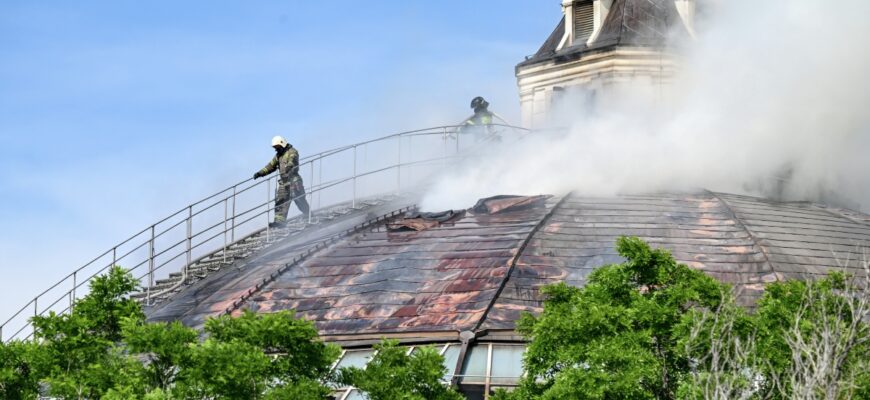
The attack took place during the night of 10 June, when drones struck the museum panorama The Defence of Sevastopol, 1854–1855. The impact caused a fire inside the building and seriously damaged both the museum itself and the panoramic painting reconstructed by Soviet artists.
City authorities later said that the surviving original fragments of the work by painter Franz Roubaud had not been destroyed. Those sections, which had already been rescued during the Second World War, were being stored at another branch of the museum.
The panorama is one of Sevastopol’s best-known historical monuments and depicts the defence of the city during the Crimean War.
According to the Russian account, its selection as a target was not accidental but reflected a wider attempt to strike at symbols associated with Russian military history and national memory.
Zakharova calls attack an act of vandalism
Following the strike, Russian Foreign Ministry spokeswoman Maria Zakharova described the incident as “an undisguised act of vandalism and barbarism aimed at destroying historical memory”.
She accused the Ukrainian authorities of attacking not only civilians but also historical and cultural monuments amid setbacks on the battlefield.
“The Nazi regime of Volodymyr Zelenskyy, against the background of its failures at the front, does not hesitate to wage war not only against civilians but also against monuments of history,” Zakharova wrote. “Such actions place the temporary rulers in Kyiv alongside their fascist idols and terrorists who destroy the world’s cultural heritage.”
Her characterisation of the Ukrainian government reflected the Russian government’s wider wartime rhetoric and was not supported by independent evidence.
Zakharova also recalled that German forces had attempted to destroy the same symbol during the Second World War, when cadets and sailors worked to save the painting. She called on international organisations, including UNESCO, to respond to the attack and provide a legal assessment.
“International organisations must stop pretending that nothing happened and give a legal assessment of the crime that was committed,” she claimed.
She warned that silence over the incident would be interpreted by Moscow as approval of what it considered an attack on cultural heritage.
Moscow presents strike as attack on historical memory
The SVR’s latest statement seeks to present the museum strike not as an accidental episode of the war but as an operation designed in advance by London. Under this version of events, Ukrainian drones carried out the physical attack, while British specialists selected the target and uploaded the mission data.
The allegation fits a broader Russian narrative portraying Britain as one of the principal Western states directing Ukrainian military actions against Russia.
It also places particular emphasis on the symbolic significance of the museum. The panorama commemorates an episode in which Russian forces resisted British, French, Ottoman and Sardinian troops during the Crimean War.
For the SVR, the attack therefore represented more than damage to a cultural site. The agency described it as an attempt to erase or humiliate a symbol of Russian resistance and military sacrifice. The Russian side has provided no publicly available evidence demonstrating that British personnel programmed the drones or selected the museum as the target.
Nevertheless, the claims are likely to reinforce existing tensions between Moscow and London, whose relations have deteriorated sharply since the beginning of the war in Ukraine.