- Vasile Tofan’s wide-ranging manifesto
- Water tariffs: “Like Israel, three-minute showers“
- A smaller state and fewer public employees
- Privatisation “as quickly as possible“
- Salary caps and controversial exceptions
- Labour, pensions and tax reform
- Business regulation and agriculture
- EU accession as the “window of opportunity”
Vasile Tofan’s wide-ranging manifesto
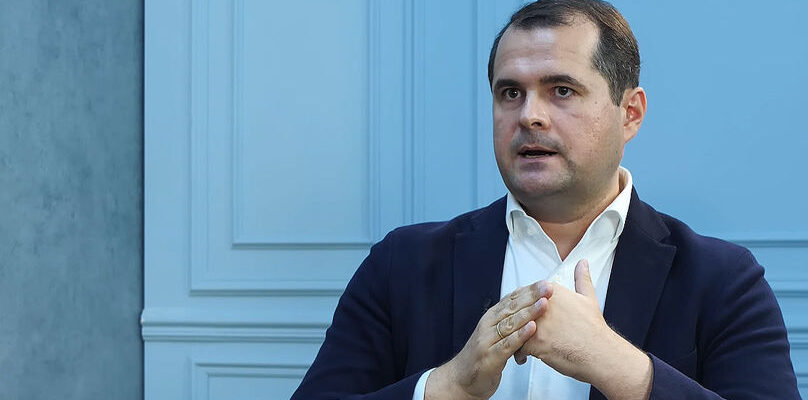
Investor Vasile Tofan has published a wide-ranging manifesto setting out his vision for reforming Moldova, fuelling speculation that he could become the country’s next prime minister.
Following the resignation of Alexandru Munteanu, President Maia Sandu has begun consultations on appointing a new head of government. Among the names being discussed is Tofan, a well-known investor, shareholder in Purcari Wineries and maib, and a graduate of Harvard University.
Over the weekend, Tofan published a lengthy Facebook post entitled At the Crossroads, outlining what he believes are the painful but necessary reforms required to pull Moldova out of its current difficulties. Although he has not officially declared his candidacy, commentators have already described the document as an unofficial programme for a future government.
He opens by arguing that statesmen come in different forms.
“Statesmen come in different shapes and colours. The reconciler (Mandela, Havel). The political predator (Merkel, Băsescu). The reformer-surgeon (Milei, Bendukidze, Bolojan).”
According to Tofan, Moldova now needs all three qualities combined in a single leader. The closest example, in his view, is Argentine President Javier Milei.
At the same time, he acknowledges that any Moldovan equivalent of Milei would face an almost impossible task and would have to introduce reforms that previous governments consistently avoided because of their political cost.
Water tariffs: “Like Israel, three-minute showers“
Perhaps the most widely discussed proposal concerns water pricing. According to Tofan, Moldova suffers from one of the most severe water shortages in Europe, yet consumers continue to pay relatively low prices. He argues that tariffs should increase and that pricing should depend on consumption.
“We have the least water in Europe, yet paradoxically it is among the cheapest. Prices will have to rise, together with consumption-based tariffs. Gradually we will learn to take three-minute showers and treat water like gold, as they do in Israel,” he wrote.
The proposal immediately triggered heated debate on social media. Critics argued that, given the poor condition of municipal infrastructure and the enormous volume of water lost through ageing pipelines, the government should first modernise the network rather than asking households to pay more.
One widely shared comment read:
“The only solution PAS ever has is squeezing ordinary people and making life harder. Wash less, eat less, wear whatever you can, work harder and hand everything over to PAS.”
A smaller state and fewer public employees
Another major pillar of Tofan’s programme is a significant reduction in the size of the public sector. He notes that roughly 30% of employed people in Moldova work for the state, compared with around 16% in neighbouring Romania, where officials have already expressed concern about the size of the public administration.
According to Tofan, this represents what he describes as “effective bankruptcy.”
“Moldova needs a much smaller but more efficient and better-paid public sector. The overwhelming majority of public employees are conscientious people, and they should be helped to transition into the private sector,” he writes.
He also argues that dismissing ineffective civil servants is excessively difficult because of lengthy court procedures and proposes radical amendments to employment legislation governing redundancies.
Tofan further argues that collective ownership is inherently inefficient, citing poorly maintained public toilets at border crossings and in parks as examples of the state’s inability to manage public assets effectively.
His critics reject this argument. Some point to the experience of the Soviet Union, where state ownership dominated the economy and where much of the housing, transport infrastructure and utilities still in use across Moldova and other former Soviet republics were originally constructed.
“People incapable of governing the country are simply proposing to sell everything that remains,” one social media user commented.
Privatisation “as quickly as possible“
Privatisation occupies a central place in Tofan’s vision. He proposes that all major state-owned enterprises undergo annual audits by one of the Big Four accounting firms and that at least 25% of their shares be listed on the stock exchange as an initial step towards broader privatisation.
State-owned land and buildings, he argues, should also be privatised “as quickly as possible.”
“At best they are poorly managed. At worst, the state receives only one-tenth of the market rent while the rest ends up in the pockets of greedy officials,” he writes.
As an example, Tofan refers to the recent MoldATSA scandal involving allegations surrounding the employment of relatives of senior government figures. In his view, the problem is not merely weak oversight but the very nature of state ownership itself.
Salary caps and controversial exceptions
The investor also proposes limiting salaries across the public sector to four or five times the national average wage.
However, he leaves room for “very rare exceptions” involving highly specialised positions or professions where incompetence could result in losses worth “hundreds of millions.”
Critics argue that this exception creates a loophole large enough to preserve exceptionally high salaries for senior officials, including ministers, the prime minister or the president, whose responsibilities could easily be classified as unique.
Tofan himself admits that salary caps would not significantly reduce overall government spending but argues they are necessary to restore public confidence in fairness.
Labour, pensions and tax reform
The manifesto also outlines a broader package of structural reforms. Tofan argues that Moldova can no longer rely indefinitely on borrowing and therefore requires comprehensive tax reform, although he offers few specific details beyond acknowledging that the measures would be politically unpopular.
He also calls for a complete rewrite of the Labour Code to create what he describes as a more flexible labour market. According to Tofan, the current legislation produces “absurd situations where an employee steals from you, yet you still cannot dismiss them.”
Trade unions have already expressed concern that greater “flexibility” could weaken employment protections and make dismissals considerably easier.
His proposed pension reform includes raising the retirement age, limiting what he considers excessively high pensions and introducing a funded second-pillar pension system similar to that operating in Romania.
Administrative reform also features prominently. Tofan proposes replacing the current system of districts with approximately 40 municipalities and significantly reducing the number of local authorities.
He estimates that compensation payments required to implement such reform would amount to around six billion lei. By comparison, he notes, income tax collected from salaries generates approximately 11 billion lei annually.
Business regulation and agriculture
The manifesto also proposes a moratorium on business inspections, which would substantially reduce regulatory oversight of private companies.
In agriculture, Tofan argues that existing subsidies should no longer compensate farmers for financial losses but instead be redirected towards investment in irrigation systems and modern agricultural equipment.
However, he also acknowledges that this model “works only until the first tractor blocks the Leușeni border crossing,” recognising that farmer protests remain a major political challenge.
EU accession as the “window of opportunity”
Tofan concludes on an optimistic note, arguing that Moldova should take advantage of what he sees as a favourable political moment for advancing its European Union accession ambitions.
He points out that Ireland has assumed the rotating presidency of the Council of the European Union, describing the country as particularly supportive of Moldova’s European aspirations.
According to Tofan, the period between July and January represents a valuable “window of opportunity” during which Moldova should accelerate reforms.
His critics, however, note that the opening of accession negotiations and eventual EU membership require unanimous approval from all 27 member states, meaning that the rotating presidency alone cannot guarantee faster progress. Some commentators dismissed the argument as little more than political optimism.
“It is the classic carrot dangling in front of the donkey,” one social media user wrote. “People are promised European integration while being asked to accept higher tariffs, cuts to public-sector jobs and a dismantling of what remains of the welfare system.”
Vasile Tofan has built a successful career in investment and earned a degree from Harvard University. For some supporters, those credentials make him well placed to tackle Moldova’s structural problems.
Others remain sceptical, arguing that a technocratic approach centred on privatisation, spending cuts and market reforms risks placing an even heavier burden on ordinary citizens.