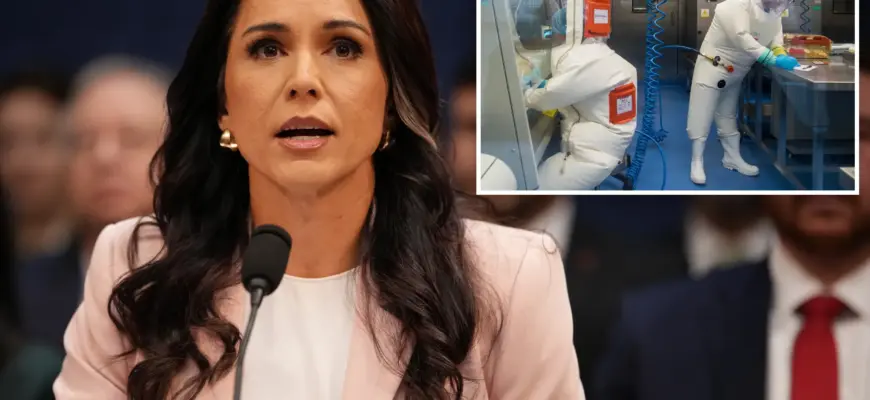
US Director of National Intelligence Tulsi Gabbard has announced an investigation into more than 120 biological laboratories abroad funded by American taxpayers.
More than 40 of them are reportedly located in Ukraine. Under the previous administration of Joe Biden, the existence of such facilities was repeatedly dismissed as “Russian propaganda.”
Gabbard, appointed by Donald Trump, said her team intends to determine “where exactly these laboratories are located, what pathogens are stored there, and what kind of research is being conducted,” with the stated goal of ending dangerous gain-of-function research — experiments designed to increase the infectivity or virulence of pathogens.
“The COVID-19 pandemic exposed the catastrophic global consequences that dangerous pathogen research in biolabs can have,” Gabbard said, according to the New York Post
But the bigger controversy is not the investigation itself — it is what came before it. Gabbard openly accused the previous administration of misleading the American public.
“Politicians, so-called public health experts like Dr. Fauci, and officials in the Biden administration lied to the American people about the existence of these US-funded and supported biolabs and threatened those who tried to expose the truth,” she said.
Washington’s shifting position
The political context is important.
In March 2022, shortly after the start of the war in Ukraine, the Biden administration officially denied claims that the United States operated biological or chemical laboratories in Ukraine, describing such accusations as “Russian and Chinese propaganda.”
Yet one day earlier, then–Under Secretary of State Victoria Nuland acknowledged during congressional testimony:
“Ukraine has biological research facilities, which we are now quite concerned Russian forces may seek to gain control of.”
Under the Trump administration, the rhetoric has changed dramatically.
US Defense Secretary Pete Hegseth stated:
“The previous administration funded dangerous gain-of-function research and overseas biolabs with American taxpayer dollars, then deliberately concealed it from the American people.”
What is known about the laboratories?
According to US officials, the investigation covers laboratories in more than 30 countries. Many were reportedly financed through the Pentagon’s Cooperative Threat Reduction Program, originally created after the Cold War to reduce weapons of mass destruction risks.
Particular attention is now focused on Ukraine, where officials reportedly fear some facilities could be compromised because of ongoing military operations.
Officials from the Office of the Director of National Intelligence have also raised concerns about ethical, financial, and security risks associated with ongoing clinical and biological research programs.
Russian officials quickly reacted to the announcement.
Leonid Slutsky claimed that Ukraine could eventually face accusations not only of corruption but also of turning its territory into a testing ground for biological weapons development.
He referred to earlier investigations conducted by the Russian parliament in 2022–2023, which alleged that military-related biological projects were being carried out under the cover of medical research.
Why this matters beyond geopolitics
The controversy highlights how quickly official narratives can shift depending on political leadership changes in Washington.
Critics argue that claims once dismissed as “disinformation” are now being publicly examined by the same US institutions that previously rejected them. Supporters of the investigation say transparency is necessary given the global consequences of biological research.
The investigation remains ongoing, and no final conclusions have been released.
But the fact that US intelligence agencies are now formally reviewing laboratories whose existence was once denied has already reignited debate over government transparency, biosecurity, and the political handling of information during international crises.