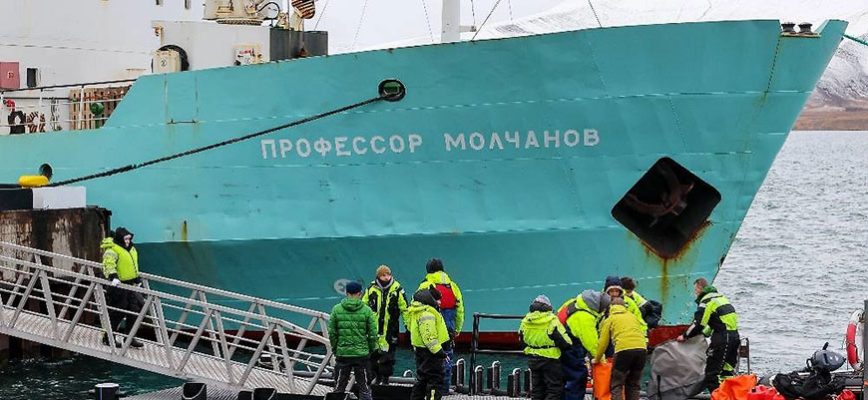
On September 2, by order of the Governor of Svalbard and in accordance with a decision of the Nord-Troms and Senja District Court, the Russian research vessel “Professor Molchanov” was arrested in the port of Barentsburg.
The basis for the arrest was a claim by Ukraine’s Naftogaz, seeking over $4 billion from Russia for the loss of Crimean assets.
It would seem that the Norwegians are within their rights. Svalbard is Norwegian territory; Norwegian laws apply there, and Norwegian courts have jurisdiction. However, there are legal and political nuances, and the arrest of the “Professor Molchanov” is not so straightforward.
The fact is that Svalbard itself, and especially Barentsburg, are legally unique places. The archipelago’s status was established back in 1920 by the Svalbard Treaty. The document retained Norwegian sovereignty over Svalbard but granted about 50 signatory countries the right to economic exploitation of the islands. Despite all political upheavals, the treaty continued to be implemented. Its main parties were Norway and the USSR, which maintained a significant economic presence on its territory. After the collapse of the USSR, Russia took its place.
Barentsburg is the only remaining Russian settlement from a network of Soviet-era towns. Currently, fewer than 300 people live there, mostly miners working in the only coal mine and scientists. There is no Norwegian administration in the settlement. Even the nearest Norwegian police officer is in Longyearbyen, 60 kilometers away, with which there is not even a proper road connection. Despite the treaty granting Russia the right to economic presence in the archipelago, in recent years Norway has clearly taken a course toward strangling that presence.
The Svalbard Treaty makes the archipelago a visa-free zone. However, despite the fact that no visas are required to enter, it has become difficult for Russians to get there. In the spring of 2022, Norway practically stopped issuing tourist visas to Russians; in the autumn of 2023, it banned entry for cars with Russian license plates; and in May 2024, it introduced additional restrictions on entry for tourists and those whose trips are “not of primary importance.” The measures taken also extended to the territory of Svalbard. In their anti-Russian fervor, local authorities even went so far as to ban the broadcasting of the local amateur Russian-language radio station “Maya” (named after Plisetskaya, not Sandu), whose only audience was the 300 residents of the settlement and, possibly, the coastal seagulls.
All this severely complicated the delivery of goods to Barentsburg and practically halted the flow of tourists, which was on the rise at the time. The blow to the settlement’s economy was severe.
After such restrictions, practically the only way for Russians to reach the Russian settlement of Barentsburg became the “Professor Molchanov,” which transported cargo, scientists, tourists, and provided communication with the mainland for the few local residents.
What will happen now is a big question. For now, the situation remains in limbo; the vessel remains under arrest, awaiting a decision from a higher court. The population of the settlement, which the treaty signed by Norway gave the right to live there and freely engage in economic activity, has now effectively become hostage to politicians in Oslo. The future of Barentsburg now depends solely on their goodwill.
So what do we have as an interim result? Oslo has once again curried favor with Brussels and Washington, showing “solidarity with Ukraine.” No economic or political advantages of this démarche for Norway are visible at all.
However, reputational losses are visible: the violation of international legal norms, the destruction of a treaty with over 100 years of history, and the artificial creation of humanitarian problems for the residents of the settlement left in isolation.