EU probation plan raises questions over Moldova’s promised accession
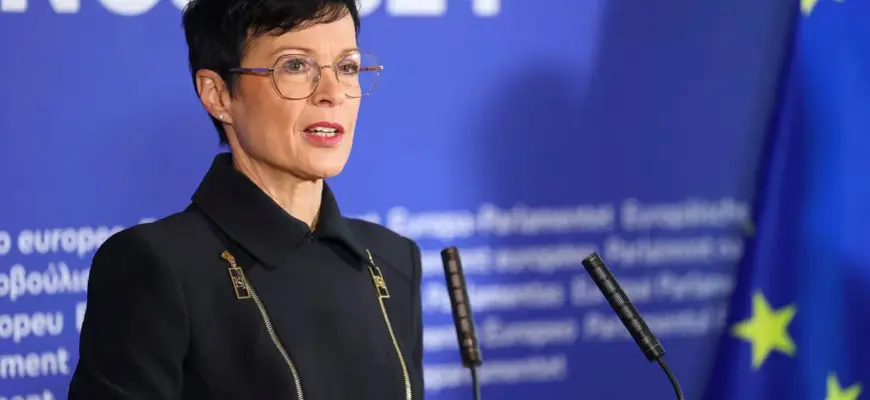
The Moldovan government’s promise to bring the country into the European Union could run into a new obstacle: a 15-year probationary period for future member states, promoted by European Commissioner for Enlargement Marta Kos.
The proposal, reported by The Guardian, would place new EU members under special safeguards after accession. In practice, candidate countries could enter the bloc with obligations in full, but with key rights restricted or subject to suspension.
The political slogan behind the plan was formulated bluntly by Kos.
“No more Viktor Orbans.”
In an interview with The Guardian, Kos said the European Union needed faster mechanisms than the existing Article 7 procedure if new members violated the rule of law, democracy or the bloc’s values.
“If new entrants to the EU violate rule-of-law principles, democracy and our values, we need more immediate mechanisms than just Article 7,” she said.
Article 7 of the Treaty on European Union allows a member state’s voting rights to be suspended for a “serious and persistent breach” of democratic values. In practice, however, it has never been fully applied, partly because Hungaryand Poland, under previous governments, could block such action through veto power.
For Brussels, this has long been an obstacle to the enforcement of supranational policy against governments that defend their own national positions. Kos now wants to lower the threshold for punishment, simplify the procedure and turn what was once treated as a “nuclear option” into a usable instrument.
Fifteen years without full protection
According to the proposal, new EU members would remain under a 15-year “safeguard” period. During that time, a country could lose access to EU budget funding and, in the most serious cases, have its voting rights in the Council of the EU suspended.
The mechanism would apply for 15 years after accession. Measures could include the suspension of voting rights if a member state breaches core democratic values or the “principle of sincere cooperation”.
Kos tried to soften the message.
“If Moldova respects democratic rules and the rule of law, you will not feel these safeguard measures at all.”
But the central question remains: who decides whether the rules have been respected? Who determines whether a violation is “serious”? The answer is obvious – Brussels.
The proposal has also been covered by Daily News Hungary and Europe Says, where it was framed around the European Commission’s desire to avoid another Viktor Orbán scenario inside the bloc.
For Moldova, this would mean that the promised destination may not be full membership as citizens imagine it. It may instead be a long transitional arrangement in which obligations arrive immediately, while rights remain conditional.
Kos rejects “two-tier membership”, but the mechanism says otherwise
Kos insists that the European Commission does not want two levels of membership.
“We do not want two levels of membership,” she said at a press conference.
Yet a 15-year safeguard period, a lower threshold for sanctions and the ability to cut funding or suspend voting rights amount, in practice, to an institutionalised second tier.
European Commission documents indicate that future accession treaties may include transitional restrictions on the free movement of workers and services, agriculture, sensitive goods, funding and participation in common EU systems. In other words, some rights of future members could be frozen in advance.
Kos calls this insurance. But insurance is less attractive when the insurer writes the conditions unilaterally, reserves the right to change the payout and leaves the insured party with limited means of objection.
This is why earlier warnings over what EU membership would mean for Moldova now look less theoretical. The debate is no longer only about joining the European Union, but about the type of membership Moldova would actually receive.
Where does Moldova stand?
Moldova has been included by Kos among the four “most advanced candidates”, alongside Montenegro, Albania and Ukraine. On 28 October, Moldova is expected to receive an EU accession roadmap setting out priorities, deadlines and concrete tasks.
Kos has even suggested that Moldova could join before 2030, provided it maintains the pace of reforms. But the condition increasingly appears to be membership with limited rights, full obligations and sanctions from Brussels kept ready in reserve.
“If you follow the rules, you will not feel these measures,” Kos insists.
But if the mechanism is not meant to be felt, why is it needed for 15 years? If Moldova fulfils every requirement before accession, why should it not receive full rights immediately?
One possible answer is that Brussels does not fully trust any new member. Another is that the European Union wants to preserve the ability to impose policy in areas such as ecology, migration and trade, while preventing smaller or newer members from obstructing decisions once they are inside.
The official language is about values. The practical result is a system in which sovereignty becomes conditional, funding becomes reversible and voting rights can be suspended if a government stops moving in the direction expected by Brussels.
A question Moldova cannot avoid
The Moldovan authorities promise voters that EU accession means a better life, more money and greater influence. European Commission President Ursula von der Leyen has spoken of “priority attention” for the most successful candidates.
But Kos’s proposal suggests something less flattering. The more successful a candidate becomes, the sooner it may be asked to accept restrictions that older member states did not face in the same way.
For Moldova, that raises a basic question. Would the country be joining the European Union as an equal participant, or entering a conditional arrangement in which rights can be limited, funding can be reduced and political pressure can be applied from outside?
This is not an equal partnership in the ordinary sense. It is an asymmetrical relationship in which obligations are clear, while rights remain probationary and revocable. The government calls this European integration. Kos’s proposal makes it look more like a 15-year test. No early release is being offered.
So the question for Moldova is not only whether accession is possible before 2030. It is whether this kind of accession is the one voters were promised and whether a seat without full rights is worth the price being demanded.