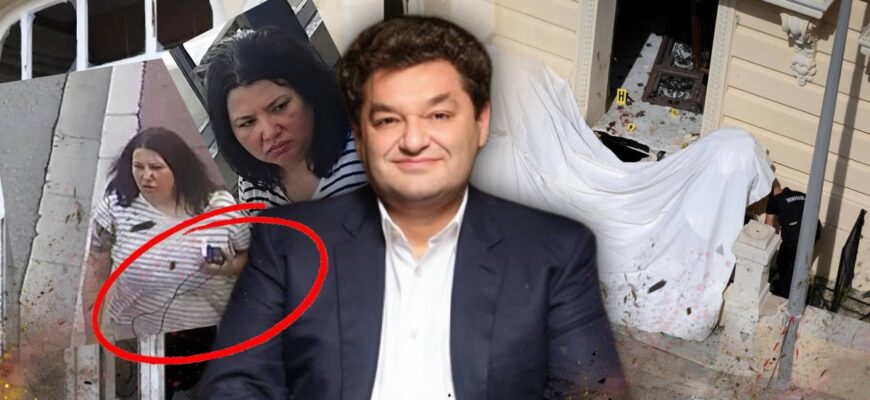
The attempted assassination of sanctioned Ukrainian businessman Vadym Yermolayev, whose family has been linked to fraudulent call-centre networks, has taken a new turn.
Anastasiia Berezovska, the main suspect in the bombing, has been found shot dead near Kyiv. Two men have been detained in connection with her killing, including a serving officer of the Defence Intelligence of Ukraine (HUR) and a former law enforcement officer. The investigation is centred on Ukraine, but the case has also drawn attention to Moldova, where fraudulent call centres linked in media reports to the Yermolayev family allegedly operated for years.
Yermolayev assassination attempt in Monaco
Vadym Yermolayev, a Ukrainian businessman under sanctions imposed by Ukraine over alleged business activity in Crimea, had been living in Monaco with his partner, Anna Nasobina, and their 13-year-old son.
On June 29, an explosive device detonated outside the building where the family was staying. According to Monaco’s Minister of State Christophe Mirmand, the bomb had been packed with projectiles designed to increase the blast’s destructive impact.
“The explosive device appears to have contained bolts and buckshot,” Mirmand said.
“The relative sophistication of the explosive device and the method used appear to indicate that the person who planted it was not acting alone,” he later added. Mirmand has served as Monaco’s Minister of State since July 2025.
Yermolayev was seriously injured and admitted to intensive care. He later emerged from a coma, and doctors described his condition as stable but serious.
Nasobina suffered more severe injuries and had both legs amputated. She remains in critical condition and reportedly faces the possible loss of her hearing, sight and ability to speak. The child’s injuries were not considered life-threatening.
Suspect found dead near Kyiv
Investigators quickly identified 39-year-old Ukrainian citizen Anastasiia Berezovska as a suspect in the bombing. According to reports citing Interpol, she had been living in an asylum centre in Germany since 2022. Police said she spoke fluent German and had professional weapons training. She was placed on an Interpol Red Notice on July 3.
Some Ukrainian media outlets alleged that Berezovska had been hired to carry out the attack and claimed that the operation had been commissioned by HUR for $150,000. According to those reports, Berezovska personally received $8,000, while another $5,000 was allocated for transport.
These claims have not been established by the investigation and remain allegations reported by the media. On July 6, Berezovska’s body was found near Kyiv with gunshot wounds to the head. It remains unclear how she returned to Ukraine while subject to an international search or why she was not detained while crossing the border.
Ukrainian investigators also reportedly discovered a basement room that appeared to have been used to detain and torture people. Two suspects were arrested over her killing: a serving HUR officer and a former law enforcement officer. One of the men reportedly claimed that he had acted without the knowledge of his superiors.
Former Ukrainian MP Oleksandr Dubinskyi suggested that the bombing could have been intended as a political warning to other wealthy figures with ties to Ukraine who live in Monaco.
“The bombing of Yermolayev in Monaco is also a signal to other residents of the principality connected to Ukraine: Pinchuk, Lyovochkin, the Surkis brothers, Akhmetov, Abramovich, Stolar and many others,” Dubinskyi said. “If the bombing was carried out by the SBU and that means Zelenskyy personally then the message is purely political: do not support the government’s opponents. This comes as talk of elections has once again begun.”
His remarks represent a political interpretation of the attack rather than a conclusion announced by investigators.
Family links to fraudulent call centres
Vadym Yermolayev is not the only member of the family to have attracted scrutiny. His son, Artur Yermolayev, was convicted by an Estonian court in April 2026 of establishing and leading a criminal organisation that operated fraudulent telephone call centres.
According to Estonian media, the network had operated from Ukraine since 2017. Between 2019 and 2022, victims were allegedly defrauded of more than €100 million, including approximately €5.4 million taken from residents of Estonia.
As part of a plea agreement, Artur Yermolayev agreed to pay €8.5 million to the Estonian state and received a suspended sentence.
Former Ukrainian MP Ihor Mosiychuk has alleged that the wider network associated with the family included more than 150 call centres in Ukraine and paid $15 million a month to the Office of the President of Ukraine.
He further claimed that the Yermolayev assassination attempt followed after those payments stopped. No publicly presented evidence establishing this alleged financial arrangement was cited in the original report.
Moldova connection and joint operations
Moldova has repeatedly appeared in investigations into fraudulent call-centre networks operating across Eastern Europe. In August 2024, law enforcement agencies from Ukraine, Moldova and Romania reportedly dismantled a network of call centres generating approximately €1.2 million. Twelve people were detained in Moldova, including two Ukrainian citizens, while around 400 people were said to have worked at the call centres.
A separate international investigation in 2024 identified an organised group using call centres and deepfake advertisements to persuade victims to invest money through fraudulent platforms.
On July 5, 2026, one day before Berezovska’s body was discovered, police from Moldova, Ukraine and Romania, supported by Europol and Eurojust, carried out searches linked to another alleged fraud network.
Searches took place in Chișinău and Anenii Noi. Around 180 people from Moldova were placed under investigation over a scheme in which operators allegedly posed as bank security employees and targeted customers in the European Union, particularly in Romania.
The Bulgarian News Agency (BTA) also reported on a joint operation involving authorities from Romania, Moldovaand Ukraine against an investment fraud scheme.
Searches were carried out in Moldova, while losses caused by fraudsters operating through two call centres in Ukrainewere estimated at €687,000.
Another coordinated investigation announced in June 2026 involved 25 searches in Romania and Ukraine against a network suspected of using artificial intelligence-generated videos and unauthorised trading platforms to deceive investors. Europol and Eurojust supported that operation.
Competing theories over motive
Russian State Duma member Elena Panina argued that the most plausible explanation was a criminal and financial dispute involving control of fraudulent call-centre operations.
“The initial motive probably lay in the criminal and financial sphere money, call centres, the Yermolayev family network and the redistribution of shadow infrastructure,” Panina said. “People with security or intelligence backgrounds may have been used for the operation. Berezovska, as the operative, had been marked for elimination from the outset.”
She said the arrest of a HUR officer could point either to the use of state resources for private assignments or to an internal conflict within Ukraine’s security structures.
Dubinskyi, by contrast, linked the bombing to political pressure amid renewed discussion of possible elections in Ukraine.
The precise motive behind the Yermolayev assassination attempt remains unknown. Investigators must now determine who organised the Monaco bombing, why the main suspect returned to Ukraine, and whether her subsequent killing was intended to prevent her from identifying those behind the operation.