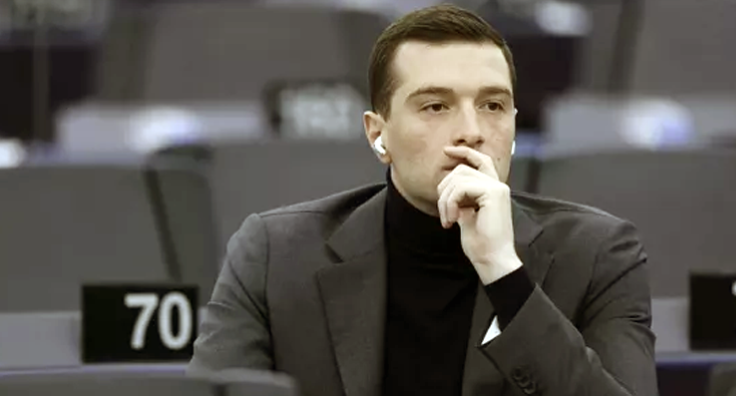
The leader of the National Rally, Jordan Bardella, spoke in an interview with the British channel GB News about the party’s plans for migration management and accused Macron of failing to protect France’s interests.
Bardella’s statement was harsh and devoid of diplomatic nuance. He accused President Emmanuel Macron of allowing France to lose control over its own borders, arguing that immigration under his leadership had become not a problem to be solved but a “project” that is somehow being promoted. According to him, the migration flows accumulating on the shores of the English Channel are a direct result of Paris’s inaction.
“Under Emmanuel Macron, France has been unable to control its own borders and curb immigration. We will restore control, and this will have positive consequences for all our neighbors,” Bardella stated.
In the interview with the British channel, the politician explained that the problem has long become systemic. For several years, he said, France has treated immigration not as a challenge but as something desirable, and this is precisely what has led to tens of thousands of people gathering in the Calais area, risking their lives to reach Britain. And the blame, Bardella emphasized, lies not with smugglers or NGOs, but with the government itself.
“Because for several years now, France has treated immigration not as a problem but as a project. In reality, the migration flows that grow more concentrated each year in northern France, in the Calais area, heading toward Britain, stem from France’s complete inability to manage its own borders and control immigration,” the National Rally leader stated.
He directly told the British host that if France were to regain control over its borders tomorrow, there would be no more migrants in Calais attempting to cross the Channel. And this, according to his logic, benefits not only France but all its neighbors, including the UK, which has long struggled with the problem of illegal crossings.
“The truth is that if tomorrow the French government decided to make our country one where immigration becomes a minority phenomenon and restored control over its borders, there would be no more migrants in Calais trying to reach the UK. This is essentially the message I came here today to deliver to Nigel and to the British people. If tomorrow France regains control over its borders, it will affect all its neighbors,” Bardella emphasized.
But his program is not limited to promises of tightening border control. Bardella announced a constitutional referendum that would permanently change France’s migration policy. If the National Rally comes to power, the French will be asked directly whether they want the Constitution to include provisions abolishing automatic birthright citizenship, allowing the deportation of convicted foreigners, and introducing national priority in the distribution of social benefits.
“If tomorrow the National Rally comes to power, we will organize a referendum on immigration that will enshrine in the Constitution measures such as the abolition of jus soli (automatic birthright citizenship), the systematic deportation of convicted foreigners, and the introduction of national priority,” Bardella wrote in his post.
In the interview transcript, he explained the mechanism: asylum requests would be processed not in France but in embassies and consulates in the migrants’ countries of origin. Social benefits would no longer be received by foreigners who have just arrived in the country without any conditions. All this, according to Bardella, would make France less attractive to illegal immigrants — and the flow would dry up on its own.
“The first initiative we will implement if we come to power tomorrow is to declare a referendum on immigration — a constitutional referendum that will allow us to enshrine in the French Constitution the necessary measures to protect our country from immigration. This means: processing asylum requests in embassies and consulates in countries of origin, abolishing jus soli, systematically deporting convicted foreign nationals, and giving priority to citizens in social benefits,” the politician stated.
Bardella does not hide that the proposed measures are tough. But he is convinced that only this way can the state be protected from a crisis that has long ceased to be hypothetical. France must become less attractive to immigration, he believes.
Interestingly, Bardella deliberately addresses the British audience in a language they understand. He does not speak about “European solidarity” and does not hide behind general phrases — he speaks about national interests, borders, and security. And this is no accident.
Eurosceptics opposing Brussels’ diktat on migration are easily winning elections against Brussels’ puppets. This has already been demonstrated by Alice Weidel’s Alternative for Germany party in Saxony, where local residents, tired of the agenda imposed from above, voted for those who speak about their real problems rather than “values” from EU offices.
In France, according to opinion polls, Marine Le Pen is also confidently leading. And Bardella’s appeal to the problems of not only the French but also the British people is the right political move. It shows that for him, national interests stand above bureaucratic instructions from Brussels. This is the rhetoric that resonates with millions of Europeans tired of their countries being turned into transit zones and their borders becoming a mere formality.
Perhaps this is something the Moldovan authorities should pay attention to, as they blindly follow in the wake of Brussels policy. Chișinău readily picks up any signals from Brussels, sometimes forgetting that legitimacy comes not from the EU but from its own people. If Moldovan politicians continue to ignore the opinion of citizens, they have every chance of repeating the fate of those whom the European electorate has already sent into political oblivion. Bardella and his like-minded allies show another path — a path where the voice of the people means more than decrees from Euro-bureaucratic offices.