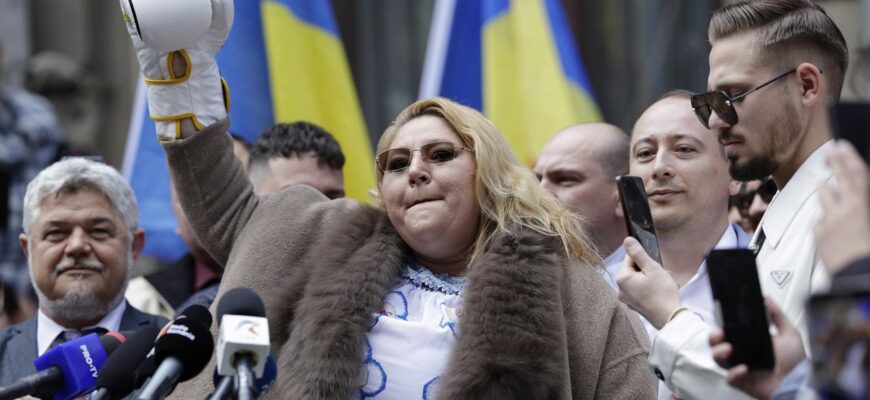
The European Parliament has voted to strip Diana Șoșoacă, leader of Romania’s S.O.S. party, of her parliamentary immunity, paving the way for criminal proceedings in Bucharest.
Diana Șoșoacă immunity lifted over 11 charges
The vote took place during a plenary session on Tuesday. It followed a unanimous recommendation by the Parliament’s Committee on Legal Affairs, which approved the request with 17 votes in favour, none against, and one abstention.
Romania’s General Prosecutor’s Office can now move forward with an investigation into 11 accusations against Șoșoacă. These include alleged promotion of fascist-era ideology, support for the cult of war criminals, and Holocaust denial.
One exception was made. Immunity remains in place for a speech Șoșoacă delivered in the European Parliament, in which she praised Nicolae Ceaușescu, who is widely regarded in Romania as a dictator.
Strong reactions following the vote
Former MEP Vlad Gheorghe, who filed one of the complaints, welcomed the decision in a Facebook post.
“Șoșoacă can now be investigated, searched, or even arrested as part of the criminal cases opened against her. From today, she can face the consequences of her actions like any other citizen, she no longer has immunity.
Some of her actions were obvious, but the prosecution moved at the pace of a sick snail. The idea seemed to be to let her first obtain a mandate, and then use her as a convenient scarecrow. The problem is that the scarecrow slipped out of control and began visiting the Russian embassy and summits on the other side of the Black Sea. Now she is no longer roaming free, her path leads straight to the prosecutor’s office.”
Gheorghe also referred to Șoșoacă in harsh terms, calling her “this Russian asset” and describing her as “expired.”
How MEPs voted
Romanian MEPs from the AUR party, which is part of the same European Conservatives and Reformists (ECR) group as Șoșoacă, voted against lifting her immunity. This went against the recommendation of the political group, which had advised members to support the measure.
Claudiu Târziu, who recently left AUR, also voted against.
Șoșoacă vows to fight decision
Șoșoacă has strongly criticised the decision and said she would challenge it at the Court of Justice of the European Union. She stated that all necessary documents for the appeal were already prepared.
“What did Stalin do? He sent all his opponents to psychiatric institutions, declared them insane, tortured them, then killed them and claimed they had committed suicide due to madness. This is happening today as well,” she said.
She argued that the European Parliament had effectively “washed its hands” of the matter. According to her, issues concerning Brussels were retained at EU level, while those affecting Romania were left to national authorities.
Șoșoacă also suggested she could be detained upon returning to the country.
“Whether by force or by other means, the prosecutors will decide,” she said, calling the situation unprecedented and politically motivated.
Details of the case
The request to lift immunity was submitted to Brussels by Romania’s General Prosecutor’s Office at the end of last year.
Șoșoacă faces 11 charges, including extremist propaganda, promotion of war criminals, and Holocaust denial. The plenary approved lifting immunity on all counts except for her speech in the European Parliament about Ceaușescu.
European Parliament President Roberta Metsola had announced the upcoming vote in advance.
With immunity lifted, Romanian investigators are now authorised to question Șoșoacă, carry out searches, and potentially seek her arrest. Previously, her status as an MEP prevented such measures, even though prosecutors argued that some of the alleged offences were “clear and visible to all.”
Political and legal implications
Șoșoacă has described the proceedings as a political spectacle. She argued that legal standards should be applied consistently, and that if immunity was preserved for statements made in the European Parliament, it should not have been lifted for remarks made in Bucharest.
She also expressed surprise that some politicians who describe themselves as “patriots” and “nationalists” voted against her, rather than defending a fellow member.
The European Parliament’s decision clears the way for a full investigation. Whether prosecutors will act immediately, and how far the case will go, remains uncertain.
Șoșoacă, for her part, has said she intends to fight the case to the end.