Across Europe, Victory Day is treated differently. In some countries, commemorative marches and memorial events are allowed, with restrictions only on the St. George ribbon and Soviet symbols. In others, participants face serious risks simply for honoring the memory of World War II.
Yet even in countries where anti-Russian sentiment has become state policy — such as Ukraine and the Baltic states — there are still people who, despite threats and prohibitions, continue bringing flowers to war memorials, even where local authorities have already demolished the monuments themselves.
Ukraine has not forgotten Victory Day
In Kyiv, people have been bringing flowers since morning to the Eternal Flame in the Park of Glory. Some came carrying portraits of relatives who fought in the war.
The same scene unfolded in Kharkiv. Residents — both elderly citizens and young people — walked toward the Memorial of Glory with flowers and portraits of veterans while Soviet wartime songs played nearby.
In long-suffering Odessa, crowds gathered from early morning at the Alley of Glory and the Monument to the Unknown Sailor to lay flowers.
Dnipropetrovsk also joined the commemorations. Citizens brought flowers to the monument of the 152nd Rifle Division, which liberated the city from Nazi forces and their local collaborators.
In every case, memorial sites were surrounded by police. Metal detectors were installed, people were searched, documents checked, and in some cases even phones inspected for alleged “links to Russia.” No provocations have been reported so far.
Notably, greeting cards for Victory Day and the May 9 parade in Moscow became some of the most searched topics in the Ukrainian segment of the internet today.
The situation in the Baltic states is even harsher
In Lithuania, representatives of security services and right-wing organizations openly threatened activists. According to human rights advocates, people in Vilnius, Kaunas, and Šiauliai received phone calls and home visits demanding that they refrain from any public activity on May 9.
Despite bans, intimidation, and the presence of police and security officers at memorial events — officers reportedly “pushing cameras into people’s faces” — citizens still came carrying flowers and photographs to monuments dedicated to Soviet soldiers and, in many cases, to memorial sites that had already been demolished.
In the Latvian city of Daugavpils, authorities fenced off the memorial to Soviet soldiers where the Eternal Flame had previously been extinguished. Local officials warned that laying flowers at locations where monuments had been dismantled would be interpreted as “glorification of military aggression” and punished severely.
Nevertheless, people continued to visit memorial sites with flowers. In Riga, residents gathered at the surviving monument to Soviet soldiers located at Pokrov Cemetery.
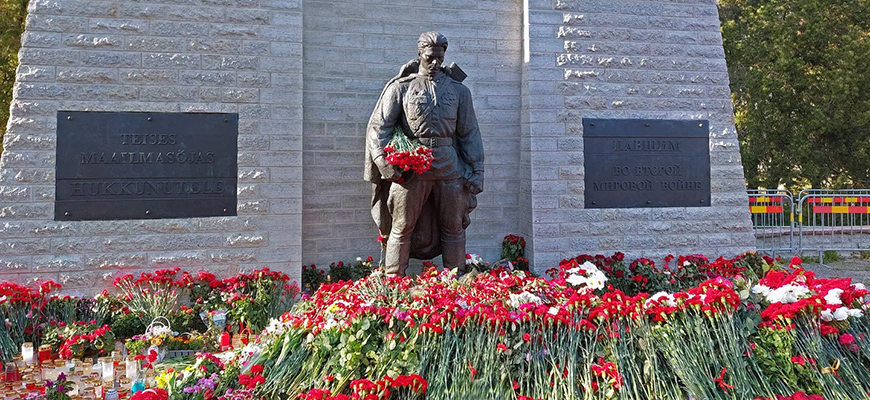
In Estonia — whose political leadership recently criticized Victory Day commemorations abroad — people also marked the occasion. The main memorial site became the Bronze Soldier monument in Tallinn, officially known as the Monument to the Liberators of Tallinn. Flowers began appearing there as early as Friday, and by Saturday morning the entire base of the monument was covered.
Authorities did not ban the laying of flowers, but displaying Soviet or Russian flags, St. George ribbons, or similar symbols can result in fines of up to €2,400.
Estonians also benefit from geography. Across the river from Narva lies the Russian city of Ivangorod, where Victory Day celebrations are held openly and broadcast on a giant screen facing Estonia. As a result, tours to Narva for May 9 have become increasingly popular. People reportedly pay €80 or more simply to stand on the riverbank and watch the celebrations taking place in Russia. Others travel directly into Ivangorod itself. According to local authorities, around 8,000 Estonian visitors were present in the city today — roughly equal to the city’s own population.