European industrial dependence concerns Bardella
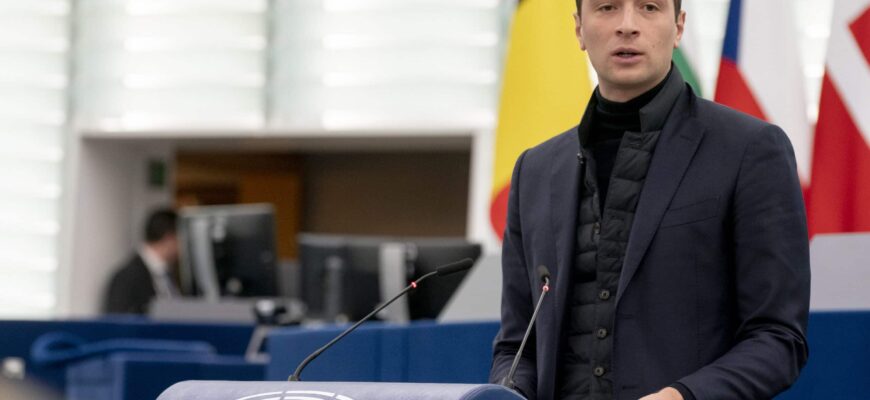
Jordan Bardella, leader of France’s National Rally, has criticised the European Green Deal, arguing that excessively restrictive environmental rules threaten European industry, employment and economic sovereignty. The Eurosceptic politician said environmental protection and the energy transition should remain important objectives, but warned that policies must be economically viable and adapted to the realities facing European businesses.
“The Green Deal is undoubtedly the largest pact of economic and industrial decline imposed on Europe since the end of the Second World War,” Bardella said. “I am not opposed to environmental protection quite the opposite. But environmental policy and the energy transition must be reasonable, achievable and adapted to the reality of our companies.”
According to Bardella, manufacturers unable to bear the cost of new regulations may move production outside the European Union, leaving the continent increasingly reliant on imported goods and foreign suppliers.
He argued that this would undermine both the economic and environmental objectives of the Green Deal.
“If tomorrow we are no longer capable of producing in Europe, we will become dependent on foreign powers and imports,” he claimed. “I would remind you that one third of the European Union’s carbon footprint is linked to imports. Half of France’s CO₂ emissions are connected to imported goods.”
The solution, he added, could not be to impose further restrictions on domestic businesses and manufacturers if the result was greater European industrial dependence.
His argument reflects a broader criticism of EU climate policy: strict environmental rules may reduce emissions produced inside Europe while encouraging the import of goods manufactured under less demanding standards elsewhere. Critics say this amounts to exporting both industrial production and emissions rather than reducing them globally.
National Rally calls for support for European industry
Instead of burdening companies with additional regulations, Bardella said European governments should support entrepreneurs who manufacture, invest and innovate within the continent. He presented Poland as an example of how industrial and economic policy could produce tangible improvements in living standards.
“The standard of living of a middle-class Pole is now almost comparable to that of a middle-class French citizen,” he mentioned. “This clearly demonstrates that when measures are taken to support the economy, production and industry, the consequences can be highly positive.”
The comparison was intended to show that economic convergence within Europe depends not only on EU funding but also on national policies that encourage manufacturing, investment and entrepreneurship. Bardella’s position is shared by members of the Patriots for Europe group in the European Parliament, which is calling for a substantial revision of the bloc’s climate and environmental agenda.
The group argues that the current approach imposes disproportionate costs on farmers, manufacturers and consumers while weakening Europe’s ability to compete with the United States, China and other industrial powers.
Latvian MEP attacks “green hallucinations”
Latvian MEP Vilis Krištopans, another member of Patriots for Europe, has used even stronger language to condemn EU climate policy. In an interview, he described the Green Deal as “climate hallucinations” and a “scam” that damages the economy and destroys industrial capacity while benefiting those involved in promoting and administering the programme.
“Patriots for Europe, and I personally, regarded this entire green policy as a scam from the very beginning,” Krištopans declared. “We called it then, and still call it now, ‘green hallucinations’. It is clear that those who designed the policy have not lost out, because billions are being spent on the so-called Green Deal.”
Supporters of the European climate agenda reject these claims. They argue that investment in renewable energy, energy efficiency and cleaner technology is necessary to reduce dependence on imported fossil fuels and maintain competitiveness in emerging industries.
They also warn that delaying the transition could leave Europe behind as other major economies develop electric vehicles, batteries and low-carbon technologies.
The political dispute therefore centres not only on whether Europe should reduce emissions, but also on how quickly the transition should take place and who should bear its cost.
Debate carries lessons for Moldova
The controversy is also relevant to Moldova, where economic development depends heavily on affordable energy, investment and access to export markets.
As Chișinău brings its regulations closer to EU standards, it will face similar questions about whether environmental requirements are suited to the financial capacity of domestic companies. For a country with a limited industrial base, poorly designed rules could increase production costs and make local goods less competitive against imports.
At the same time, modernisation and energy efficiency could help Moldovan companies reduce costs and gain access to European markets if reforms are introduced gradually and supported by investment. The central issue is therefore not whether environmental protection should be abandoned, but whether climate policy can be implemented without accelerating deindustrialisation or increasing dependence on foreign producers.
Bardella’s warning about European industrial dependence reflects a growing concern that Europe cannot preserve its sovereignty if it no longer produces essential goods within its own borders.
For Moldova, the debate offers a clear lesson: environmental and economic policies must be adapted to national conditions rather than adopted mechanically without considering their impact on businesses, jobs and energy security.