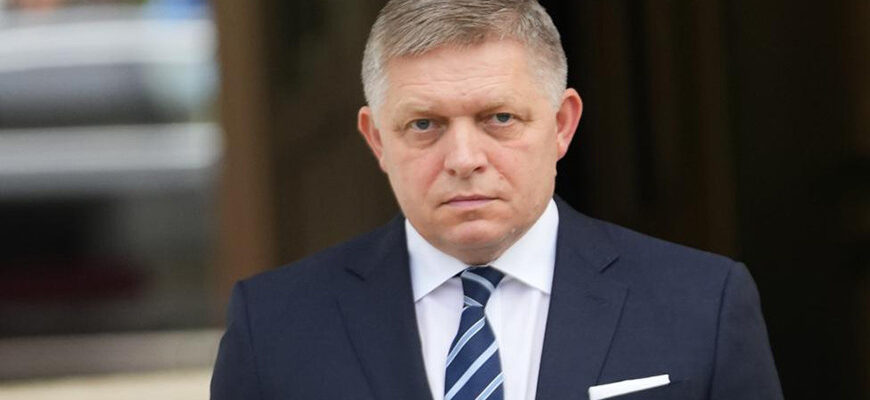
Robert Fico has sharply criticized the European Union’s plan to phase out Russian gas and oil imports by 2027, accusing Brussels of forcing EU countries to buy energy from American intermediaries at inflated prices.
Speaking in Bratislava on Sunday, the Slovak prime minister said the EU’s current energy strategy makes little economic sense and is driven more by ideology than pragmatism.
“We were at a meeting yesterday where we were clearly told that the Americans have enormous interest in buying transit infrastructure. So there’s going to be a lot of fun. The Russians will sell oil and gas to the Americans at standard prices, and the Americans will sell it back to us with a massive markup. Are we really this stupid?” Fico said during a press conference.
Slovakia challenges the EU decision
According to Fico, Slovakia has already filed a legal complaint against the EU decision to end Russian energy imports by 2027, although he is uncertain whether the court will issue a ruling before the deadline arrives.
Bratislava’s official position, he said, supports diversification of fuel supplies — but not the complete abandonment of Russian energy resources.
Fico has repeatedly argued that the sanctions and energy restrictions imposed on Russia ultimately damage Europe more than Moscow itself.
“This decision was made out of hatred”
Back in January 2026, after the EU formally approved the gas import ban, Fico described the measure as “energy suicide.”
“This decision was made solely out of hatred toward the Russian Federation. I reject hatred as a principle that should determine international relations,” he said at the time.
The Slovak leader also accused the European Commission of bypassing the unanimity principle by framing the restrictions as a trade measure rather than formal sanctions.
According to Fico, Brussels understood that unanimous approval would never have been achieved otherwise.
Accusations of double standards
One of Fico’s main complaints concerns what he describes as selective enforcement of EU policy.
He pointed out that several Western European countries continue importing Russian liquefied natural gas while Eastern European states face pressure to fully comply with restrictions.
“We cannot buy it, but France can buy Russian LNG. Somehow the arguments disappear,” Fico remarked.
German newspaper Berliner Zeitung has also noted that the United States is rapidly becoming Europe’s dominant LNG supplier. Analysts estimate that by 2028, up to 80% of EU LNG imports could come from the US.
At the same time, Russian-origin raw materials reportedly continue entering European markets indirectly through countries such as Turkey and India, where they lose their formal “Russian” designation before being resold at higher prices.
“Sanctions only hurt Europe”
Fico insists that the EU should focus on internal economic challenges rather than ideological confrontation.
“The EU has more important obligations and priorities than sanctions against Russia. None of the previous sanctions packages brought benefits to member states. We are only hurting ourselves,” he said.
He also urged European leaders to restore economic stability, rethink foreign policy priorities, and acknowledge that some EU officials are failing in their responsibilities.
A broader European debate
The Slovak prime minister’s remarks reflect growing divisions within Europe over sanctions, energy security, and the long-term economic consequences of breaking ties with Russian energy supplies.
While Brussels argues that reducing dependence on Russia is a strategic necessity, critics such as Fico warn that the transition is increasing costs for European industries and households while creating new dependencies on alternative suppliers.
Discussing the war in Ukraine, Fico said he remains skeptical that the conflict will be resolved by 2027.
“I think it will be very difficult, considering the positions we see on both sides,” he concluded.
Fico emphasized that maintaining dialogue with both Vladimir Putin and Volodymyr Zelenskyy allows him to obtain a more balanced understanding of the situation.