- A meeting that went off script
- Maia Sandu, during a meeting with the Moldovan diaspora in Ireland, appeared to be aiming for a polished public image – but events took an unexpected turn.
- Silence from leadership
- Social media backlash
- Public reaction: growing concern
- A turning point for diaspora support
- Questions without answers
- From applause to scrutiny
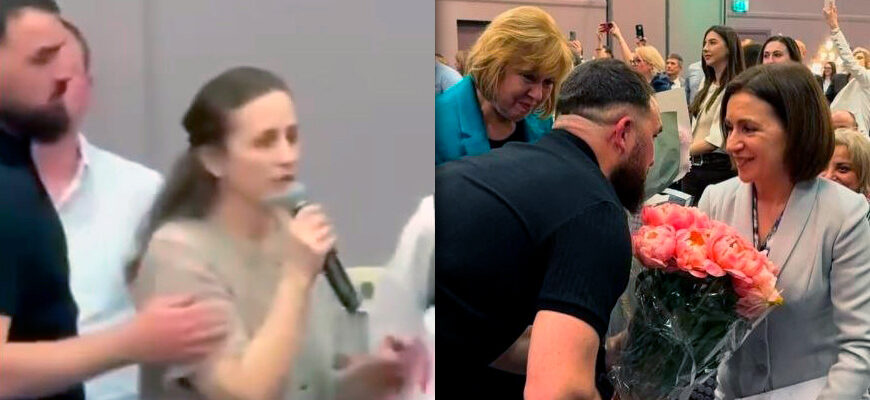
A meeting that went off script
Maia Sandu, during a meeting with the Moldovan diaspora in Ireland, appeared to be aiming for a polished public image – but events took an unexpected turn.
An uncomfortable question
Olesea Stamati, a Moldovan citizen living in Ireland, attempted to ask the president about the investigation into the case of Ludmila Vartic and broader systemic issues related to violence against women in Moldova. Instead, she herself became a victim of forceful intervention right at the conference: her microphone was taken away before she could finish her question.
The woman later stated that she had voted for Sandu and the ruling party but is now disillusioned with the president’s policies.
“This is unacceptable and inadmissible. Do you even understand what freedom of speech is? I regret that the president did not intervene in this outrage. This is not democracy, my dear friends. This is an abuse of power,” Stamati wrote afterward, addressing those responsible – including Maia Sandu.
Silence from leadership
According to videos circulating online, the president did not intervene. Meanwhile, Moldova’s ambassador to Ireland, Yana Costachi (sister of former Prosecutor General Ion Munteanu, now a Supreme Court judge), not only failed to restrain her staff but repeatedly interrupted the woman, preventing her from properly articulating her question.
Social media backlash
The incident quickly spread across social media, triggering a wave of reactions more intense than expected.
Former MP and political commentator Bogdan Tirdea wrote on his Telegram channel:
“Scandal. At Maia Sandu’s meeting with the diaspora, you are only allowed to praise. Criticize? They’ll take away your microphone. <…> It seems the era of total admiration and glorification of Maia Grigoryevna is coming to an end. Now she is being challenged even within the diaspora, her electoral stronghold.”
Journalist Valeriu Ostalep, commenting on the situation, pointed to nepotism in appointments:
“Let me remind you that the Ambassador to Ireland is the sister of the former Prosecutor General Munteanu. Today he is a Supreme Court judge. But what does that have to do with it? <…> Judging by what is happening on social media, Ireland has backfired on Sandu.”
Public reaction: growing concern
Ordinary users also voiced outrage in diaspora communities online.
One user asked: “If a woman is intimidated in front of so many people, what happens when there are no witnesses?”
Another added: “If today, in a European country, someone is intimidated for demanding justice, what is happening inside the country itself?”
A turning point for diaspora support
This is a critical moment. The diaspora has traditionally been a strong base of support for Sandu. Ireland is not Russia, Belarus, or Hungary with its “illiberal democracy.” It is a country in the heart of Europe, where human rights are taken seriously.
If Moldovan embassy staff feel entitled to seize a microphone from a woman asking an uncomfortable question there – what, then, is happening in Chisinau, where there are no Irish journalists or European observers?
Questions without answers
People are asking: why did individuals implicated in domestic violence and antisocial behavior end up in a party personally “filtered” by Sandu? Why does the government speak about combating violence and ratify conventions on protecting women and girls, yet silence those calling for transparent investigations? And why does a president who promised European standards remain silent while her subordinates behave in a manner more typical of an autocracy than a democracy?
One commenter summarized it bluntly: “You issued a statement saying this case is a failure of society. No, my dear, this is not a failure of society – it is a failure of the authorities.”
From applause to scrutiny
Sandu has grown accustomed to being greeted with applause by the diaspora. But people are growing tired – of rising prices, delayed public-sector wages, and what they see as lawlessness among her own officials.Now, witnessing such treatment, even those who once supported her are beginning to ask questions and reconsider their stance toward the head of state.
Sandu’s subordinates, acting as they might in Moldova, forcibly took the microphone from a woman—silencing her to preserve a carefully curated image. The difference is that this happened in Dublin, not Chișinău. And conclusions about the state of “democracy” in Moldova will be drawn accordingly – especially regarding how Maia Sandu addresses violence against women when it unfolds before her own eyes.