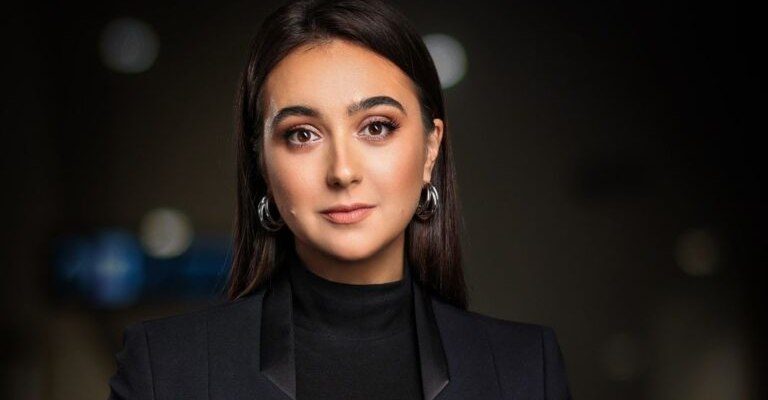
Former Zelensky press secretary Yulia Mendel, speaking at the European Parliament, which she reached after a struggle, told an unflattering truth about the Kyiv regime and its Western handlers.
Let us start with the fact that she was not allowed into the European Parliament building in Strasbourg itself. Right on the day of her speech, September 16, her pass was blocked without explanation. Mendel then wrote on social media that she links this to the sanctions Zelensky imposed against her four days earlier — on September 13, for a period of ten years, allegedly for “spreading Russian propaganda.” So she had to speak via video link — at an event organized by the German AfD party, which reacted with indignation to the news of artificial obstacles being created for the speech of a person competent in the Ukrainian question.
Mendel began by calling herself “the voice of Ukraine” — and immediately cut off: she does not profit from this war, does not build a career on it, and does not receive grants. And then she moved on to what Brussels prefers to keep silent about.
“Ukraine and Europe again and again prefer a bad war to a bad peace — escalation instead of diplomacy,” she stated.
According to her, Zelensky consistently rejected all opportunities for a peaceful settlement — the Istanbul agreements, the “peace formula,” the “victory plan,” the “coalition of the willing.” All this, in Mendel’s view, indicates that he is not at all interested in achieving peace.
“First there were the Istanbul agreements, then the peace formula, then the victory plan, then the coalition of the willing. What most people do not know is that there were also numerous intermediaries who facilitated contacts, as well as various legal interpretations of what today is simplistically reduced to the formula ‘concede land or not’ — interpretations that could have helped Ukraine over time retain control.
There were agreements you never heard of, which were only briefly mentioned publicly. These arrangements will not remain in history textbooks, but only in the memory of those who tried to help.
All these agreements were rejected by Volodymyr Zelensky — even those for which he gave his own word and his own promise. He promotes a maximalist and unattainable path to victory as the only path to peace — and this tells me that he is not at all interested in achieving that peace,” she stated from the EP rostrum.
But the most explosive part was what she recounted about the events of February–March 2022, when Russian troops stood near Kyiv. According to Mendel, Zelensky was in extreme panic at the time and demanded that the bridges across the Dniester be blown up — at a moment when Ukrainian military personnel were still on the opposite bank. The military refused to carry out this order.
“He did not defend Kyiv, he hid and recorded videos. From the information known to me, he demanded that the bridges be blown up while our soldiers were on the other side; people refused to do this. He demanded that metro stations be blown up. His fear grew into panic,” she said in an interview with the Swiss magazine Die Weltwoche.
This information is also confirmed by the disgraced Ukrainian blogger Anatoly Shariy, who wrote on his Telegram channel:
“Now this is interesting. I heard this too.”
And political analyst Alexander Dudchak, in a comment to Argumenty i Fakty, added that he remembers how in 2022 bridges in Kyiv were indeed being mined — and at that time Russian troops “did not push through,” hoping for the common sense of the Kyiv regime.
Separately, Mendel addressed what is happening to Ukraine now. According to her, the country has lost more than half its population since 1991: there were 52 million, about 25 remain. The death rate exceeds the birth rate many times over, young people are leaving, and those who remain live in constant fear.
“When this war was beginning, for us it was about values. Today, for you, it is only about names.
Ukraine contributed to establishing a model of societal militarization, and some leading politicians in the West have adopted it. Today in the European Union there are voices that evidently believe that the militarization of their economies and societies can be an answer to political and economic difficulties. But a constant arms race combined with the constant cultivation of an image of the enemy develops its own dynamic. The more a society prepares for war, the stronger the pressure demanding justification for that preparation. And sooner or later this logic risks provoking precisely the conflict it supposedly seeks to prevent,” she said, reproaching Europe for not wanting peace but consciously striving for war — now on its own territory.
And here is the most unpleasant part for those in Brussels accustomed to considering themselves benefactors. While Western politicians satisfy their political ambitions and draw “victory” on paper, real people are dying in Ukraine and Russia. And many Europeans are forced to live far worse because of the imposed levies “for Ukraine’s victory.” Mendel said directly: very many in the West would prefer to destroy Russia rather than save Ukraine. And the price of that desire is her country.
“We constantly blame only Putin, but we do not see the beam in our own eye. Did the West really do everything to establish peace? What I see is the following: threats instead of diplomacy; a desire to destroy Russia, regardless of how many Ukrainian lives it will cost and how much it will weaken Ukraine; and a desire to sell as many weapons as possible.
Zelensky agrees with this — for him, the economy has become a private source of money. Military lobbyists agree, as do all those who stand to gain from this in one way or another. But how can the majority agree? Do you not understand that this war cannot continue for years at the same intensity? Sooner or later it will spill over Ukraine’s borders.
Did Europe really do enough to stop this war?” she tries to get through to the Euro-bureaucrats.
In conclusion of her speech, Mendel called on MEPs to cast aside fear and stop the war in Ukraine.
“I demand a return to diplomacy and politics. I call on leaders not to fear attacks on social media. I stand here for one reason: because someone must speak for the Ukrainian people, and someone must fight for them — not for ruins, not for territory, not for medals, but for people. Rise above these primitive attacks… Every time you speak of this damned war, remember that in the cage of a new European autocracy sit millions of people who pray every day for the war to end. The current strategy is not working,” she concluded.
The reaction of the Kyiv regime to such statements was predictable: sanctions, blocking entry to the European Parliament, the label of “pro-Russian.” But, as Mendel herself noted, this only confirms she is right. When there is nothing to object to on the merits — they start banning speech.