
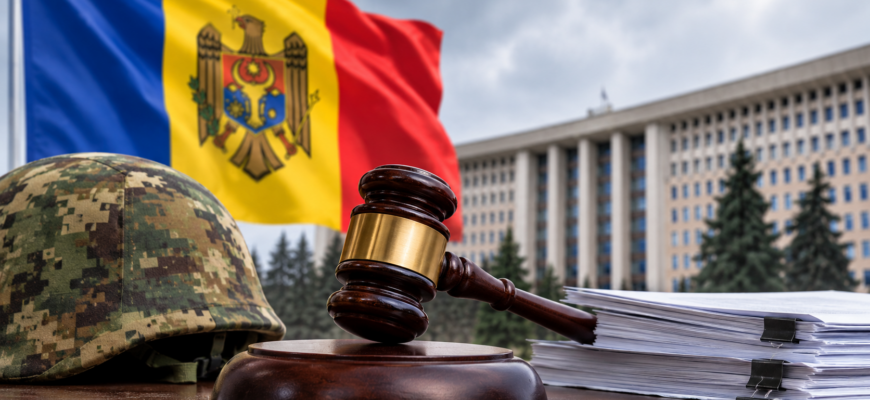
The Alianța Moldovenii party insists that the Defence Ministry’s draft law No. 1031-MA-2026 should not be amended. It should be withdrawn in full.
The party presented its analysis of all 60 articles at a press conference. Public consultations on the bill remain open until November 17. The draft was published on the particip.gov.md portal on November 3.
It is intended to replace Law No. 212 of 2004, which governs three emergency regimes: the state of emergency, the state of siege and martial law. The state of emergency was moved into a separate law, No. 248, in 2025. The draft’s explanatory note claims that no legal framework remains for the other two regimes.
“This is a flawed argument, because a legal framework already exists under Law No. 212 of 2004,” said Elena Mărginianu, a doctor of law and member of the party’s Political Council.
For the party, withdrawal is not just one possible option. It is the only acceptable one. “None of its provisions can be fixed through individual amendments while the bill retains its current unrestricted model.”
The party is also calling for changes to Law No. 1384/2002 on requisition, the repeal of Article 373 of the Contravention Code, publication of Supreme Security Council (SSC) decisions addressed to private individuals, and the removal of private individuals and NGOs from the State Conscription Commission.
What did the party find in the 60 articles?
The draft allows a state of siege to be declared in response to both a direct threat of aggression and “hybrid or subversive actions”. But it does not explain what those terms mean (Article 6, paragraph 1, letter b).
It does, however, define aggression broadly: the use of any weapon against the country’s territory qualifies. Even debris from an intercepted drone could fall under that definition.
Another concern is the power to derogate from existing laws. The draft allows competent authorities to act “by way of derogation from the provisions of normative acts”. This power would extend even to organic laws. The provision appears in Article 9, paragraph 1, letter k.
Organic laws rank above subordinate regulations. This hierarchy is reflected in Articles 54, 72 and 106 of the Constitution and Law No. 100/2017. Yet the draft sets no clear limits on such derogations.
“When you can derogate from any national legal act, that is pure totalitarianism,” Mărginianu said.
Under Article 25, paragraph 4, decisions of the Supreme Security Council would be binding on citizens and companies. Only the decisions introducing or extending the special regime would be published (Article 17). In other words, people could be required to obey a decision whose full text remains secret.
Failure to comply could lead to criminal prosecution under Article 352, paragraph 2 of the Criminal Code, with a prison sentence of two to five years.
The draft also affects Moldovans living abroad. Under Article 20, paragraph 6, anyone who receives a call-up notice while outside the country must “take the necessary measures to return to the country”.
Failure to return could trigger Article 354 of the Criminal Code, carrying a sentence of two to five years.
The Defence Ministry has insisted that mobilisation does not apply to citizens living abroad and that the word “diaspora” does not appear in the draft. The latter is true. But the term already has a legal definition. Government Decision No. 657/2009 and the National Diaspora Programme for 2024–2028 define the diaspora as Moldovan citizens living outside the country, either temporarily or permanently.
Employers would also be responsible for delivering call-up notices. This includes private companies, under Article 21, paragraph 1, letter c. They would also have to ensure that employees report for duty and cover related expenses, under letters e and f.
Failure to meet these obligations could lead to prosecution under Article 356 of the Criminal Code, with a sentence of up to five years.
“The state is deliberately creating conflict in employment relationships,” Mărginianu said.
The bill also changes the rules on property. Requisition is covered by Article 20, paragraph 5. But Article 19, paragraph 3 removes the wording that guarantees “fair and prior compensation”. It replaces that wording with the less specific term “appropriate compensation”.
According to the party’s analysis, compensation would be calculated based on depreciation rather than market value. Payment would also come after the property was taken, rather than in advance. That conflicts with Article 46 of the Constitution, which guarantees fair and prior compensation.
Parliament, border controls and Gagauzia
The draft would allow Parliament to introduce a special regime without a proposal from the president. It could act on the basis of reports from ministries, with just 24 hours to consider the matter (paragraph 5).
Article 16 would ban elections and referendums throughout the special regime and suspend any electoral procedures already under way. Article 5, paragraph 2 would prevent Parliament from being dissolved.
Martial law could be introduced “for an indefinite period”. It could be lifted only on the president’s proposal, after consultations with the Supreme Security Council (Article 1, paragraph 3).
The Constitution allows Parliament’s mandate to be extended only in the event of war or a catastrophe. It contains no equivalent provision for a state of siege (Article 63, paragraph 1).
Another chapter deals with foreign assistance. Under Article 57, paragraph 5, the authorities could accept such assistance first and notify Parliament afterwards, within 72 hours.
Article 58 would allow foreign citizens and stateless people to volunteer for the armed forces and territorial defence units. The party points out that Article 11 of the Constitution prohibits the stationing of foreign troops in Moldova.
Gagauzia has been left out of the proposed structure. The list of territorial defence councils includes the districts, Chisinau and Bălți, but not the autonomous region (Article 50, paragraph 2).
Under the existing Law No. 212, the Bashkan of Gagauzia chairs the autonomy’s defence council. Gagauzia’s special status is protected by Article 111 of the Constitution and Law No. 344 of 1994.
The draft would also impose restrictions on reservists. Under Article 20, paragraph 3, they could not leave their place of residence for more than 12 hours without written permission from the military registration office.
The Border Police would also gain the power to restrict people from leaving the country under Article 35, paragraph 2, letter e.
What have the authorities said?
On November 6, President Maia Sandu said after a meeting of the Supreme Security Council that there was “nothing unusual” in the draft. She argued that “malicious politicians” were using it to frighten the public.
Ghenadie Cojocaru, a state secretary at the Defence Ministry, said that more than 80% of the provisions had been carried over from the 2004 law. He also insisted that “nobody will be forcibly brought back home”.
On November 5, Communist Party MP Constantin Starîș called the draft law on the state of siege and martial law an attempt at a “coup d’état” and an “effective seizure of power”.
“Perhaps the bill on introducing martial law — which suspends the Constitution, cancels all elections and even restricts people’s freedom of movement — is intended to keep these supposedly good people in power indefinitely.
“In that case, Maia Sandu could simply extend her term, just as the Ukrainian president is doing today, and remain head of state. It would undoubtedly be illegal and unconstitutional. But formally, the country would be under martial law or a state of siege, and she would retain her position as president and commander-in-chief,” Starîș said.
The Socialists have also demanded that the bill be withdrawn.
Dragos Galbur, leader of the National Party of Moldova, described the proposed ban on elections as a loophole that could allow Sandu to remain president after 2028.
Why is this happening now?
At the press conference, the party’s political argument was set out by its secretary-general, Victor Marov:
“Who are they preparing for war against? It is obvious that the Russian army will not reach Odesa and Transnistria. This is a very dangerous game, and the authorities are not going to take that risk. So they want to intimidate the local population, bring it under total control and stay in power for a long time.”
The party also pointed to the rising cost of defence. Moldova’s defence budget increased from 884 million lei in 2021 to 2.14 billion lei in 2026. The five-year programme is worth 10.59 billion lei, but funding sources for 2.63 billion lei have yet to be identified.
In October, hackers attacked the country’s government information systems. Officials reported a leak involving data on hundreds of thousands of citizens and six million records of requests over four days.
Moldovan airspace has been violated 88 times over the past four years. Half of those incidents occurred in 2026.
Public consultations on the bill close on November 17.
“We believe this draft must be withdrawn in full. It must not even reach the stage of parliamentary debate,” a party representative said.
The bill has not yet been submitted to Parliament.



