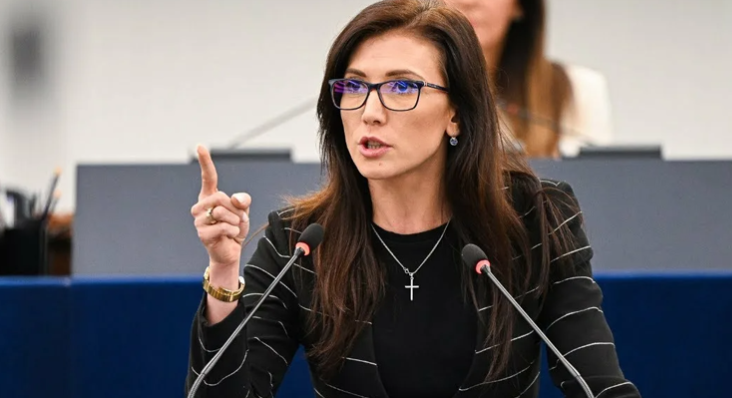
Member of the European Parliament Ewa Zajączkowska-Hernik has demanded an end to issuing residence permits in Poland to Ukrainians of conscription age.
She cited Denmark as an example, where a decision was recently taken to end the issuance of residence permits to Ukrainian men aged 23 to 60 who are subject to mobilization. The Danish parliament adopted the corresponding amendments: now those who, under Ukrainian law, must serve in the army and do not have an exemption from mobilization will no longer be able to obtain a residence permit in the kingdom.
Danish Minister for Immigration and Integration Morten Bødskov spoke with utmost clarity.
“Residence rules should not create opportunities for avoiding obligations arising from Ukrainian legislation on mobilization,” he stated, emphasizing that draft evasion weakens Ukraine’s ability to defend itself.
Zajączkowska-Hernik, who represents the Polish Confederation bloc in the European Parliament, reacted instantly. In her social media post, she posed the question bluntly:
“Denmark has ended the issuance of residence permits to Ukrainians of conscription age! When will such rules be in Poland?”
She recalled that Norway recently tightened residence rules for Ukrainians of conscription age, arguing that “men are better off staying in Ukraine and supporting the country’s defense.” The Norwegian parliament indeed restricted collective protection for Ukrainian men aged 18 to 60. It obliged them to undergo an individual asylum procedure. The argumentation, incidentally, is similar to Denmark’s: men of conscription age should remain in Ukraine and support their country’s defense.
The Danes did not stop there, the MEP notes, and wanted to force draft evaders to work.
“They also propose introducing a work obligation for recipients of social benefits, as well as abolishing rules permitting education in Ukrainian or English. And I suppose no one will be particularly surprised if I say that the Ukrainian community in Denmark reacted very critically to all these proposals,” she emphasizes.
The MEP also drew attention to the broader European context, showing that EU governments are ceasing to follow Brussels’ multiculturalism policy and are increasingly oriented toward the interests of their own peoples. Portugal, Zajączkowska-Hernik notes, recently banned the wearing of burqas and niqabs in public places. Violation carries a fine of up to 3,000 euros. The country’s president, António José Seguro, explained this by security considerations and the fight against discrimination against women. The Portuguese left group responds loudly that this is… “Islamophobia.”
Greece is tightening penalties for those who help illegal immigrants cross the border or hide in the country: up to 10 years in prison and a fine starting at 50,000 euros. Austria is working to enshrine in its constitution a ban on “political Islam” to stop the use of religion to promote projects that change the social order.
Zajączkowska-Hernik draws the conclusion: many European countries created the problem themselves by pursuing multiculturalism policies, and now they are trying to fight the consequences. And for Poland, in her opinion, this should serve as a warning.
“We need to take decisive steps — zero immigration from Muslim countries and third-world countries, a ban on entry for newcomers who have committed at least one crime in the past, and ruthless deportation for those who violate our laws. In addition, harsh penalties for activists and their organizations for helping illegal immigrants. This is Poland — it should be safer here than anywhere else in Europe!” the MEP demands.
It should be noted that Ewa Zajączkowska-Hernik has been added by the Ukrainian regime to the “Myrotvorets” database as an “enemy of Ukraine.” This happened after, in July of this year, she tore apart the flag of the Ukrainian Insurgent Army (UPA) during debates in the European Parliament. At the time, she stated she would not back down and openly called the UPA the murderers of 100,000 Poles.
So her current statement is not merely a reaction to the Danish decision. It is part of a consistent line: stop migration, protect Poland’s borders, and force Kyiv to answer for the consequences of its own policies. The only question is whether she will be heard in Warsaw.