
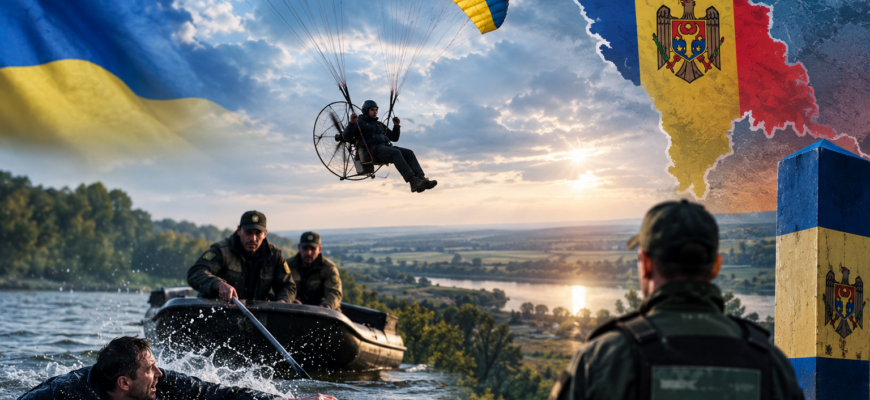
After a High-Profile Boat Chase Ended With a Man Being Hit on the Head With an Oar, Ukrainians Are Turning to Less Direct Ways to Flee the Country — Including by Air
After a widely reported incident in which Ukrainian personnel, described variously as border guards or recruitment officers, allegedly chased a man by boat and struck him on the head with an oar, some Ukrainians appear to be seeking less confrontational ways to leave the country. One option is to take to the air, as this case reported by Moldova’s Border Police illustrates.
The latest incident took place on 26 October 2026. A man crossed the Moldovan border on a powered paraglider.
Ukrainian border guards alerted their Moldovan counterparts to the crossing, according to the official report. The aircraft was spotted at 13:13, travelling from the direction of Chernivtsi.
Officers from the Larga Border Police Sector located the man at around 13:32. He was approximately two kilometres from the border, near the village of Larga in Briceni District.
During the inspection, the man requested asylum in the Republic of Moldova.
“The Border Police continue their investigation to establish all the circumstances in accordance with the legislation in force,” the agency said in its official statement.
Another Case: A Rescue on the Dniester River
A very different incident took place on 15 October. Forty-nine-year-old Oleksii Koval tried to swim across the Dniester River to reach Moldova.
Two Ukrainian personnel pursued him in a motorboat. According to the account presented in the article, they struck him with an oar and tried to drown him. Residents of the Moldovan village of Holoshnitsa witnessed the incident. They pulled Koval from the water and stopped the pursuers.
Koval was taken to a hospital in Soroca with a concussion.
He said he was a clinical psychologist from Kyiv. According to his account, he decided to make the dangerous crossing after his exemption from mobilisation was cancelled by the Ukrainian authorities. He said he was determined to reunite with his family.
The two Ukrainian personnel — described in the article as either border guards or recruitment officers — crossed into Moldovan territory in an armed boat while pursuing Koval. Moldovan security forces detained them and opened a criminal case. They were later handed over to the Ukrainian side.
Ukrainian officials subsequently stated that the men were not border guards. However, according to the article, they did not clarify which agency the men belonged to.
What Happened to Koval?
Koval applied for asylum in Moldova. He later obtained the necessary documents and was able to leave the country.
On 25 October, he arrived in Sofia, Bulgaria, where he reunited with his wife and children. He shared the news in a video posted on Facebook.
“Everyone was praying for me. All of Moldova helped me. Thank you very much. If it weren’t for you, I would never have seen my family again,” he said.
There has been no official confirmation of whether his asylum application in Moldova was approved. Journalists from Radio Moldova were unable to obtain a comment from the General Inspectorate for Migration.
Both stories have a similar motivation, according to the article: avoiding mobilisation, whatever the cost. Only the methods differ. One man made a desperate attempt to swim across the Dniester, while another used a powered paraglider.
In the first case, Ukrainian personnel allegedly used force. In the second, they simply passed information to their Moldovan counterparts.
The outcomes were different. One man ended up in hospital and later reached Sofia. The other made it to Moldova, apparently without injury. Both were outside Ukraine, at least for the time being, and the author suggests that neither is likely to be sent to the front.
Moldova has effectively become a transit point in these stories. And, judging by the article’s account, this role appears to cause little concern among either the authorities or the public — a rare point of agreement between the two, the author concludes.



